


Key Takeaways
- US growth accelerated to 3.4% while jobless claims remained low, strengthening the case for a December Fed hike.
- The Fed chose gradualism despite persistent inflation and internal pressure for immediate tightening.
- The ECB’s fiscal and growth constraints leave the euro vulnerable whether policymakers tighten or turn cautious.
- The BoC hike supports CAD, but a 127-basis-point yield deficit and fragile domestic growth limit further gains.
US data raise the cost of Fed patience
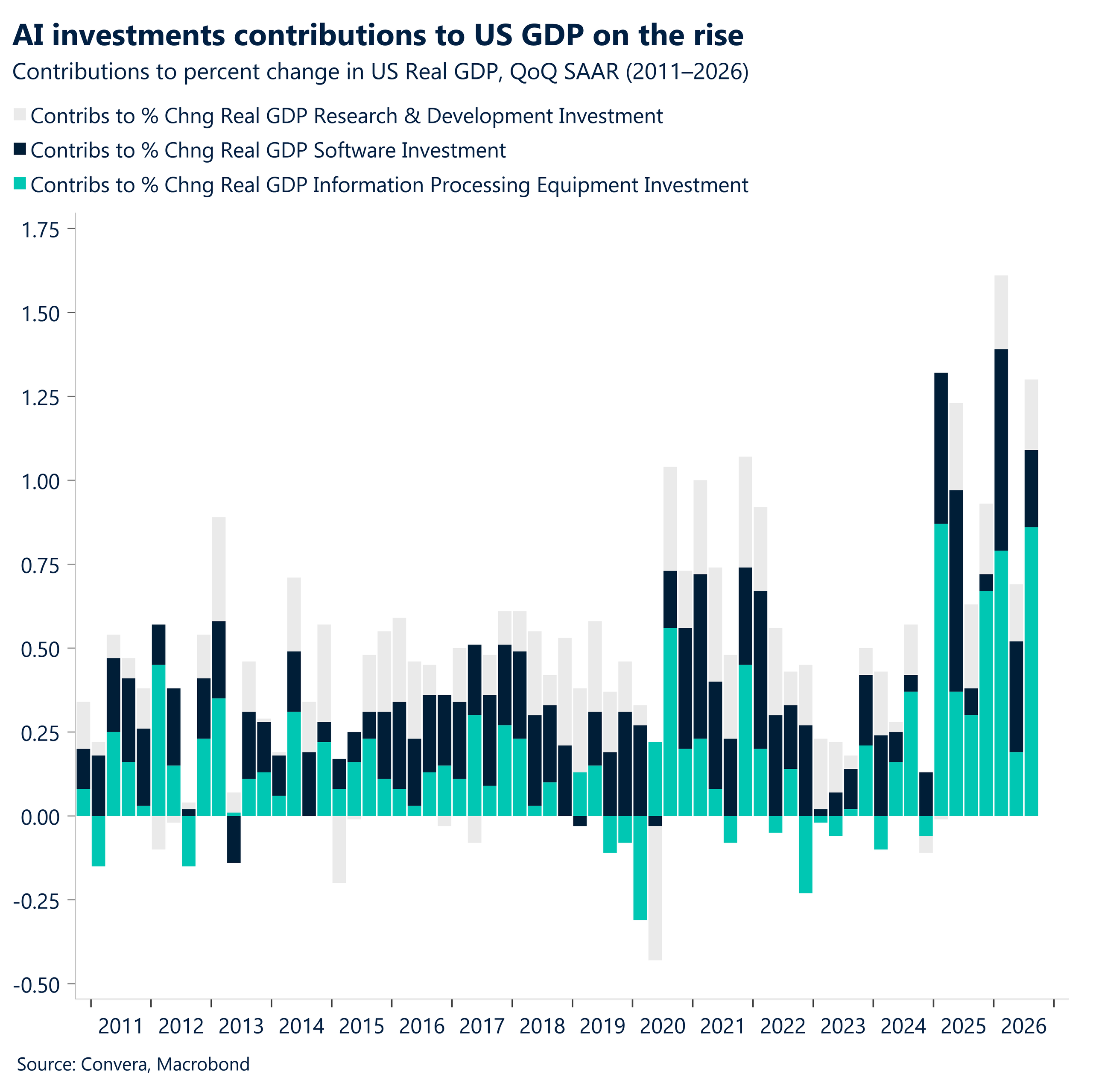
Thursday’s data strengthened the US growth story and made the Fed’s decision to hold harder to defend. Third-quarter GDP expanded at a 3.4% annualized pace, supported by consumer spending and AI-related investment, while initial jobless claims of 194,000 showed little sign of a broader labour-market deterioration. Core PCE remained elevated at 3.1% year over year. Flat real personal spending and a cooler GDP price index added some restraint, but the combined message was still one of firm growth and persistent inflation.
That backdrop strengthens the dollar’s relative position. The Fed can afford to move gradually because the economy is still absorbing higher rates, while the ECB and the BoC face more immediate constraints from weak growth, fiscal stress and rate-sensitive households. The dollar therefore benefits from more than high US yields. It is also supported by a widening gap in economic resilience, which leaves other central banks with less room to match the Fed if inflation remains sticky.
Strong growth keeps December hike in play
Chair Warsh delivered a placeholder meeting, holding rates at 3.75%–4.00% while keeping December firmly in play. Dissents from Cook and Hammack in favour of a 25-basis-point hike show the hawkish pressure inside the committee, but the Fed is choosing gradualism over reacting to each new data point. Thursday’s releases make that choice harder to defend: 3.4% annualized growth, low jobless claims and core PCE at 3.1% describe an economy that is neither losing momentum nor returning inflation cleanly to target.
At the same time, the decision to reduce the number of policy meetings to six from 2027 looks harder to justify when global shocks are becoming more frequent. Less flexibility now could leave the Fed needing to do more later if inflation remains sticky.
The bond market has picked up on that tension. Two-year yields initially fell as traders removed the risk of an immediate hike, while the 10-year held near 5%, steepening the 2s10s curve to around 32 basis points. The front end welcomed the delay, but the long end continued to price inflation, fiscal supply and the possibility that waiting now requires a higher policy peak later. The latest data reinforce that tension and should keep December firmly in play, even if Warsh remains reluctant to provide a clear roadmap.
The economy may also be less sensitive to higher rates than earlier tightening cycles would suggest. Services account for a larger share of household spending, gasoline takes up a smaller portion of consumer budgets, and cash-rich technology companies can finance much of the AI buildout internally. That does not make growth immune to tighter policy, but it helps explain why demand has remained firm despite higher borrowing costs. The dollar benefits from that resilience, although the eventual cost may be a more restrictive terminal rate and a sharper slowdown in 2027.
DXY remains supported near 102 and above its 50-day and 200-day moving averages. Net speculative longs of roughly 13,000 contracts do not point to an overcrowded trade, leaving room for positions to build if markets increase the probability of a December hike. Support sits near 101.60, with 102.60 the immediate ceiling. A break higher now has a clearer fundamental case, while a move below support would require a genuine deterioration in employment or inflation rather than another decision by the Fed to proceed slowly.

ECB faces a difficult balancing act today
Today’s European Central Bank (ECB) meeting comes at an awkward time for the euro. Despite an 18% rally in Brent this month, markets have barely added to ECB tightening expectations, with swaps still pricing ~75bps of hikes through end-2027.
France is a key reason. Wider OAT spreads and ongoing fiscal concerns have raised the bar for further tightening, while softer eurozone data and falling economic surprise indices reinforce the case for caution. Lagarde’s recent comments also suggest little urgency to respond to energy-driven inflation given the absence of meaningful second-round effects.
We think the ECB therefore faces an uncomfortable trade-off. A more dovish tone could help ease pressure on French and broader euro-area sovereign debt markets, but risks widening policy divergence with the Fed and weighing further on EUR/USD. Equally, maintaining a tightening bias risks keeping borrowing costs elevated and prolonging strains in French fixed income markets, which could also prove euro negative.
In that sense, the ECB’s policy dilemma increasingly looks like a lose-lose proposition for the single currency. As flagged yesterday, though, the confluence of support around 1.11 continues to hold. For now, that leaves EUR/USD at a critical juncture, with today’s ECB communication likely to determine whether the next move is a deeper retracement towards the low-1.10s or another temporary reprieve for the euro.

Loonie gains capped by deep yield deficit
The Bank of Canada’s first-rate hike in more than three years gives the loonie a needed policy tailwind, but it does not change the broader setup. Governor Tiff Macklem turned more hawkish to contain energy-driven inflation and acknowledged that current policy is not yet restraining growth.
Higher inflation forecasts leave room for another move, although his emphasis on proceeding carefully says plenty about the limits of this cycle. Markets are getting a rate hike driven almost entirely by headline energy shocks rather than broad-based core demand, leaving the economic rationale for a sustained cycle looking somewhat thin.
The policy shift has narrowed the two-year US-Canada yield gap from 161 to 127 basis points and pulled USD/CAD back toward 1.40. That is meaningful, but a 127-basis-point deficit still leaves the loonie carrying a sizeable rate disadvantage against the dollar. Higher crude prices provide some compensation through Canada’s terms of trade, yet oil cannot close that gap on its own. US yields need to continue dropping, or Canadian yields rising, for CAD to extend its recovery much beyond current levels.
That becomes difficult once the domestic economy enters the calculation. Canada lost 68,300 jobs in September, while its short-duration mortgage structure passes higher borrowing costs into household budgets much faster than in the US. Trade friction adds another constraint.
USD/CAD has broken below its 50-day moving average at 1.402 and its 100-day average at 1.404 to trade near 1.398. Holding below 1.40 would bring the 200-day moving average near 1.389 in focus, provided markets continue pricing a December BoC hike while the Fed stays on hold. For now, 1.3900–1.4100 remains the more convincing range as loonie buying runs into a wide yield deficit and fragile domestic growth.

Market snapshot
Currency trends, trading ranges & technical indicators

Key global risk events
Calendar: October 26 – 30

All times are in EST
Have a question? [email protected]
*The FX rates published are provided by Convera’s Market Insights team for research purposes only. The rates have a unique source and may not align to any live exchange rates quoted on other sites. They are not an indication of actual buy/sell rates, or a financial offer.