


CAD: Inflation and market data
The most consequential data point for Canada this week will be the September Consumer Price Index (CPI), scheduled for release tomorrow 8:30 am ET. As the final major inflation reading ahead of the Bank of Canada’s (BoC) October 29 interest rate decision, it will play a pivotal role in shaping the policy outlook. Governor Tiff Macklem has reiterated the Bank’s data-dependent stance, and while this week’s economic releases will provide broader context, the CPI print stands out as the key determinant. The BoC faces a familiar policy dilemma: a slowing economy that argues for easing, versus persistent inflation risks that call for restraint.
On the growth side, the case for a rate cut is well supported. GDP growth remains subdued and labor market conditions showing underlying weakness despite a temporary rebound in September. September’s 60,000 job gain, including in tariff-exposed sectors like manufacturing, offers short-term relief. However, Canada has still lost 46,000 jobs over the past three months. This increase in economic slack, typically signals reduced inflationary risk over the medium term and strengthens the argument for monetary easing. However, the BoC may prefer a more measured approach, spacing out any adjustments while awaiting further clarity from the November 4 federal budget and monitoring developments in U.S. trade negotiations.
Counterbalancing this dovish bias is the inflation outlook, which remains uncertain. The BoC’s latest business outlook surveys, due this week alongside producer price data, suggest that inflation expectations remain elevated, hovering near the upper bound of the Bank’s 1–3% target range. Firms continue to anticipate rising input costs, and while many have absorbed the impact of tariffs to date, margin pressures are mounting. The partial removal of retaliatory tariffs in September may offer some relief going forward, but in the near term, a rate cut risks reinforcing entrenched inflation expectations. The Bank is therefore navigating a narrow path: macro conditions point to the need for stimulus, but inflation dynamics warrant caution. The September CPI release will likely serve as the decisive factor in determining the appropriate policy stance.
Meanwhile, global markets will be focused on a broader set of developments. The U.S. Q3 earnings season enters a critical phase, with more than 80 S&P 500 constituents reporting this week, including several members of the ‘Magnificent Seven’. Key releases include Netflix and General Motors (Tue), Tesla (Wed), Intel, General Electric and Ford (Thu). In parallel, investors will digest a series of high-impact macro data releases, including CPI from the US, Canada off course, the UK, and Japan, as well as global PMI surveys.
These developments set the stage for a pivotal week ahead, which will bring monetary policy decisions from several major central banks, including the Federal Reserve, the Bank of Canada, the Bank of Japan, and the European Central Bank, and the expected meeting on October 29 between President Trump and President Xi-Jinping. Against this backdrop, this week’s data flow will be instrumental in shaping market expectations and informing policy trajectories.
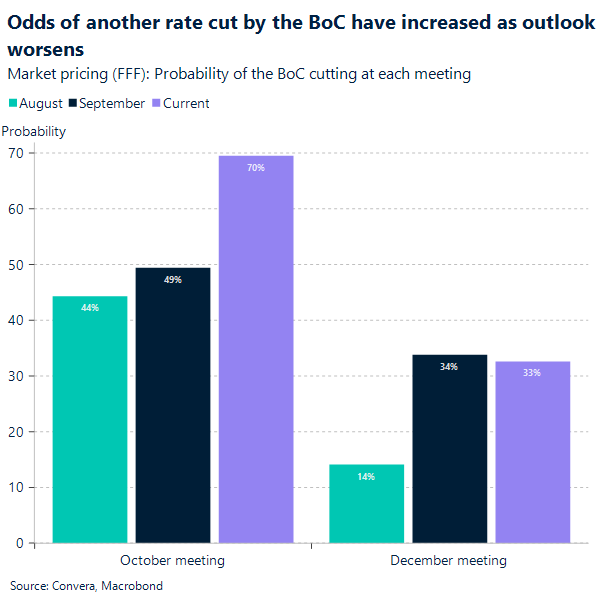
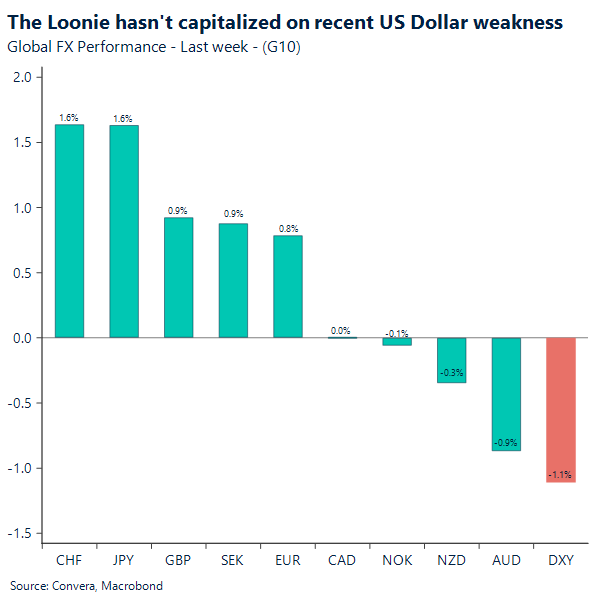
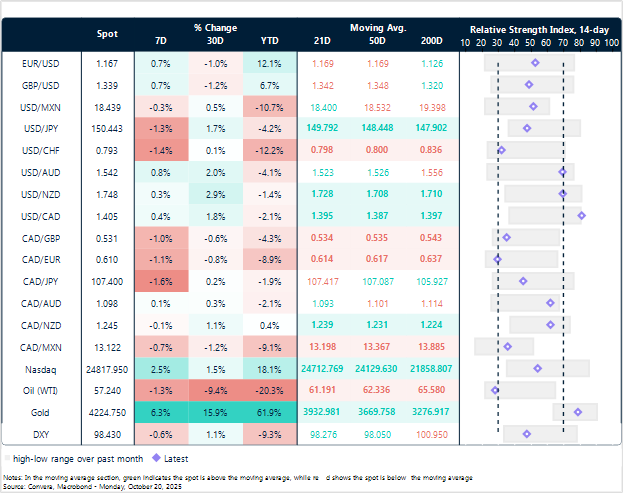
Despite renewed selling pressure on the U.S. Dollar, the Canadian Dollar has underperformed relative to its G10 peers, likely constrained by a soft domestic macro backdrop and a decline in WTI crude prices below $60 per barrel. After retreating from its six-month high of 1.408, the USD/CAD, has traded as low as 1.4008 during Asia-Pacific hours, with the 200-day simple moving average appearing as a key support ahead of this week.
EUR: Realignment, not breakout
Section written by: Antonio Ruggiero
The euro closed the week 0.7% higher against the dollar, after paring back gains and failing to break resistance at 1.1720, as the greenback benefited from an end-of-week sentiment boost.
The week also ended with remarks from ECB President Christine Lagarde, who noted that while the outlook for euro-area inflation remains uncertain, as the still-volatile global trade environment continues to pose both upside and downside risks, the range of risks on both sides has narrowed. While the comments were directionless and unlikely to move price action on their own, one could infer that with a cleaner canvas to work from, the next upside or downside surprise may carry greater weight in shaping ECB expectations.
To start, the final eurozone core inflation year-on-year print was revised up to 2.4% from 2.3%, while other releases came in line with expectations on Friday. The data reinforces the consensus around a comfortable rate setting for now.
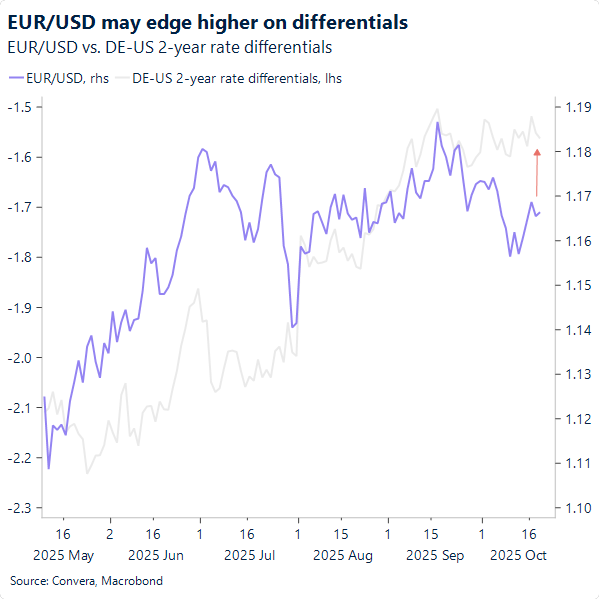
All else equal, we maintain a bias for EUR/USD to edge higher this week – as the pair continues to benefit from the Fed’s dovish lean relative to a firm ECB, as calmer sentiment conditions allow rate differentials to exert greater influence. That said, short-term price action suggests anything above 1.1750 seems hard to achieve for now.
MXN: 50-day SMA
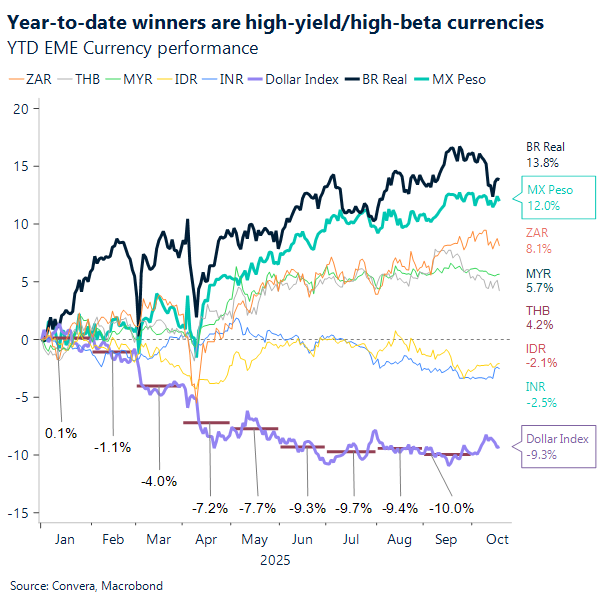
Despite repeated attempts to break above the 50-day Simple Moving Average (SMA), the Mexican Peso has remained below this key medium-term trend indicator since April. Last week’s push toward 18.6 was short-lived, as dovish signals from the Fed weakened the US Dollar, sending the Peso back below its average and reaffirming 18.5 as a key resistance level. The USD/MXN pair, which had posted strong year-to-date gains on the back of robust carry trade appeal, has now entered a phase of choppy, sideways consolidation around the 18.40 mark. While recent geopolitical tensions, including the U.S.-China trade spat, briefly pushed the Peso higher, its retreat reflects a return to low-volatility trading, with support from Mexico’s solid macro fundamentals and interest rate differential likely keeping the pair range-bound in the near term. For the short-term, the USD/MXN is expected to continue this range-bound crawl, holding year-to-date gains at 12%.
Short-term overbought signs from Aussie, Kiwi and Loonie
Table: Currency trends, trading ranges and technical indicators
Key global risk events
Calendar: October 20-24
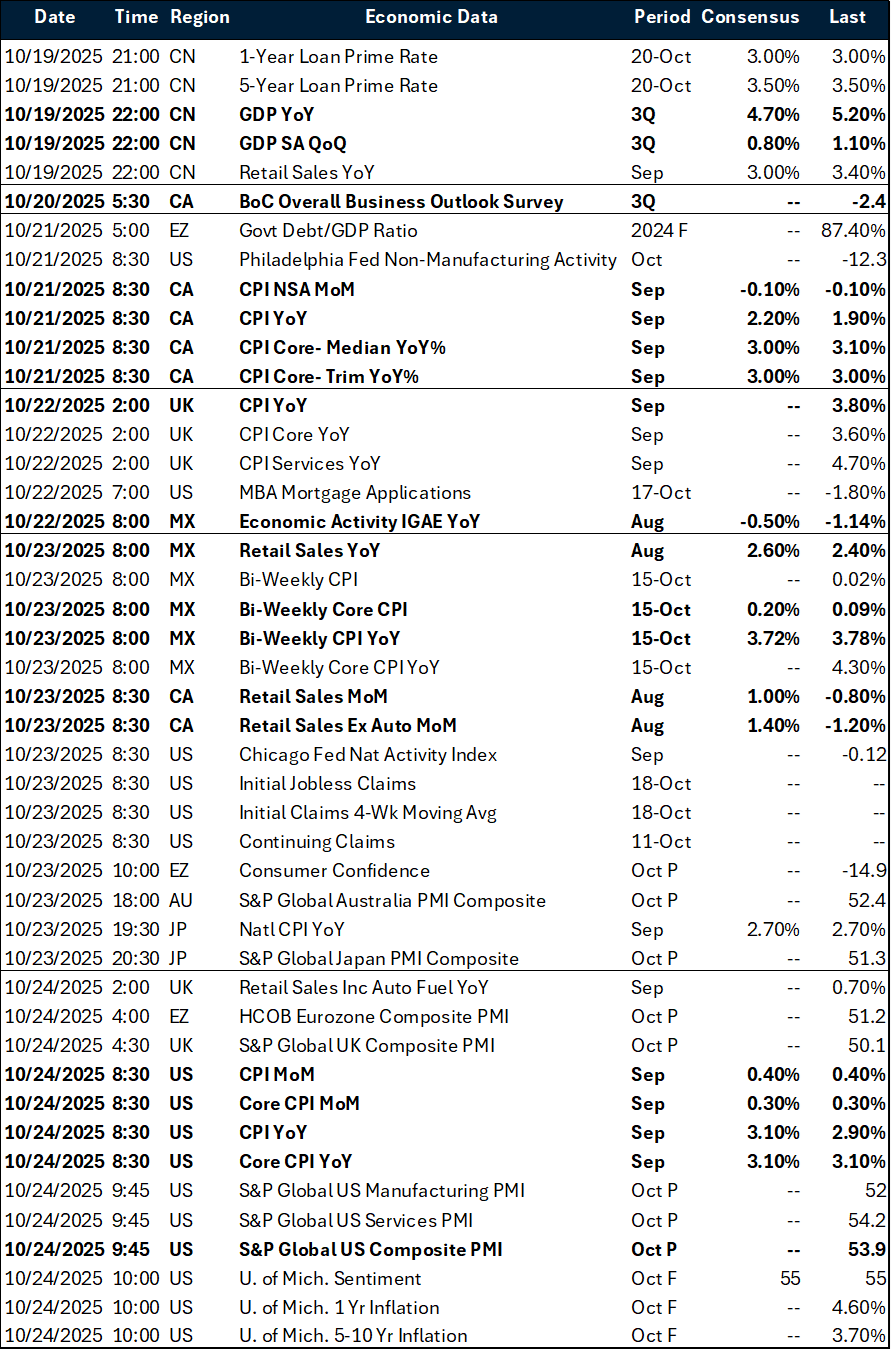
All times are in EST
Have a question? [email protected]
*The FX rates published are provided by Convera’s Market Insights team for research purposes only. The rates have a unique source and may not align to any live exchange rates quoted on other sites. They are not an indication of actual buy/sell rates, or a financial offer.