
Written by Convera’s Market Insights team
Bad news is good news
Boris Kovacevic – Global Macro Strategist
The recent string of disappointing US macro data and the Federal Reserve’s interest rate pause have convinced markets that the tightening cycle is now finally over. While the volatility in the bond markets continues to be elevated due to credit risks and deteriorating liquidity, equities have mostly benefited from investors pricing out any more rate hikes from the Fed.
The S&P 500 has risen in nine out of the last ten trading days, reaching the highest level since the 20th of September (4415) on Friday. The equity benchmark is now up by around 8% since its October low and less than 5% away from its all-time high. A perfect storm involving a hawkish speech from Jerome Powell, a failed 30-year Treasury auction showing weak demand for government bonds and a cyberattack of the world’s largest bank had pushed US yields up on Thursday, leading equities to record their first daily fall in eight days. However, the losses were quickly recovered when the Michigan University showed consumer confidence falling for a fourth consecutive month, strengthening the assumption that the Fed would be done raising interest rates. Markets will have to digest the news over the weekend, that rating agency Moody’s downgraded its outlook on US credit to “negative”.
This comes at a time when the US government deficit and debt interest payments have increased quite a lot in recent times and markets will need to absorb an additional $2 trillion of bonds every year for at least the next two years as the Fed has stopped its quantitative easing program. The Congressional Budget Office expect the budget deficit to swell to above 5% this year and 6% in 2024 and 2025 respectively. As of market moving events this week, investors will closely follow the release of US inflation on Tuesday, producer prices and retail sales on Wednesday and industrial production on Thursday. On the geopolitical side, the meeting between US president Joe Biden and Chinese leader Xi Jinping mid-week will be watched as well. The US dollar remains well bid after the sell-off two weeks ago, trading between (DXY) 105.00 and 107.00. European stock markets are expected to open higher. The bar for a positive open might be higher for US equities as the Moody’s downgrade might be digested.

Dawning data deluge to steer sterling
George Vessey – Lead FX Strategist
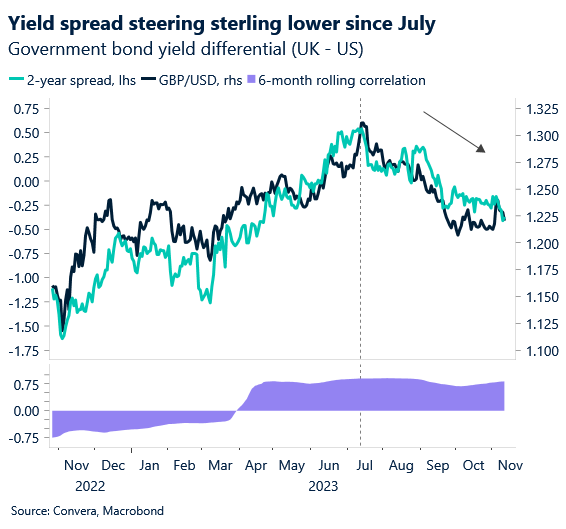
The jump in sterling the week before last appears to have been something of a false dawn as softening global risk appetite, dovish Bank of England (BoE) comments, and evidence of a stagnating UK economy saw GBP/USD erase over half of last week’s gains. The pair failed to close above key long-term daily and weekly moving averages and is perched about 1.5% above than its 9-month low recorded last month.
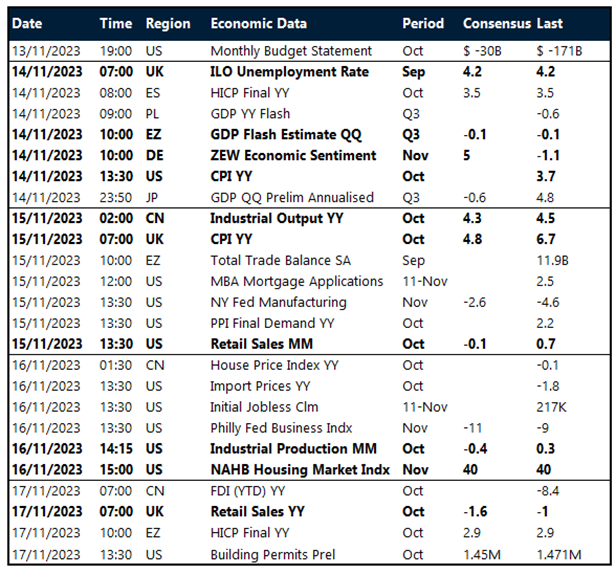
It’s a big week of data this week, which increases the risk of volatile price action for the pound. The UK labour market report early tomorrow morning kicks things off. Although issues with data collection have raised questions about reliability, we think the jobs market is cooling and private sector wage growth is likely to ease off fractionally, which will please BoE policymakers. In addition, the latest UK consumer inflation report will be published on Wednesday, with headline expected to drop sharply from 6.7% to under 5% y/y. Core is expected to fall from 6.1% to 5.8%, whilst services inflation is likely to stay unchanged at 6.9%, and this is what the BoE is most wary about. UK retail sales wraps up the week on Friday. Overall, barring any big data surprises, we believe the BoE has likely reached the end of its tightening cycle, but with UK inflation taking longer to fall, the BoE is unlikely to cut interest rates until at least the summer of 2024.
We do think GBP/USD will recover next year, but the outlook is obviously highly uncertain, and the risk of recession remains a strong headwind. Price action in the short-term will depend largely on economic data because data is important to policy decisions and therefore rate pricing, which is a key driver of FX trends.
Waiting for the European bottom
Boris Kovacevic – Global Macro Strategist
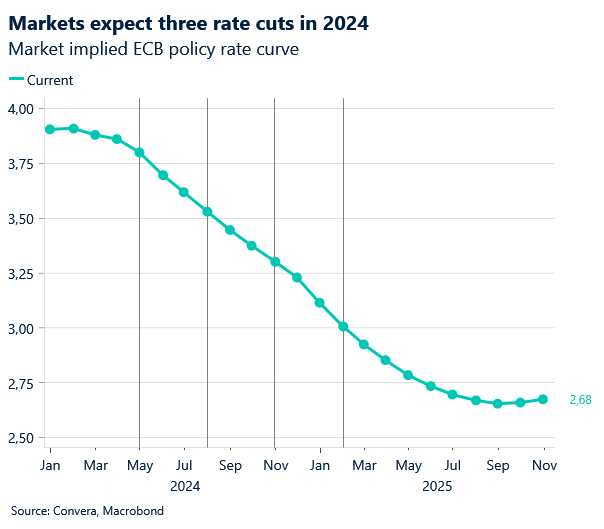
In pro cyclical and rates sensitive regions like Europe and China, investors are mostly awaiting new data releases to gauge how close the economy is to bottoming, with markets pricing in rate cuts from the big three central banks next year. Beijing has stepped up monetary and fiscal easing in recent months, such as cutting interest rates and the amount of cash banks must keep in reserve, as well as issuing additional sovereign bonds in order to meet its 5.3% GDP target for 2023. However, last week’s surprising fall of inflation into negative territory (Oct) has renewed hopes for further stimulus.
We continue to see inflation falling more quickly than currently priced in. The median consumer expectations for Eurozone inflation over the next 12 months did rise sharply to 4.0% in September, reaching the highest level since April as revealed by data released by the ECB Consumer Expectations Survey. However, the continued weakness in economic activity should put pressure on prices in 2024. German industrial production dropped once again last month (Sep) for the fifth consecutive time, highlighting the challenge that Europe’s largest economy faces in averting a recession. The index contracted by 1.4%, below market expectation of -0.1%, and is now down 17% from its pre-pandemic trend. Momentum does not appear to be turning positive any time soon either. German construction PMIs hit the lowest point since April 2020, signaling the health of its construction sector continues to worsen.
The euro is currently stuck trading between $1.05 and $1.06 with any breakout to the upside quickly losing steam. While the slide in US yields two weeks ago and weak US data have been positive for the euro, the upside has been limited. This is explained by the fact, that we have not broken out of the regime, in which Eurozone data continues to disappoint week by week. Once the global business cycle turns positive, this might change. In the meantime, following data releases will be crucial to gauge when currencies are headed. No data releases are scheduled for today.
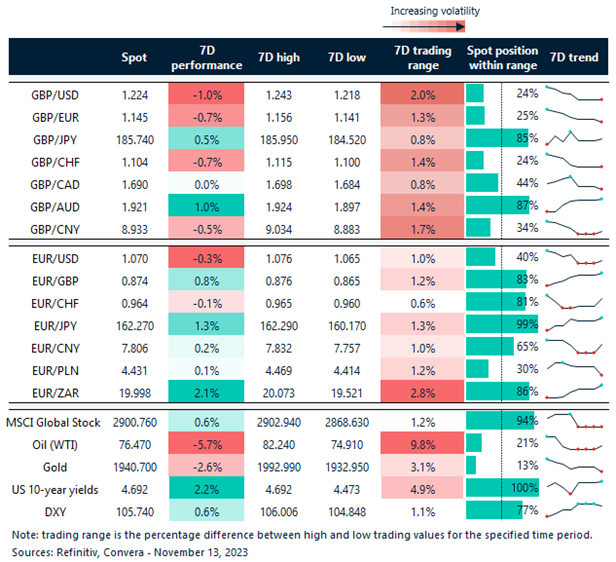
GBP/USD down 1% from seven days ago
Table: 7-day currency trends and trading ranges
Key global risk events
Calendar: November 13-17
Have a question? [email protected]
*The FX rates published are provided by Convera’s Market Insights team for research purposes only. The rates have a unique source and may not align to any live exchange rates quoted on other sites. They are not an indication of actual buy/sell rates, or a financial offer.