
Written by Convera’s Market Insights team
New reality of higher for longer sets in
Boris Kovacevic – Global Macro Strategist
The US dollar continued its ascent after Fed Chair Jerome Powell acknowledged the recent string of much stronger macro and inflation data in a speech and signaled that policy might need to stay restrictive for longer. With the 3-month average jobs growth running at 244 thousand, 3-month annualized core inflation at 4.5%, policy makers will most likely be able to sit out a couple of meetings and hold rates unchanged.
Investors are adjusting to this new neutral Fed with selling government bonds and buying the US dollar. Treasury yields have risen to their highest level since November with the two-year yield briefly touching the 5% mark. The US Dollar Index rose for a fifth consecutive day, recording its best streak since October and extending its year-to-date gain to 4.9%. Powells acknowledgement was the final blow to investors hoping for lower rates this year. Markets came into 2024 pricing in six rate cuts by the Fed. These speculations have been crushed by above trend growth and inflation and have been reduced to just a single cut coming in September.
The real economy has remained resilient against interest rates at two-decade highs. However, as the higher for longer rates regime takes hold and mortgage and business loans adjust to the upside, some pain might still be ahead of us. New home construction fell to its lowest in nine months in March as the demand for new housing is dampened by high interest rates. Without any relevant data points scheduled for today, we turn to the economic releases on Thursday for guidance on the US economy. Second tier data like initial jobless claims, the Philadelphia Fed Manufacturing Index, the Conference Board Leading Economic Index, and existing home sales will be closely watched.

Upside CPI surprise gives Sterling a boost
Ruta Prieskienyte – FX Strategist
On Tuesday, the British pound extended its losses for the third consecutive day as investors digested the latest UK macro reports and the US dollar remains buy thanks to expectations that the Fed would maintain higher rates for an extended period. Weaker risk conditions hampered Pound’s attempt at recovery as European equities extended their slide, with FTSE100 falling by close to 1.8% on the day – the worst plunge in nine months amid global sell-off.
This morning’s latest CPI print showed UK inflation falling to the lowest rate since September 2021 to 3.2% y/y in March, down from 3.4% in the previous month, but above the market consensus of 3.1%. Food prices rose less than a year ago, putting downward pressure on inflation, which was then partially offset by the cost of motor fuel. The core inflation rate, which excludes volatile items such as energy and food, dropped to 4.2% y/y, the lowest rate since December 2021 and also slightly above expectation of 4.1% y/y. Meanwhile, inflation in the services sector, watched by the BOE for indications of domestically driven price pressures, eased to 6% y/y from 6.1% y/y. The pound reversed its earlier losses after the print, rising as much as 0.2% to $1.2445 and snapping three days of declines.
With the calendar light, the key events to watch out for later today will be Fed’s Beige book and a number of central bank speeches from both the Fed and the BoE. Most notably, BoE Governor Bailey is due to speak later today. The BoE policymakers are waiting for evidence that underlying price pressures are subsiding before cutting rates from their 16-high of 5.25%. Markets participants will watch for clues on whether the latest data print is enough to encourage the BoE to cut rates in H1. Any such indications would fuel Sterling weakness and erase this morning’s gains.

USD strength negates positive EU data surprise
Ruta Prieskienyte – FX Strategist
The euro extended its losing streak to six consecutive sessions, trading at fresh 6-month lows near $1.0610, pressured by diverging scenarios for the European Central Bank and the Federal Reserve. As the President Lagarde confirmed that the ECB will cut rates soon, Fed’s Chair Powell said inflation data indicate the US central bank may need more time to feel comfortable lowering interest rates, indicating that Fed officials don’t feel a pressing need to lower rates.
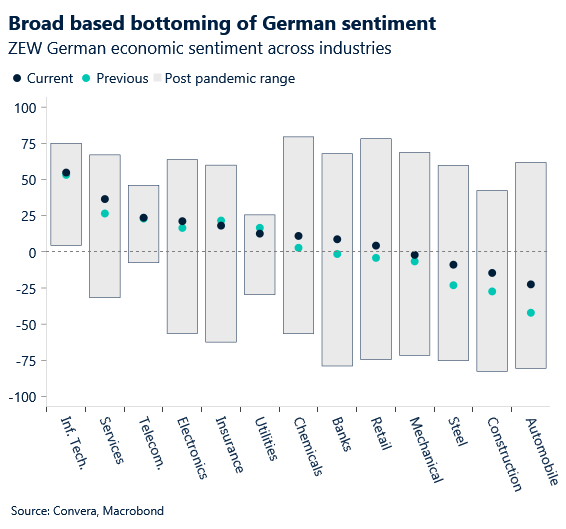
On macro front, the ZEW Indicator of Economic Sentiment improved for the 9th consecutive print, with the headline index climbing to a fresh 2-year high across both Germany and the Eurozone. German index rose to 42.9 in April, up from 31.7 in the previous month, while the equivalent measure for Euro zone rose by 10.4 points to 43.9. Half of the surveyed analysts surveyed expect the German economy to improve in the next six months, driven by a more favourable assessment of the economic situation and expectations for top export destinations, as well as the strengthening of the dollar and euro. The survey results point to signs that the worst of economic slump is now behind us and European macro will not be a burden for the common currency as economic momentum starts picking up. While still not strong enough to be a catalyst for pushing the euro higher, markets will now focus solely on US developments to determine the path of EUR/USD.
Although EUR/USD is looking oversold, the upside continues to remain limited, with the key resistance seen at $1.0695. With the calendar light, we expect the directional bias to remain bearish below this area, even if the euro hints at a recovery attempt. The next downside target below the $1.06 handle is the key $1.05 barrier and October 13th low of $1.0495.
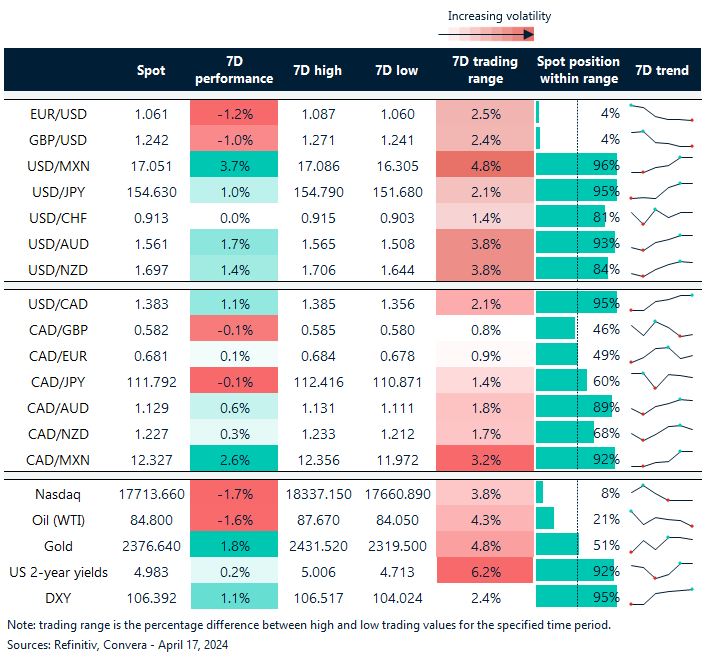
DXY rises for 7th consecutive session
Table: 7-day currency trends and trading ranges
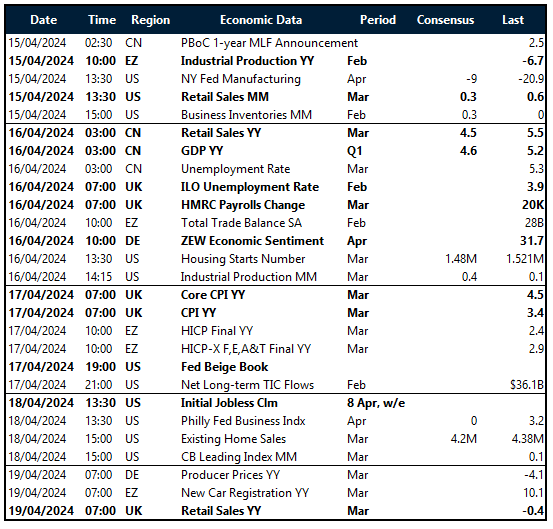
Key global risk events
Calendar: April 15-19
Have a question? [email protected]
*The FX rates published are provided by Convera’s Market Insights team for research purposes only. The rates have a unique source and may not align to any live exchange rates quoted on other sites. They are not an indication of actual buy/sell rates, or a financial offer.