

Key Takeaways
- Strong US payrolls revived the dollar and made a December Fed rate hike the clear base case.
- The dollar retains a wide yield advantage, but further gains depend on US CPI lifting Fed expectations and Treasury yields.
- Weak Canadian jobs widened the US-Canada growth gap, pushing USD/CAD higher as private-sector employment fell by 52,500.
- Banxico’s surprise rate cut narrowed the Mexican peso’s carry cushion, although the divided vote points to an extended policy hold.
- US CPI is the next major FX catalyst, with another firm reading likely to add pressure on both the Canadian dollar and Mexican peso.
Payrolls restore dollar support but upside narrows
October payrolls gave the dollar a firmer footing after its post-midterm decline. Employment rose by 165,000, more than double the 70,000 consensus. Unemployment fell to 4.1%, while wage growth accelerated to 3.1%. Revisions added another 84,000 jobs to the previous two months, making September’s weakness look temporary.
Hiring also broadened into management, scientific and technical consulting. That suggests the AI investment cycle is supporting white-collar implementation roles, not just construction and manufacturing. Large technology companies also show little sign of a broad pullback in spending. Power costs, infrastructure bottlenecks and political resistance may delay some projects, but the wider investment cycle remains intact.
Markets lifted the probability of a December Federal Reserve hike to roughly 80%. The dollar also retains a sizeable rate advantage. Two-year Treasury yields near 4.52% stand about 152 basis points above their Canadian and German equivalents. Those gaps make it harder to hold short-dollar positions while December tightening remains the base case.
The trading setup is less clear-cut than the macro picture. Speculators hold about 14,000 net-long DXY futures contracts, placing positioning near the upper end of its one-year range but below the annual peak. The dollar is also elevated on a broad, inflation-adjusted trade-weighted basis. That does not prevent further gains, but it means strong data may simply preserve support unless Fed pricing and relative yields move materially higher. DXY has reclaimed its 20-day moving average, with resistance near 102.5.
Tuesday’s CPI report is the next test. Headline and core prices are expected to rise 0.3% on the month. A firm reading would reinforce the case for December and bring the October DXY high back into focus. Softer inflation could contain the index below 102.5, but one benign report is unlikely to erase December pricing after the payroll surprise.

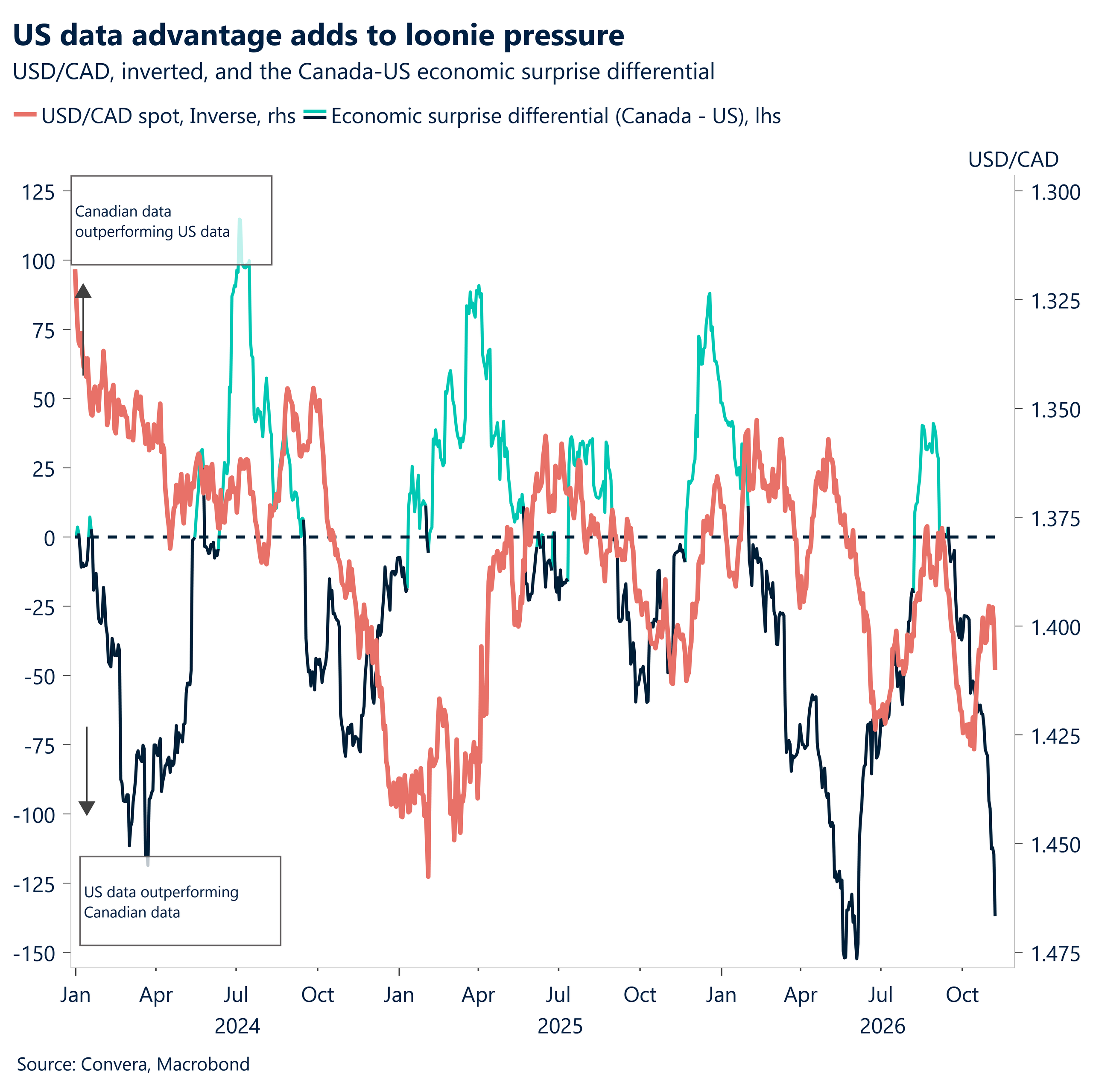
Private-sector weakness widens loonie’s US divide
Canada’s October employment report was weaker than the 4,700 headline decline suggests. Private-sector payrolls fell by 52,500, unemployment rose to 6.7% and wage growth slowed to 2.0%. Employment in the more cyclical parts of the economy, excluding health care, education and government, contracted by 0.4% from a year earlier. Manufacturing and services PMIs also slipped below 50, pointing to a broader loss of momentum in private demand.
The contrast with the 165,000 US payroll gain pushed USD/CAD to 1.413 and left the pair up 1.1% for the week. Canadian two-year yields near 3.14% sit roughly 137 basis points below US Treasuries, while the 10-year gap is around 120 basis points. The pair has moved back above its 20-day and 50-day averages, with 1.4250 the next significant resistance level if US yields continue higher.
The Bank of Canada’s renewed mandate gives inflation clearer primacy, but removing the language around maximum sustainable employment does not automatically create a more hawkish reaction function. The more difficult issue is the policy mix. Private activity is slowing just as the federal budget adds a fiscal impulse estimated at 0.7%–1.0% of GDP. Government spending may support demand and complicate the inflation outlook, but it cannot fully offset weaker private employment, contracting business surveys and household sensitivity to higher rates.
Canadian manufacturing sales will show whether the employment weakness is spreading further into output, although US CPI remains the larger near-term risk for USD/CAD. A firm US reading would reinforce December Fed tightening and keep 1.4250 in view. A sustained loonie recovery requires softer US data, a meaningful rebound in oil or evidence that Canada’s private-sector slowdown is stabilizing. None is visible yet, leaving the wide yield gap as the more reliable guide for the pair.
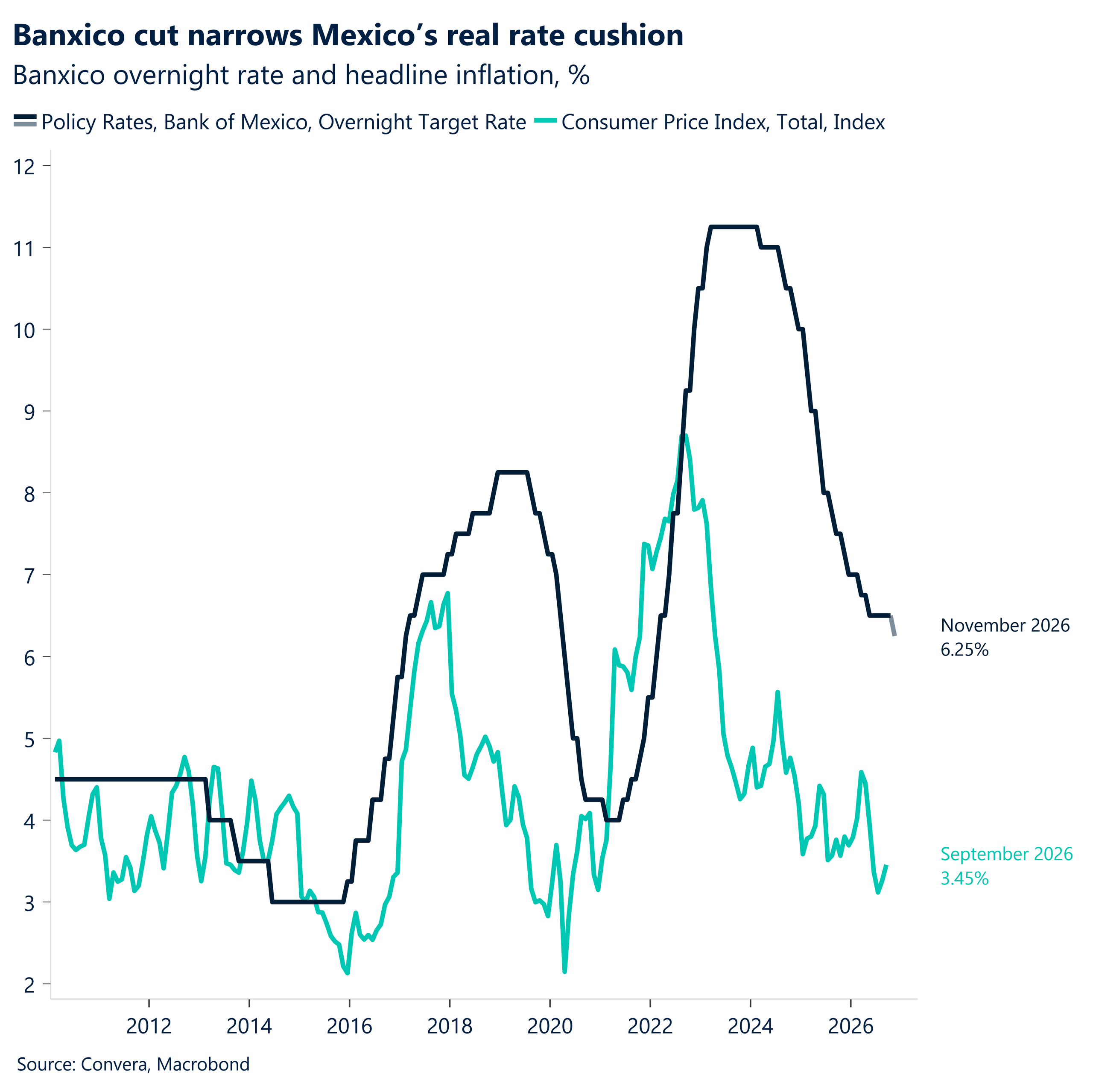
Banxico cut narrows carry but hold signal helps
Banxico’s surprise cut to 6.25% narrowed the peso’s carry cushion, but the decision was less dovish than the headline suggests. The vote split 3–2, the fourth-quarter inflation forecast was raised to 3.7% and policymakers indicated that rates could now remain unchanged for an extended period. That points to a one-off adjustment rather than the start of another easing cycle, although the communication will be difficult to sustain if inflation remains firm.
Friday’s US payroll report added pressure from the other side of the spread. Mexico’s two-year yield near 7.31% still offers a premium of roughly 279 basis points over Treasuries, but that advantage will continue to erode if the Fed tightens while Banxico holds. The spread remains large enough to discourage a disorderly peso unwind, particularly as Mexican growth momentum improves and the earlier support from lower food prices begins to fade. Those domestic conditions should keep some tightening premium embedded in the Mexican curve.
USD/MXN closed the week near 18.6, remaining relatively unchanged following the decision. The pair remains above its 20-day and 50-day moving averages, but Banxico’s extended-hold signal should provide the peso with some near-term support after its recent underperformance. The next move depends on whether the data validate that message rather than invite another cut.
Inflation above the 3.64% consensus would strengthen the case for a prolonged hold and could help the peso despite elevated US yields. A softer print would make the cut easier to justify but could also encourage markets to price another move and weaken the carry advantage further. US CPI creates the opposite risk: another firm reading would lift Fed expectations and compress the spread from the dollar side. A durable peso recovery therefore requires either lower US yields or convincing evidence that Banxico has finished easing.
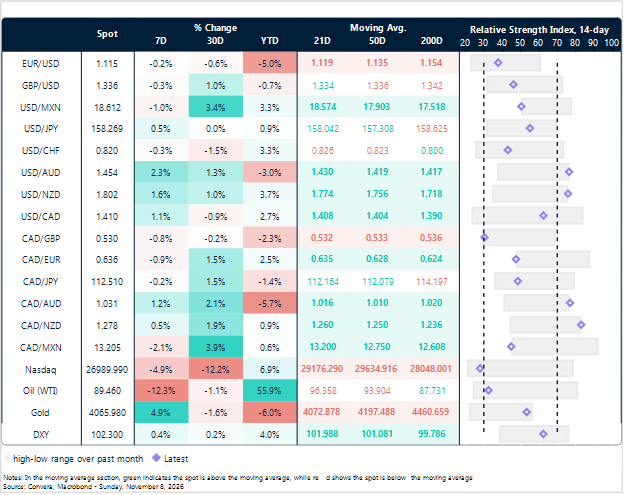
Market snapshot
Table: Currency trends, trading ranges & technical indicators
Key global risk events
Calendar: November 2 – 6
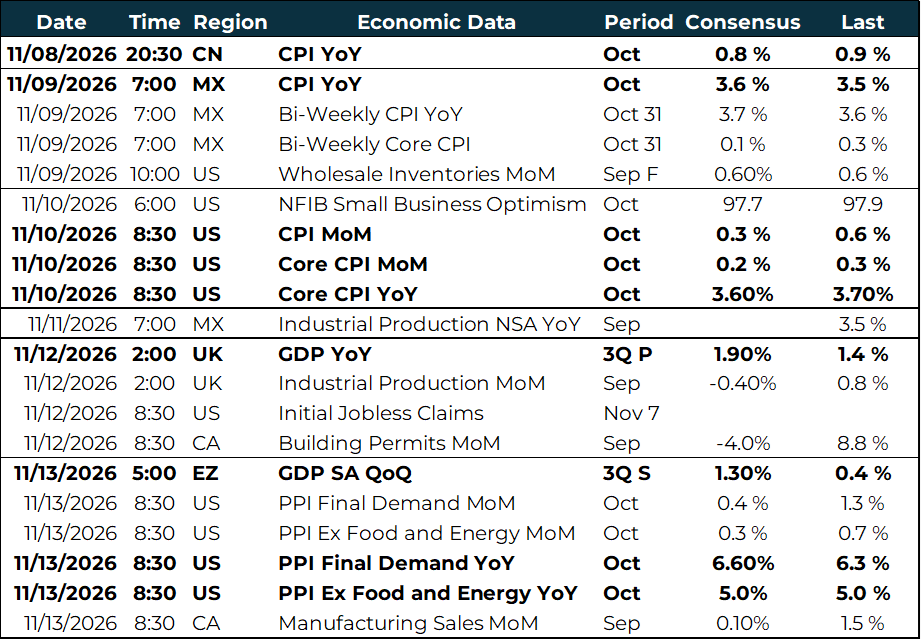
All times are in EST
Have a question? [email protected]
*The FX rates published are provided by Convera’s Market Insights team for research purposes only. The rates have a unique source and may not align to any live exchange rates quoted on other sites. They are not an indication of actual buy/sell rates, or a financial offer.