


Cautiously optimistic
Markets had a lot to chew on in the first half of 2025. From century high tariffs and renewed recession chatter to fiscal shakeups and geopolitical curveballs, it’s been anything but dull. The U.S. administration, in true multitasker fashion, tried to tackle everything, everywhere, all at once, sending markets on a rollercoaster ride of volatility and second-guessing.
But as we step into the second half of the year, a strange calm has settled in. Major fears have started to fade, and despite all the noise, equity markets are flirting with all-time highs (new ATH for the S&P500). That said, the horizon still looks hazy, and plenty of questions remain unanswered:
- What about tariffs? If there’s one thing we’ve learned about this administration, it’s that deadlines are more like guidelines. Case in point: the July 9 expiration of the 90-day reciprocal tariffs reprieve. Markets aren’t holding their breath. Many expect the White House to kick the can down the road again, buying more time for ongoing negotiations with Europe, Japan, and South Korea. A deal with India looks imminent, and in a notable gesture, Treasury Secretary Bessent and China’s Vice Premier He Lifeng recently shook hands over rare earth shipments, an addition to the recent ‘done deal’ between US and China. On Friday on the other hand, Trump zeroed in on Canada’s digital services tax, which will likely drag on negotiations with its most important trading partner. What’s sticking around, however, is the 10% baseline tariff. Expect it to show up not just in trade data, but also in rising prices over the next few months.
- Stagflation ahead? Last Friday threw a macro curveball. Consumer spending pulled back, likely a hangover from months of stockpiling ahead of anticipated tariff hikes. At the same time, inflation crept up, not by a lot, but enough to bring that dreaded word back into conversation: stagflation. The classic mix of cooling growth and rising prices, typically triggered by supply pressures (like, say, tariffs), is one investors watch warily.
- Section 899 no more? According to a post last week on X by Treasury Secretary Scott Bessent, Section 899, part of the so-called OBBB (“One Big, Beautiful Bill”) that unsettled markets back in May, is now likely to be removed. This follows Bessent’s negotiations with the OECD, which resulted in an agreement to exclude U.S. companies from the second part of the Global Tax Deal, known as Pillar 2. That part of the deal establishes a global minimum corporate tax rate, typically around 15%, meant to curb profit shifting to low-tax jurisdictions. The broader deal also includes rules allowing countries to tax a share of multinational profits even without a physical presence. Section 899 had been introduced by the U.S. as a countermeasure to what it saw as unfair foreign tax regimes, including the minimum tax rules under Pillar 2. But with those provisions no longer applying to U.S. firms, the rationale for Section 899 has faded. In response, the US Treasury department has called on Congress to scrap the measure, framing it as a step toward smoother international coordination.
- A still independent Fed? The Federal Reserve’s upcoming meetings in July and September are attracting more than just economic scrutiny. Under President Trump’s leadership, questions are growing about how much political pressure might be creeping into the Fed’s decisions. Trump hasn’t been shy about hinting at a possible replacement for Chair Jerome Powell, potentially as early as September. That alone puts Powell’s independence, and the Fed’s broader credibility, under the spotlight. Enter Chris Waller, one of Trump’s appointees to the Fed’s policymaking body. Waller has taken a noticeably dovish stance, recently suggesting a rate cut could be on the table in July, even though markets are assigning just a 20% probability to that outcome. If he becomes Trump’s pick to lead the Fed (leads odds with 21% according to Polymarket), it raises the question: will he be expected to move swiftly to lower rates? And will he feel pressure to prove his loyalty during the next two meetings? This dynamic may seem like background noise for now, but it could shape how markets interpret Fed members’ comments in the months ahead. So far, investors seem more focused on the potential for lower interest rates than on the political currents swirling beneath.
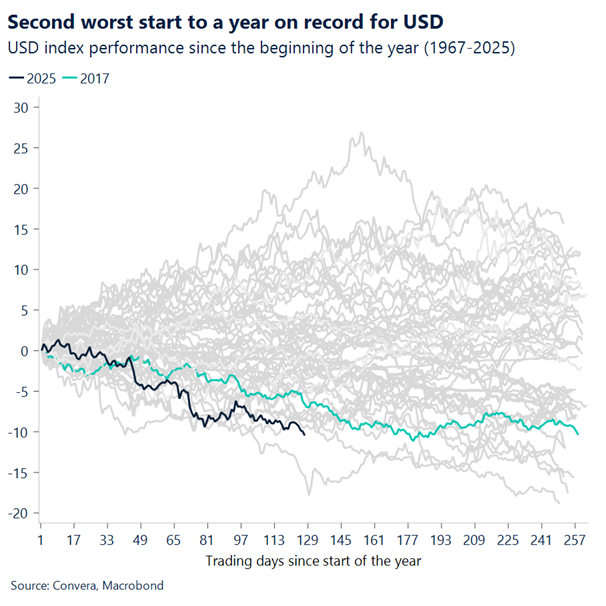
- Has the dollar bottomed? While there’s no doubt about the global dominance of the U.S. dollar and U.S. financial markets, their once-unshakable safe-haven status has come under fresh scrutiny in the first half of the year. In 1H, the dollar has posted its second-worst start to a year on record, falling 10%, and “short USD” has emerged as one of the most crowded trades in the market. Behind this trend is a growing chorus of foreign investors who are no longer taking U.S. exceptionalism for granted. Foreign investors have grown increasingly cautious, spooked by erratic policy decisions and shifting economic signals. There hasn’t been a dramatic exodus from U.S. assets, but a noticeable pivot toward risk management, through hedging strategies and broader portfolio diversification, is underway. At the same time, global currents are reshaping capital flows: China is reemerging as a force in tech innovation, and a wave of investor confidence is sweeping across Europe, fueled by bold infrastructure plans, particularly in Germany. These shifts aren’t triggering market turmoil, but they are gently nudging capital toward new centers of gravity.
The second half of the year is poised to begin on a quieter note, with U.S. markets closed this Friday in observance of the July 4th holiday and Canadian markets closed tomorrow for Canada Day. Despite the holiday-driven lull, attention will quickly shift to the release of the non-farm payrolls report, always a key fixture on the first Friday of the month, to be published on Thursday. This month’s data is expected to carry added weight, potentially shaping the evolving market narrative around stagflation risks in the latter half of the year.
Euro ticks up, but trade progress may keep bulls cautious
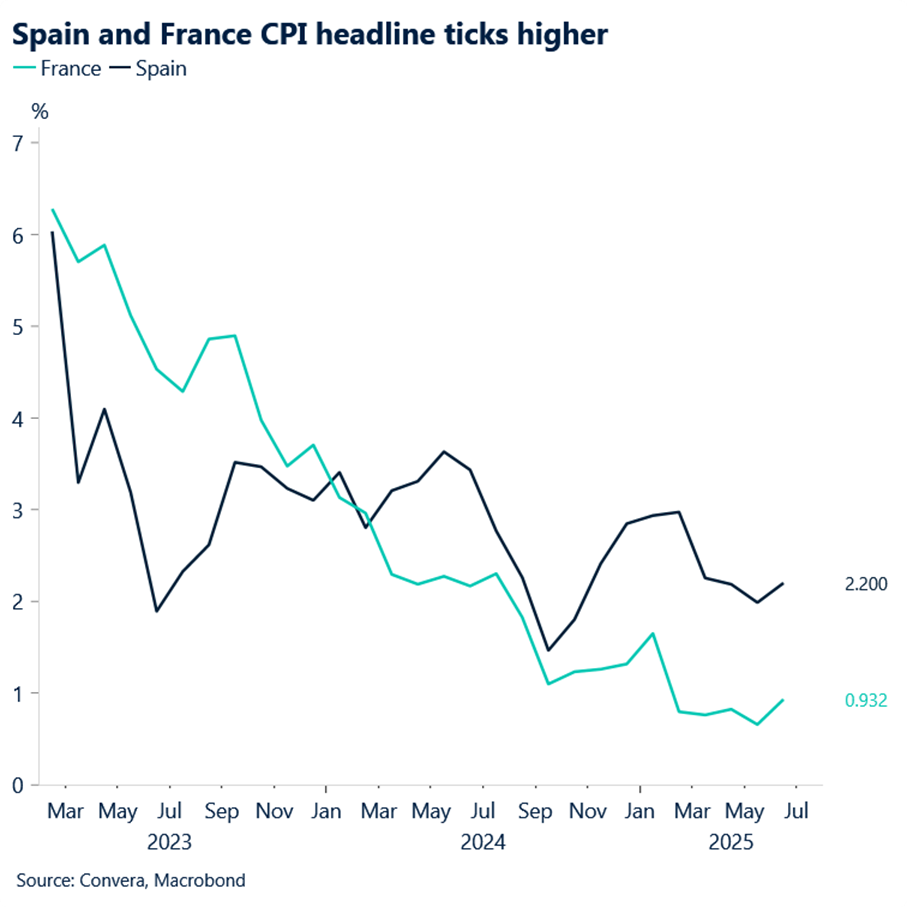
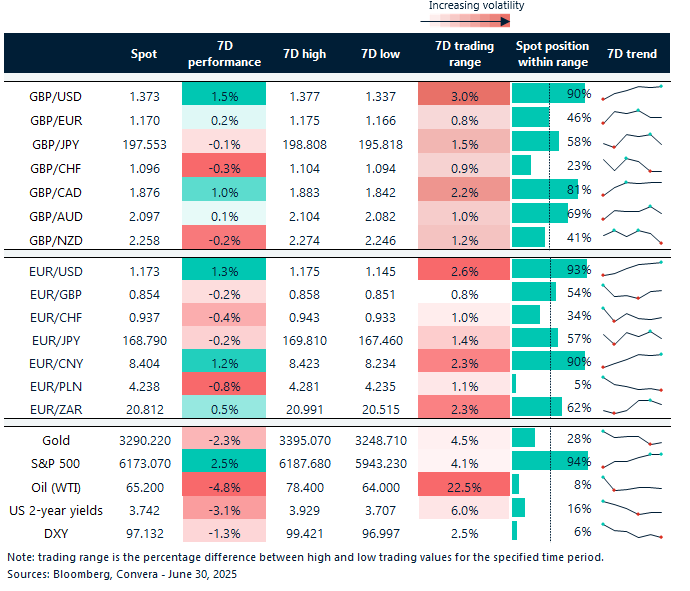
EUR/USD rebounded from Friday’s dip below $1.17 as upside surprises in French and Spanish inflation—rising to 0.3% (from –0.1%) and 0.6% (from 0.1%), respectively—pushed back market expectations for a September ECB cut, with pricing dropping from over 60% to just below 50%. All eyes now turn to Germany’s inflation figures today and eurozone’s tomorrow, seen as a key further catalysts to reinforce the ECB’s hawkish tone and extend euro support.
Later of Friday, EUR/USD’s rise found further fuel, climbing to $1.1754 – a new year-to-date high – after weak U.S. personal consumption data weighed on the dollar. While the common currency held above $1.17 into the close, further gains were capped as the Fed’s preferred core PCE index rose 0.2%: while softer spending may reflect headwinds from President Trump’s unpredictable trade agenda, the inflation print, more of a concern to the Fed right now, fell short of prompting an early Fed pivot, reinforcing the prevailing wait-and-see stance.
As inflation missed its chance, focus now turns to this week’s U.S. employment data, which could help anchor—but not solidify—rate expectations. While sentiment around the dollar remains fragile, a still-resilient labour market should offer underlying support. Looking ahead, barring any softening in this week’s U.S. labour data, EUR/USD is unlikely to break significantly higher.
Attention is turning back to trade: the U.S. has formalised a deal with China following the Geneva discussions. Also, late Friday, both the EU and U.S. expressed confidence that an agreement will be reached before July 9, while the U.S. continues to pursue deals with other partners. Momentum is building—and with recent EUR/USD gains largely driven by trade-related uncertainty and fear, tangible progress on that front will likely temper further upside.
Fed caution, BoE cuts: a tale of two paths
The pound closed last week just above 2% stronger against the dollar, buoyed by ongoing dollar weakness and a distinctly more dovish shift from the Fed. With little on the UK data calendar to challenge sentiment, sterling rode the wave of broader USD malaise.
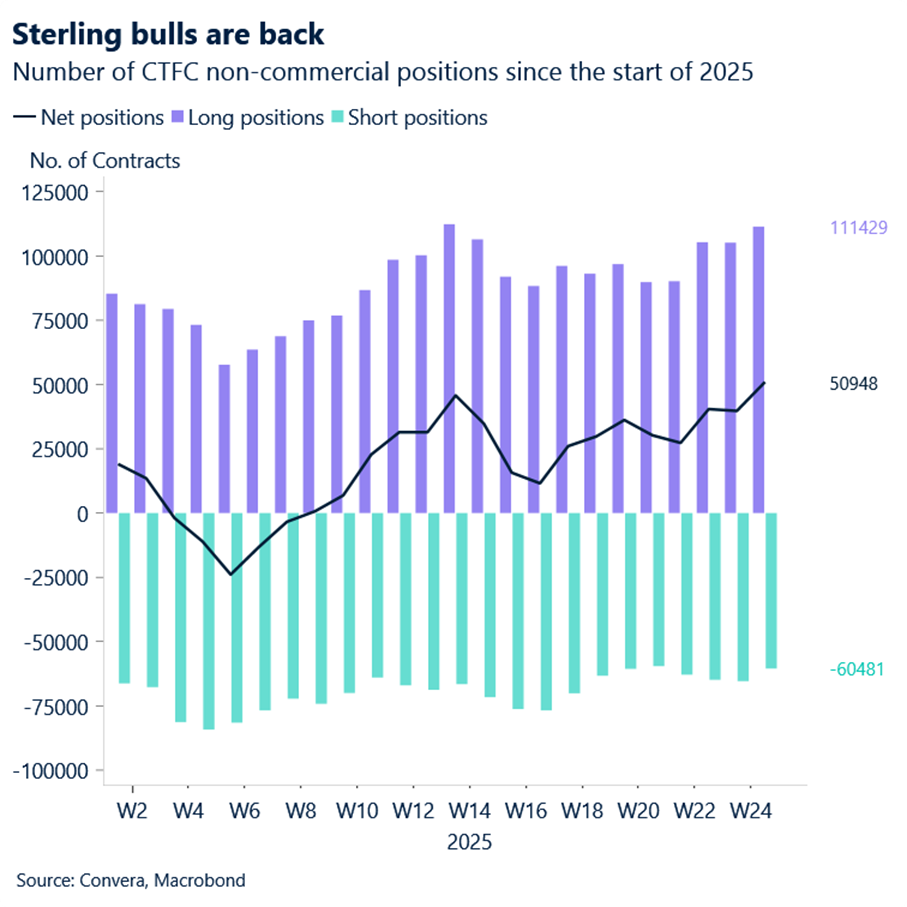
That tide has proven strong enough this year to convert even long-time pound sceptics. Net positioning, once deeply negative for sterling at the end of January, has now flipped considerably bullish — a telling shift in market tone.
Still, risks remain. Governor Bailey struck a cautious note on the UK labour market, and while his remarks weren’t overtly dovish, markets have already priced in roughly an 83% chance of a rate cut by August, with two cuts fully baked in by year-end.
From a rate differential perspective, the UK continues to offer higher nominal rates than the eurozone—but also grapples with persistently sticky inflation, with headline CPI still well above the 2% target. This erodes some of sterling’s appeal, particularly as the BoE leans toward further rate cuts.
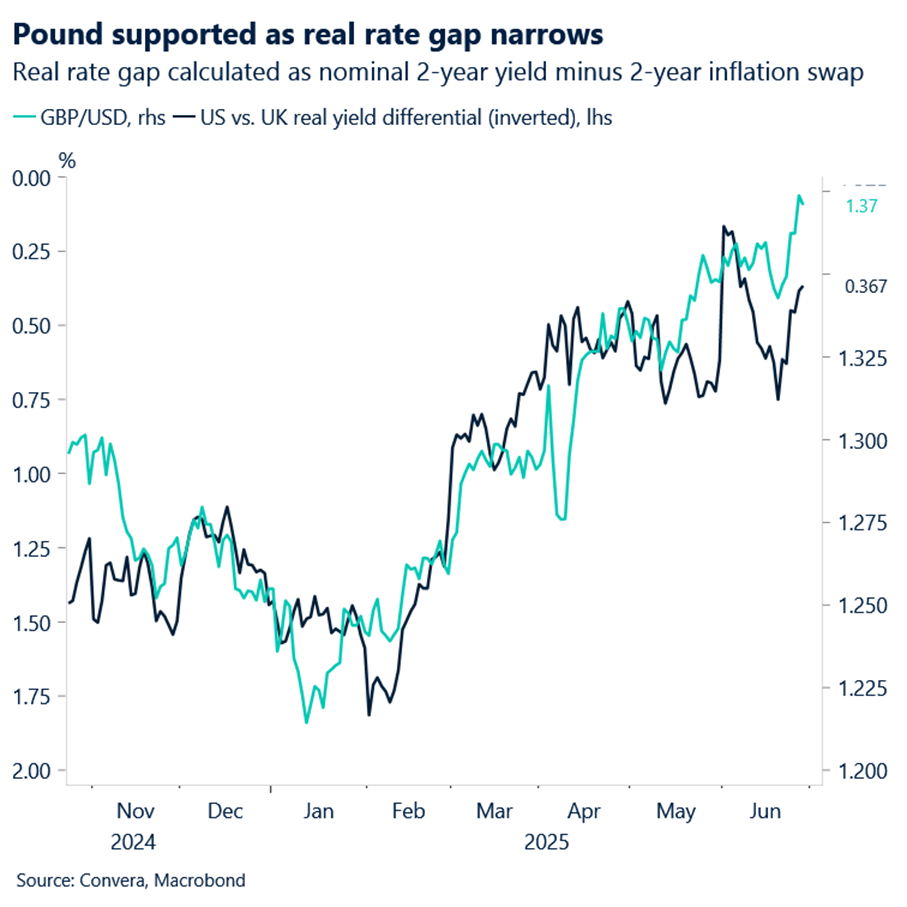
That said, real rate differentials—while still favouring the dollar—have steadily narrowed since the start of the year, offering a foundational layer of support to the pound. Should the Fed adopt a more dovish tone than markets anticipate—especially if this week’s U.S. labour market data disappoints—sterling could find fresh momentum for another leg higher.
Domestically, the UK data calendar is light this week, with second-tier releases and final prints unlikely to attract the BoE’s attention. GBP price action is more likely to be driven by sentiment shifts—potentially improving—linked to U.S. developments as trade discussions advance.
S&P at all-time highs
Table: 7-day currency trends and trading ranges
Key global risk events
Calendar: June 30-4
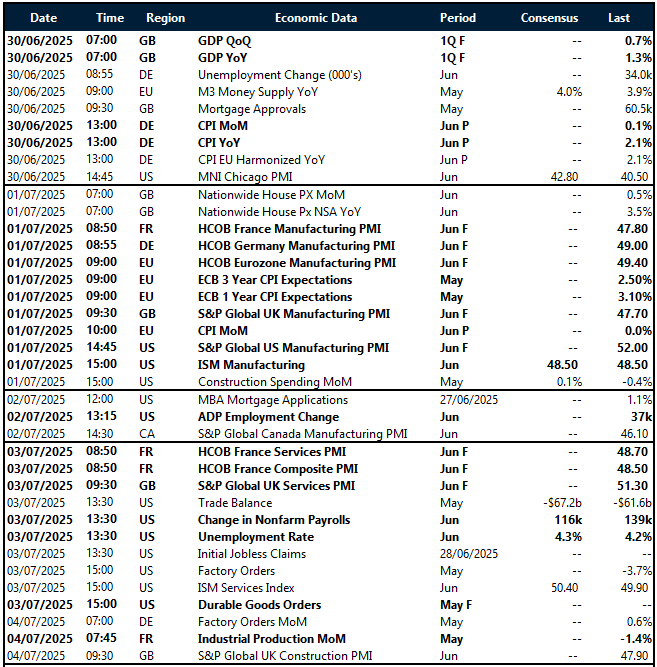
All times are in BST
Have a question? [email protected]
*The FX rates published are provided by Convera’s Market Insights team for research purposes only. The rates have a unique source and may not align to any live exchange rates quoted on other sites. They are not an indication of actual buy/sell rates, or a financial offer.