


USD: Peace deal hopes denting dollar support
The US dollar index briefly slipped to its lowest level since the outbreak of the war in Iran (late February) after headlines suggested a potential pathway toward ending the conflict in the Persian Gulf and reopening the Strait of Hormuz.
Sentiment improved after the White House confirmed President Trump would pause “Project Freedom” following recent escalations with Iran, which had included missile strikes on the UAE. Optimism was reinforced by reports yesterday that Iran is reviewing a new US proposal to end hostilities. The framework reportedly includes partial sanctions relief, a moratorium on Iran’s uranium enrichment programme, and a phased reopening of the strait alongside the lifting of the American blockade on Iranian ports.
Tehran is expected to respond within the next 48 hours, although Trump warned that “the bombing starts” should Iran reject the terms, keeping a near‑term geopolitical risk premium in play despite the more constructive headlines.
Markets nonetheless moved quickly to price de‑escalation. Brent crude fell more than 10%, dropping below $100 per barrel for the first time since late April, easing global energy shock fears. Lower oil prices weighed on the dollar via an unwind of safe‑haven and inflation‑risk hedging, particularly against pro‑cyclical and energy‑importer currencies.
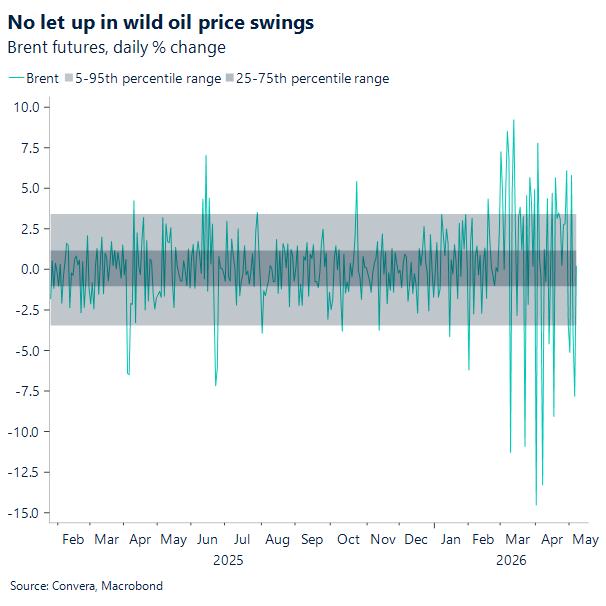
The tentative breakthrough comes as Trump faces mounting domestic pressure to end a conflict. The closure of Hormuz — a critical artery for global energy flows — had pushed US gasoline prices above $4.50 per gallon for the first time since July 2022, intensifying political scrutiny ahead of November’s Midterm elections.
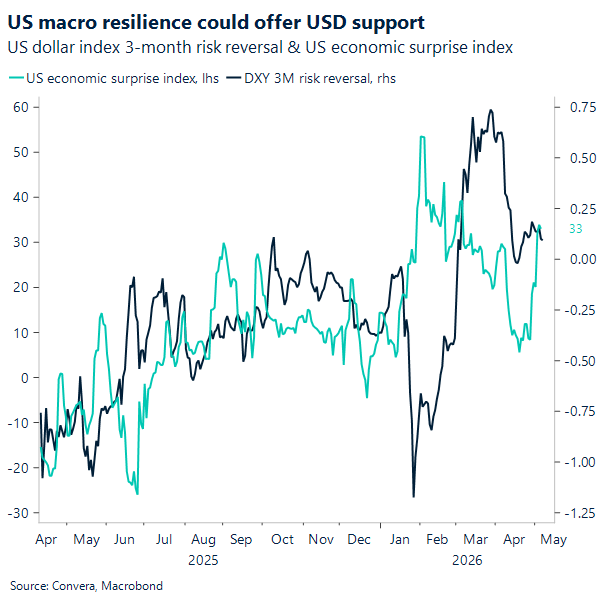
Bottom line: fading geopolitical risk and a sharp pullback in oil are removing key supports for the USD, at least tactically, though headline risk remains high until an Iranian response is confirmed. That being said, the relative resilience of US growth and activity suggests that expectations for a sustained and material dollar decline are premature.
GBP: Buoyed by external forces, tested by local politics
Sterling firmed following renewed optimism around a potential US–Iran deal, with easing geopolitical risk triggering a rally in risk assets and a sharp pullback in oil prices. That combination allowed GBP/USD to reclaim the 1.36 handle, which remains driven more by oil and USD dynamics than UK inputs. The pair retains a bullish bias above its 21-day moving average, with multiple longer-term moving averages clustered between 1.34-1.35 offering strong support.
Elsewhere, the pound also outperformed energy‑linked peers such as the CAD and NOK. However, higher‑beta FX like the AUD and NZD rallied more forcefully, leaving GBP softer on those crosses, while GBP/EUR was little changed just shy of the 1.16 handle.
The geopolitical de‑escalation narrative also drove a rally in global bonds, pulling UK gilt yields lower. Notably, those declines followed a sharp earlier rise in UK yields, which had already incorporated a domestic risk premium ahead of today’s local elections. At the long end, 30‑year gilt yields briefly reached their highest level since 1998, reflecting both tighter BoE pricing and heightened political uncertainty. However, an end to the conflict and the reopening of the strait would likely drive UK yields materially lower, as inflation risks fade and markets further unwind BoE rate‑hike expectations, even if domestic political risks persist.
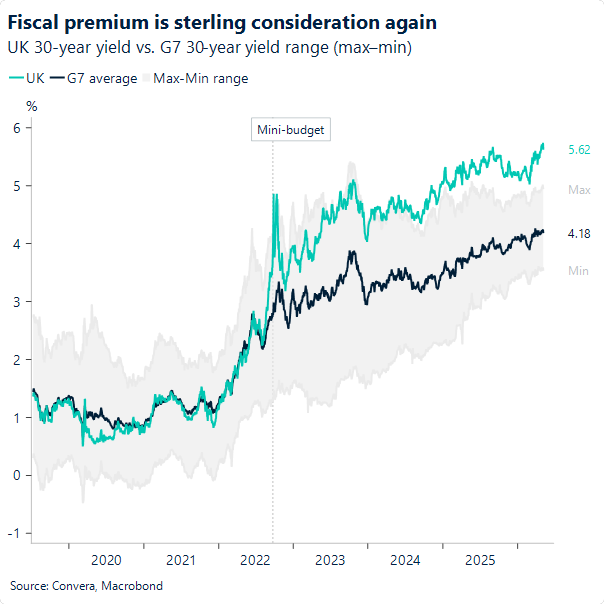
For sterling, global forces have dominated price action, with concerns around Prime Minister Starmer largely sidelined by geopolitics. That balance may now shift as local election results come into focus, with control of the Scottish and Welsh parliaments and more than half of England’s councils at stake. A poor result would likely revive leadership speculation and sharpen fiscal concerns at a time of fragile growth and renewed inflation pressure, turning higher yields into a headwind rather than support for GBP.
By contrast, a more benign outcome would likely keep political risk contained and preserve sterling’s carry appeal, provided global risk sentiment holds. As ever for GBP, yield support is conditional — it endures only while confidence remains intact.
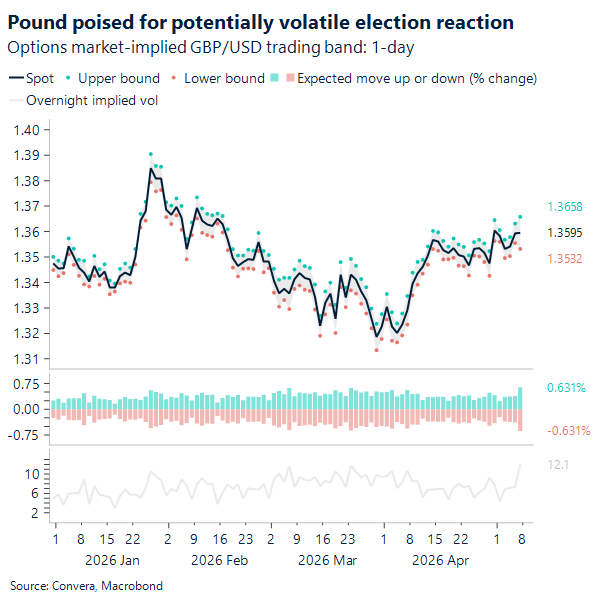
From an options perspective, overnight GBP/USD volatility sits just above 12%, implying an ~85‑pip breakeven from spot near 1.3600. A constructive election outcome could therefore see cable push toward a fresh three‑month high, while options suggest a break below 1.3440 would require a more severe political shock.
When will we know the election results?
Polling closes at 10pm on Thursday. Some English councils will declare overnight, but a clearer national picture may not emerge until Friday. Scotland and Wales begin counting Friday morning, with first results expected around midday.
EUR: Relief rally, limited upside
EUR/USD edged higher yesterday on renewed de‑escalation momentum. A swift succession of calming signals – including increased diplomatic pressure from China – proved sufficiently convincing for markets, which remain broadly hopeful despite Monday’s bout of violence. Markets now eagerly await Iran’s response to the US proporsal to end the conflict.
Yet even if Iran were to accept the proposal, oil prices may take time to normalise, and tensions are likely to persist over key contentious issues, including Iran’s nuclear programme. As such, this is unlikely to mark a clean shift to a no‑conflict scenario. Against this backdrop, a sustained move above 1.18 in EUR/USD appears unlikely. The level has acted as key resistance since mid‑2025, and de‑escalation alone may not be sufficient to break it decisively.
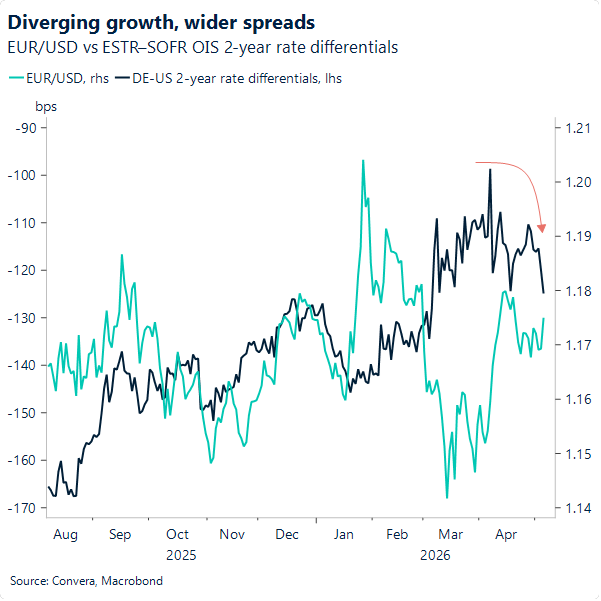
More broadly, the dollar may prove reluctant to relinquish its conflict‑driven gains, particularly as the war has brought relative macro performance into sharper focus, with countries differently positioned to absorb its impact. The US continues to outperform the eurozone, which has unexpectedly underperformed so far in 2026 – even prior to the conflict – limiting euro‑driven upside. This divergence is also reflected in rate differentials, which have recently re‑widened in favour of the US. Meanwhile, markets’ hawkish bias for the ECB – currently pricing around 75% chance of a hike next month – is unlikely to provide sustained support to the euro if met with a continued soft data cadence.
For this week, we expect EUR/USD to hold firmly above 1.1680, with scope to test 1.18 should Iran accept the US proposal. As said, we would however advise against chasing further upside beyond that level.
Market snapshot
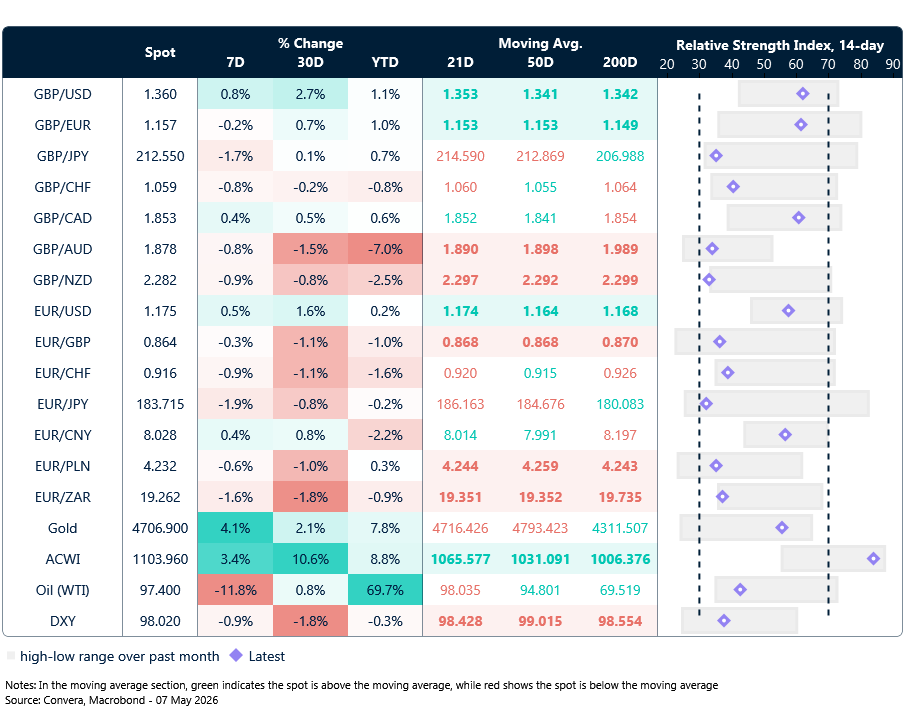
Table: Currency trends, trading ranges & technical indicators
Key global risk events
Calendar: May 4-8
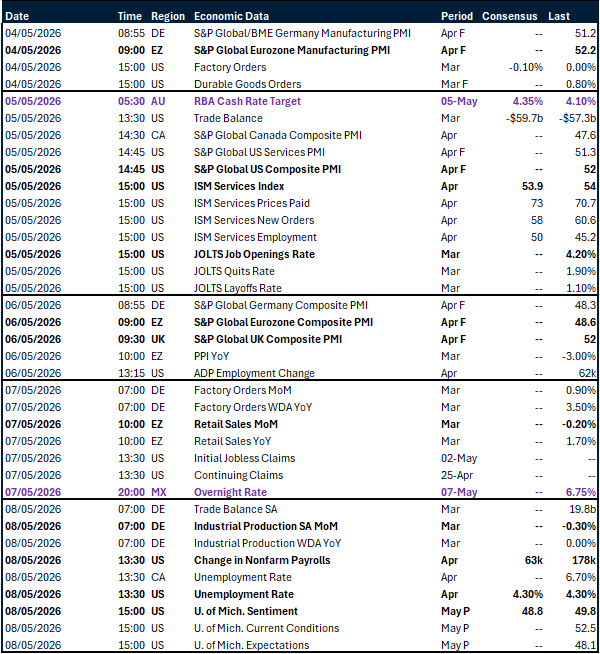
All times are in BST
Have a question? [email protected]
*The FX rates published are provided by Convera’s Market Insights team for research purposes only. The rates have a unique source and may not align to any live exchange rates quoted on other sites. They are not an indication of actual buy/sell rates, or a financial offer.