
Check out our latest Converge | Podcast on Spotify covering the monumental shift in sentiment and Fed pricing caused by a string of better than expected US macro data. With volatility on the rise again and geopolitical risks looming, we explore what lies ahead in the coming weeks.
Written by Convera’s Market Insights team
US data in focus as dollar settles
Boris Kovacevic – Global Macro Strategist
Investors are coming to terms with the fact that the Federal Reserve might only cut rates one or two times this year. This adjustment to a neutral Fed is complicated by the recent developments in the Middle East and central banks outside the US laying the groundwork for easing policy. All of this has created a perfect environment for the Greenback to shine, as its benefiting from its unique position as a high yielding, high growth, commodity backed safe haven currency. The high demand for the dollar is reflected in the cost for protecting against further upside rising to a 7-month high. FX investors had become complacent about the risks associated to inflation remaining sticky and the Fed maintaining policy rates higher for longer, which explains the divergence between bond and FX volatility.
However, yesterday’s trading session gave global investors a breather as both the US dollar and oil prices fell. The Greenback recorded its first setback in six days, while the price for a barrel crude oil dropped by the most since February (3.2%) on Wednesday. The relentless rise of inflation expectations, the dollar, commodities, and bond yields has dampened risk taking and has put the S&P 500 on track to fall for a third consecutive week. The longest losing streak since October (-4.5%) was not even stopped by yesterday’s drop of the dollar and oil prices, highlighting the mounting selling pressure on the equity side.
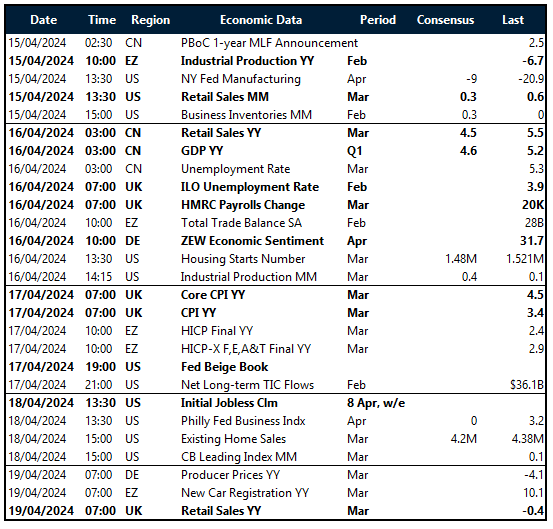
Without any relevant data points released yesterday, attention turns to today’s economic releases for guidance on the US economy. Second tier data like initial jobless claims, the Philadelphia Fed Manufacturing Index, the Conference Board Leading Economic Index, and existing home sales will be closely watched.

Pound bottoms, helped by inflation
Boris Kovacevic – Global Macro Strategist
Inflation in the United Kingdome eased less than expected, rising by 3.2% on an annualized basis in March. While this still represents the lowest inflation rate since September 2021, economists had been expecting a fall to 3.1%. The marginal upside surprise helped the British pound find a bottom this week at around $1.24. Traders pared back their expectations for policy easing from the Bank of England for this year and are now pricing in the first rate cut in November with a 50% chance of another cut in December.
Looking at the underlying components of the inflation basket, we do not think that the latest CPI report has changed our conviction of inflation falling below 2% in the coming months. However, the stickiness in services (6.0%), rent (7.2%) and wage (5.3%) inflation might mean that going sub 2% does not automatically guarantee we will be staying there indefinitely. As BoE policy maker Megan Greene warned in a speech this week, the untangling of global supply chains may keep price pressures elevated for longer.
GBP/USD has fallen to its lowest level so far this year as the continued strength of the US dollar didn’t leave any room for other currencies to shine. However, the paring back of Bank of England cuts means that we have not seen a strong divergence between pricing for the Fed and BoE. We conclude that the recent weakness in the pound is mainly a function of risk sentiment turning sour and oil pricing rising to new yearly highs. The $1.24 -$1.28 area will now define the short-term trading range (3.2%) for the pound. The main risk for the currency pairs lies in the probability of British policy makers having to cut much earlier than November as inflation continues to fall.
Euro inches to a 1-week high
Ruta Prieskienyte – FX Strategist
The euro has managed to break its 6-day losing streak to close in green, trading above $1.0670 level, on the back of improved risk sentiment and light profit taking. As the final reading of the HICP came out in line with the initial estimates, market shrugged off the news and instead focused on the slew of ECB and Fed speakers.
Unsurprisingly, the main talking points from the key ECB members did not unveil any new insights on the future policy path, as all policy markets reiterated the data dependant stance of the central bank. The members did warn the markets that despite the latest inflation data providing satisfactory evidence of sustainable convergence towards its 2% target, the policy easing path shall not be linear. Admittedly the most hawkish member of the Council, ECB’s Holzmann said he is not yet fully convinced that interest rates should be lowered in June. He highlighted the key risks to H1 cutting scenario as Eurozone pay discussions as well as rising geopolitical tensions. Meanwhile, his Dutch colleague Nagel expressed more confidence, confirming that the likelihood of June cuts has increased on the back of the latest inflation report. He too cautioned the markets, that the path to cuts is not without its risks, highlighting the recent increases in oil prices. Money markets assign a 90% probability that the ECB will cut the deposit rate by a quarter point in June, down from an almost sure thing last Friday.
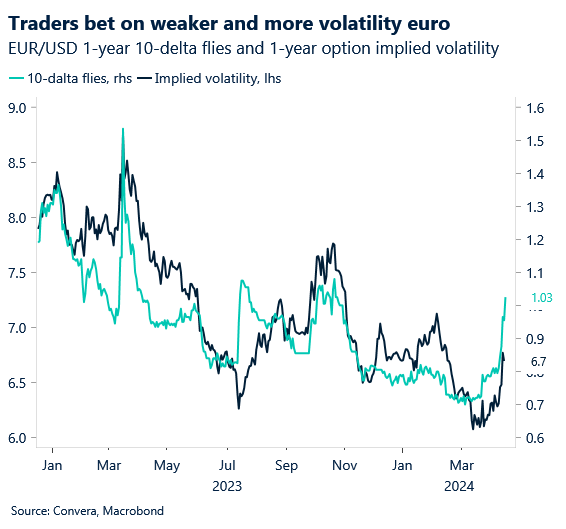
EUR/GBP briefly plunged to a 1-month low of £0.8521 on the back of an uptick in UK CPI, which fuelled broad Sterling gains against the majors. Despite a marginal gain, EUR/USD recovery remains sluggish with the pair facing a resistance barrier of $1.0700 in the near term. Looking ahead, options data shows that investors are looking for wilder swings in the common currency thanks to expectations for policy divergence between the Fed and the ECB. The cost of hedging against euro’s moves over a 1-year window has increased to the highest level since November 2023, while demand for structures that pay out if the euro trades beyond its most recent annual range is at a one-year high. As of recent, we have indeed seen 1-month realised volatility (Parkinsons basis) rise to a 2-month high, while equivalent measure on close-close basis had advanced to a 3-month high.
DXY slips after 6-day advance
Table: 7-day currency trends and trading ranges

Key global risk events
Calendar: April 15-19
Have a question? [email protected]
*The FX rates published are provided by Convera’s Market Insights team for research purposes only. The rates have a unique source and may not align to any live exchange rates quoted on other sites. They are not an indication of actual buy/sell rates, or a financial offer.