


USD: Dollar drifts, data leads
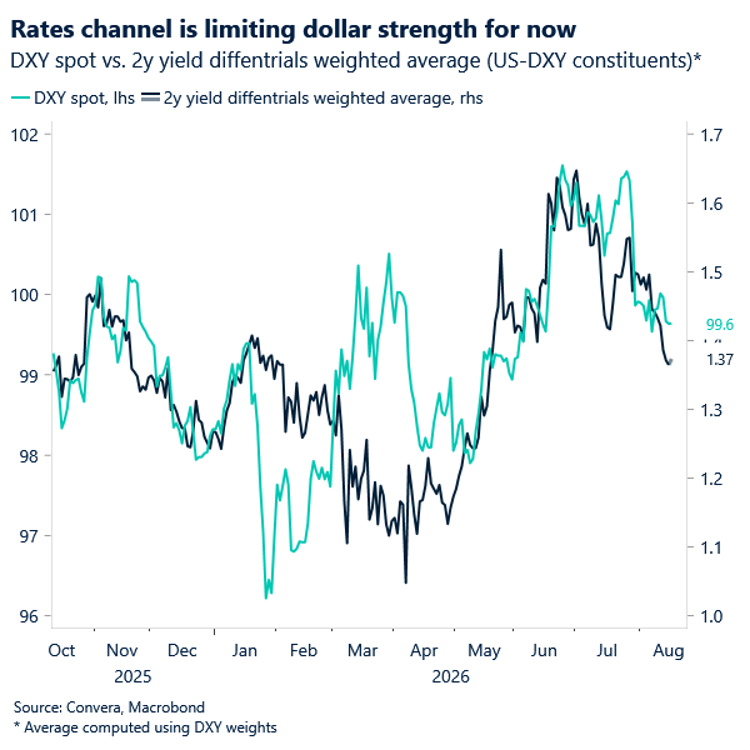
The US dollar index posted a second consecutive day of losses, closing near 99.50, though remaining broadly confined to the hesitant 99.50-100.00 range that has been in place since early August.
Prospects for a reopening of the Strait of Hormuz suffered another setback yesterday after President Donald Trump said he was in no hurry to end the war with Iran and had no interest in extending the Memorandum of Understanding (MoU) signed in June, which is due to expire on Monday. Meanwhile, Israel’s renewed strikes in Lebanon, coupled with sporadic attacks on vessels transiting the Strait, have further undermined US-Iran peace prospects.
Nonetheless, FX markets appear increasingly desensitised to geopolitical headlines. FX transmission channels through oil prices and broader risk sentiment have largely broken down, allowing the more familiar rates-driven regime to reassert itself. The dollar’s subdued price action has coincided with a pullback in front-end Treasury yields from their late-July highs, as a softer run of economic data through August has tempered expectations of further Fed tightening next month.
With little Fed communication on the calendar, particularly from the anti-forward-guidance Kevin Warsh, and no clear path towards a resolution of the conflict, markets have increasingly turned back to economic data to guide near-term FX moves.
Of course, geopolitics still matters, and any significant breakthrough would quickly be reflected in prices. At the same time, ruling out further dollar upside from a hawkish repricing around upcoming event risks, including tomorrow’s FOMC minutes, the Jackson Hole symposium and key September data releases, would be premature.
Our broader view remains, however, that the Fed will stay on hold for the remainder of the year, and that an unwinding of hawkish market pricing will ultimately weigh on the dollar.
For today, markets will keep an eye out on July industrial production and housing starts data.
EUR: ZEW surveys in focus today
The euro hit a nine-week high against the US dollar yesterday, although it has slipped back below 1.16 this morning. The common currency remains well supported, but its ability to extend gains continues to depend more on the dollar than developments in Europe.
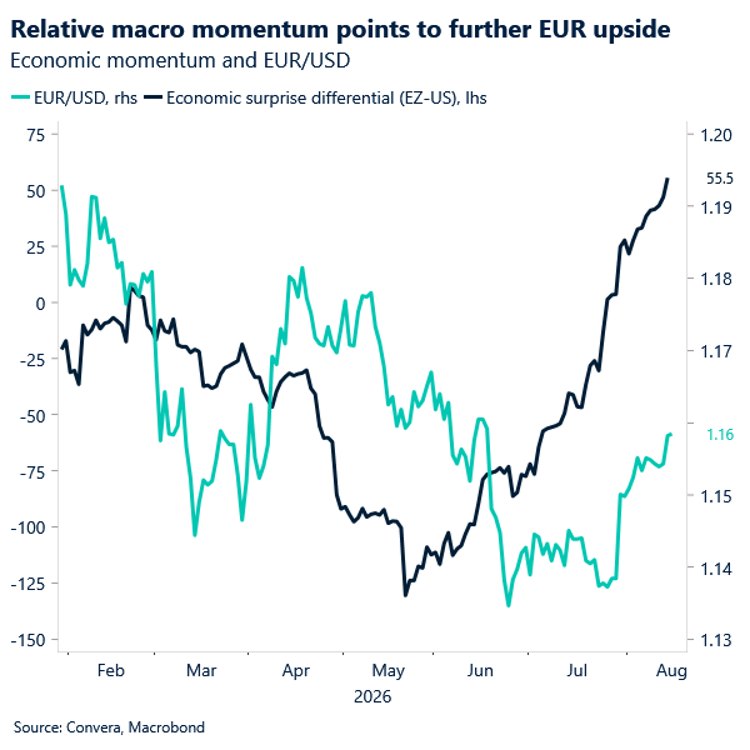
Encouragingly, the relative growth backdrop is becoming less USD-positive. Recent US data, including weaker retail sales figures, have pushed US economic surprises sharply lower, while eurozone surprises have improved materially, narrowing a key divergence that favoured the dollar earlier this year.
That improving picture could be reinforced by today’s ZEW surveys. Germany’s assessment of the current economic situation remains deeply negative, having spent the longest period in contractionary territory since 2006. However, expectations for future growth have rebounded sharply from their mid-year lows and are expected to improve further. The contrast suggests investors remain cautious about present conditions but increasingly optimistic that the worst of the slowdown may be passing.
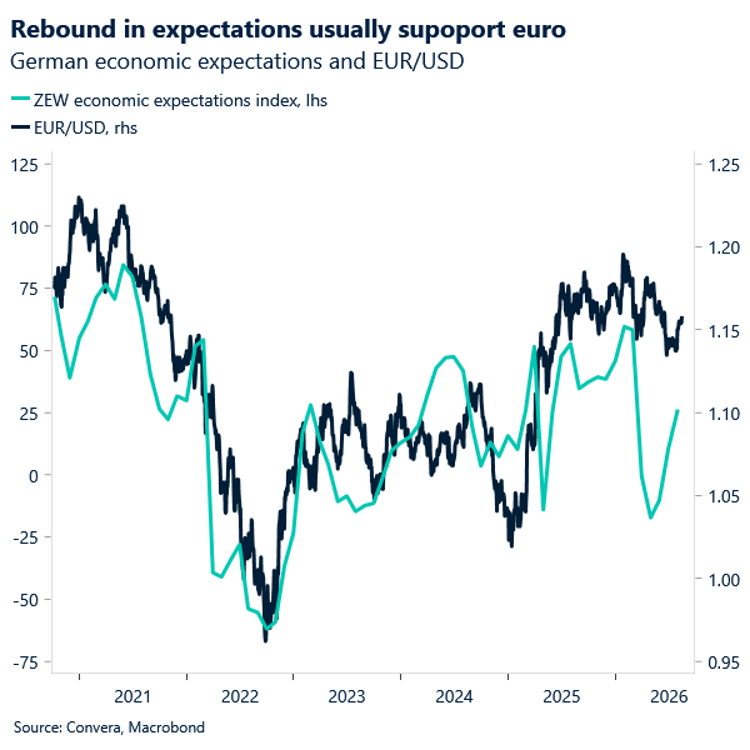
This shift has helped cement expectations for a September ECB rate hike, while the first fully priced Fed hike has been pushed out to 2027. Combined with resilient eurozone growth and easing inflation concerns, it has created a supportive backdrop for risk assets and helped underpin EUR/USD in an environment where rate differentials and risk sentiment are doing much of the heavy lifting.
However, upside remains constrained. While the correlation between EUR/USD and oil prices has weakened markedly in recent weeks as rate dynamics have taken centre stage, higher energy prices remain a structural risk for the euro area. A more meaningful escalation in the Middle East would likely refocus markets on Europe’s vulnerability to imported energy, capping gains in the euro even if the near-term rate backdrop remains supportive.
GBP: Continued labour market softeness
This morning brought the latest UK labour market report. June’s unemployment rate held steady at 4.9%, contrary to expectations for a dip to 4.8%. Meanwhile, payrolled employment fell by 13k in July versus expectations for no change, while employment growth in the three months to June came in at 84k, undershooting forecasts of 130k.
There was some upside surprise in the wage data. Average Weekly Earnings rose 4.1% in the three months to June, slightly ahead of the 4.0% consensus estimate. Private sector pay growth came in at 2.8%, matching expectations.
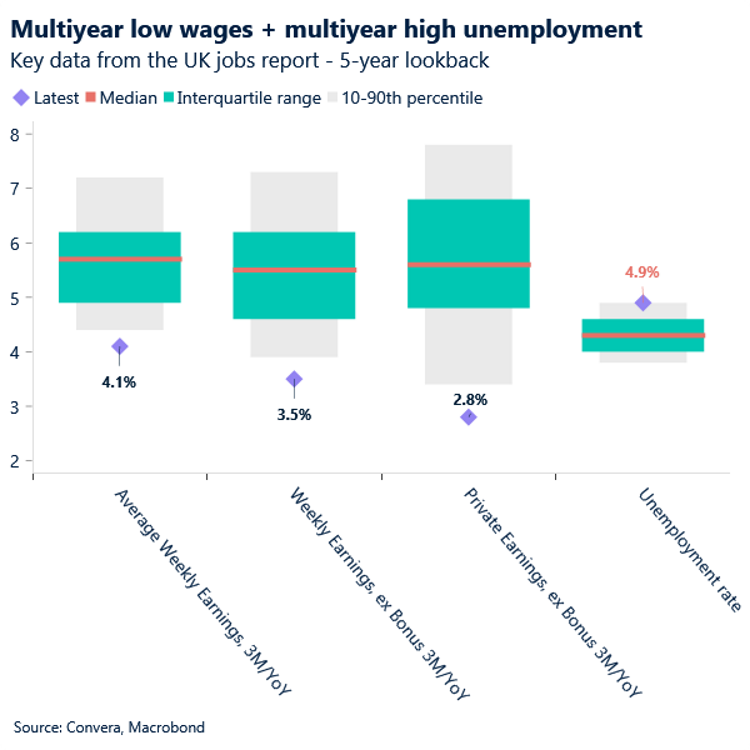
Overall, the release continues to paint a picture of a softening labour market. The Bank of England’s latest central projections point to unemployment averaging 5.0% in Q4 2026, suggesting policymakers are already braced for further deterioration. After all, uncertainty at home and abroad provides little incentive for businesses to increase hiring or step up investment. That may help explain the relatively muted reaction in sterling, with markets perhaps seeing little that was genuinely new in today’s data.
There is also a data quality caveat. In the release notes, The ONS noted that the July estimates are based on around 85% of the usual information being available and should therefore be treated as being of “lower quality”.
The Bank’s reaction function also remains more closely tied to the inflation outlook, particularly given ongoing geopolitical tensions that continue to pose upside risks. Tomorrow’s July CPI release at 7:00am BST will therefore be the next key test.
Market snapshot
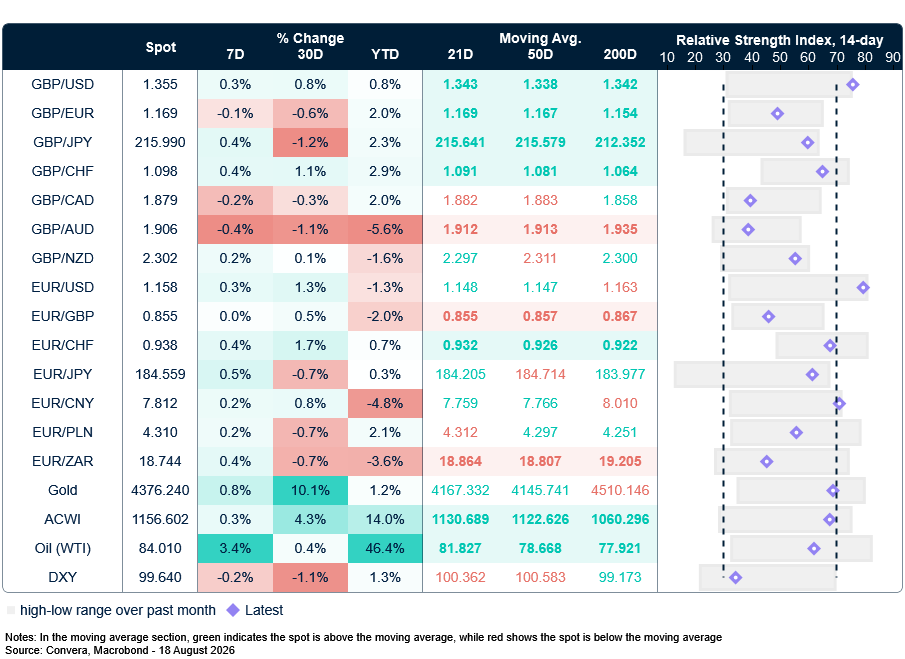
Table: Currency trends, trading ranges & technical indicators
Key global risk events
Calendar: August 10-14
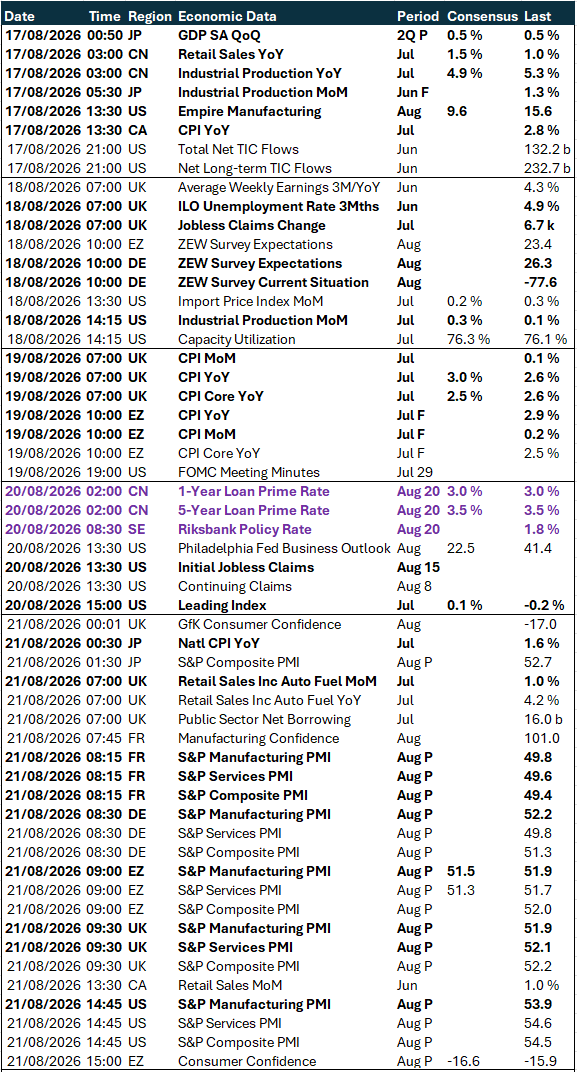
All times are in BST
Have a question? [email protected]
*The FX rates published are provided by Convera’s Market Insights team for research purposes only. The rates have a unique source and may not align to any live exchange rates quoted on other sites. They are not an indication of actual buy/sell rates, or a financial offer.