

Key Takeaways
- The dollar enters October near its 2026 high, supported by firm US inflation signals and French fiscal stress. Softer payrolls slowed the rally, but expectations for a December Fed hike remain supportive.
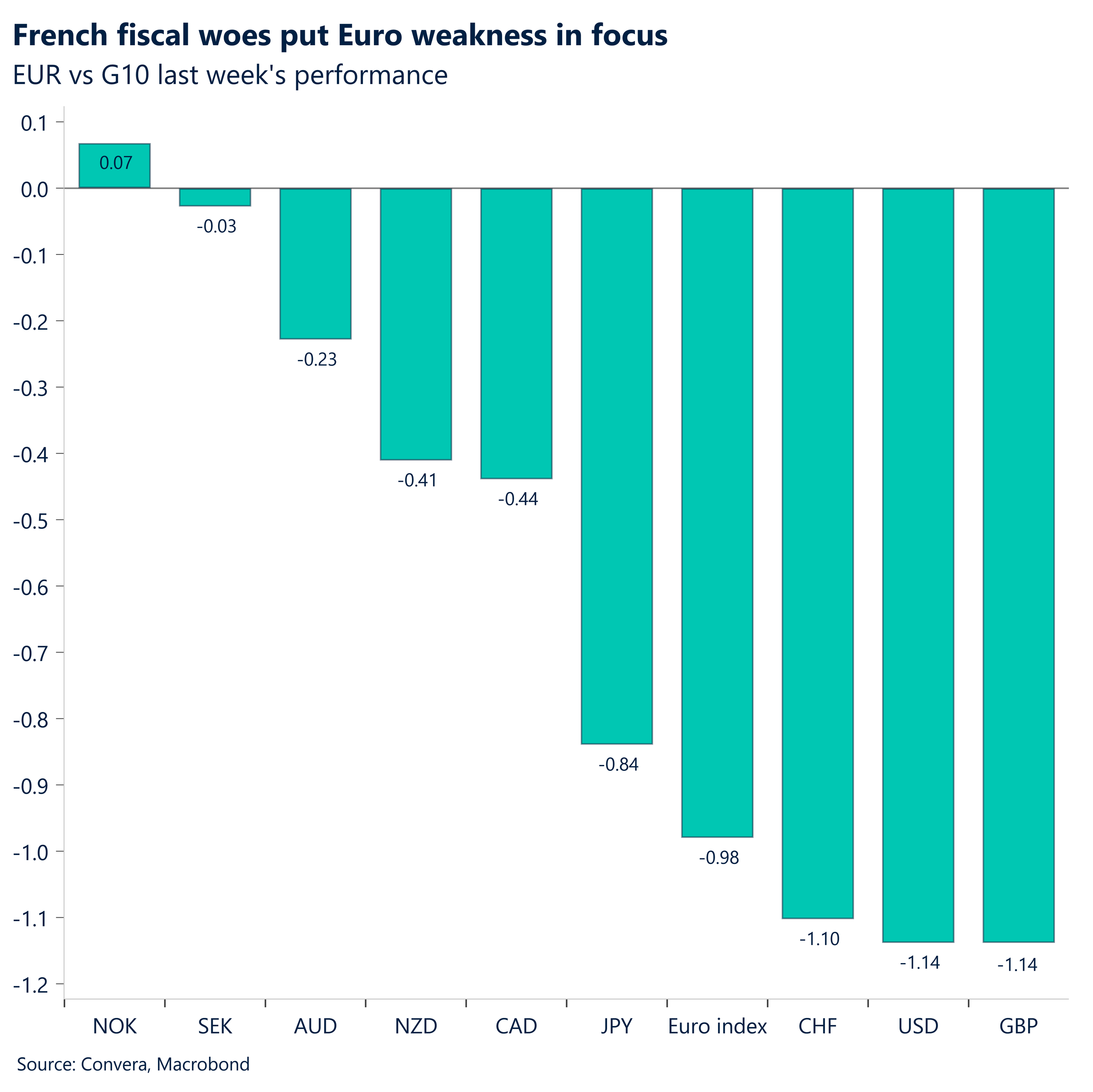
- French budget concerns pushed sovereign spreads sharply wider and EUR/USD down 1%. Continued pressure on the euro adds another layer of support for the dollar.
- USD/CAD trades above 1.425, extending its advance into a fifth consecutive week. Wide yield differentials and trade uncertainty continue to outweigh support from higher oil prices.
- The peso erased its 2026 gains in September as dollar strength and higher volatility triggered a carry unwind. Strong exports provide a buffer, but investors remain cautious about rebuilding MXN exposure.
- This week, US services ISM and the FOMC minutes will guide the broader dollar move. Canadian employment, Mexican inflation and the Fed and Banxico minutes will shape near-term hedging levels in USD/CAD and USD/MXN.
French stress supports US dollar despite weak payrolls
The dollar enters October near its 2026 high, supported by firm US inflation signals and growing fiscal stress in Europe. Thursday’s stronger ISM manufacturing report and elevated prices paid kept another Fed hike in play, while French budget concerns pushed the OAT-Bund spread to 154 basis points. EUR/USD fell 1% to 1.125, helping DXY reach a new year-to-date high of 102.2 before Friday’s payroll report dented the dollar’s momentum.
The US added just 29,000 jobs in September, wage growth slowed and unemployment rose to 4.2%. Markets cut the probability of an October hike from 48% to 18%, pulling two-year yields lower and weakening the dollar on Friday. December remains priced at 85%, however, while higher long-term yields show that inflation, fiscal concerns and term premium continue to support the dollar beyond the next Fed meeting.
The euro side of the story provides a separate source of dollar strength. France’s fiscal watchdog challenged the assumptions behind the government’s deficit plan, while wider Italian spreads showed that the pressure was spreading beyond French assets. EUR/USD recovered only modestly after payrolls, suggesting investors were unwilling to unwind the French fiscal premium even as expectations for near-term Fed tightening fell.
This week’s services ISM and FOMC minutes will test both sides of the dollar rally: whether US price pressures remain firm and whether policymakers continue to favor a December hike despite weaker hiring. For October, firm services inflation, hawkish minutes and continued pressure on French bonds would support DXY toward the 102.5–103 level, while softer US data or narrower European spreads would favor a move back below 101.5.
The Q4 view remains moderately constructive, but another payroll gain below 50,000 would weaken the December case, while sustained EUR/USD weakness below 1.12 would keep an important source of dollar support in place.
Canadian dollar weakness extends into a fifth week
The Canadian dollar fell for a fifth straight week, with USD/CAD trading above 1.425 even as expectations for further Bank of Canada tightening have increased. The wider US-Canada rates gap remains the clearest explanation of the consistent underperformance: US two-year yields are now around 156 basis points above Canadian yields, the largest spread in 2026. Slower domestic growth and renewed trade friction with the US have also made it harder for the loonie to benefit from higher oil or a more hawkish BoC outlook.
Friday’s US payroll miss offered little relief. It lowered the probability of an October BoC hike from around 50% to 34%, as markets questioned whether the Bank needs to move quickly while growth is slowing on both sides of the border. Friday’s Canadian employment report will now carry more weight after the economy lost 41,700 jobs in August. A modest rebound would keep October in play, but another weak report would make it difficult for the BoC to justify tightening before December.
Some caution is warranted after such a sustained move, particularly with CAD already underperforming and positioning tilted against it. Still, USD/CAD holding above 1.42 despite higher oil and softer US payrolls shows that rates and trade uncertainty will keep setting the tone. The October outlook remains centred on a 1.41–1.44 range: a BoC hike or genuine progress in US-Canada trade talks would favour the lower end, while weak Canadian employment and persistently wide yield spreads would keep 1.43–1.44 in play.

Carry unwind tests the Mexican Peso
The peso erased its 2026 gains in September, as the stronger dollar and the unwind of crowded carry positions pushed USD/MXN back above 18.00. Mexico’s yield advantage remains substantial, but the two-year spread over the US has narrowed to roughly 300 basis points while implied volatility has nearly doubled. That combination makes the carry less attractive once the risk of further peso losses is taken into account.
For now, the move appears more closely tied to positioning than to a sharp deterioration in Mexico’s fundamentals. Exports rose 29% over the first eight months of the year, while Banxico’s decision to drop its explicit hold guidance leaves room to tighten if inflation picks up or peso weakness becomes more persistent. The unresolved US-Mexico trade talks and the threat of US diesel export restrictions complicate that picture, however, and may prevent investors from rebuilding peso positions quickly.
Thursday’s inflation report and Banxico minutes will show how seriously policymakers are considering another hike, with a firmer inflation print likely to offer the peso some support. USD/MXN has established itself above 18.00 after reaching 18.43 last week, with 18.45–18.5 the next test if carry positions continue to unwind. The Q4 range remains 17.8–18.5, with the direction set by whether the Mexico-US yield spread holds near 300 basis points and whether trade negotiations regain momentum.

Market snapshot
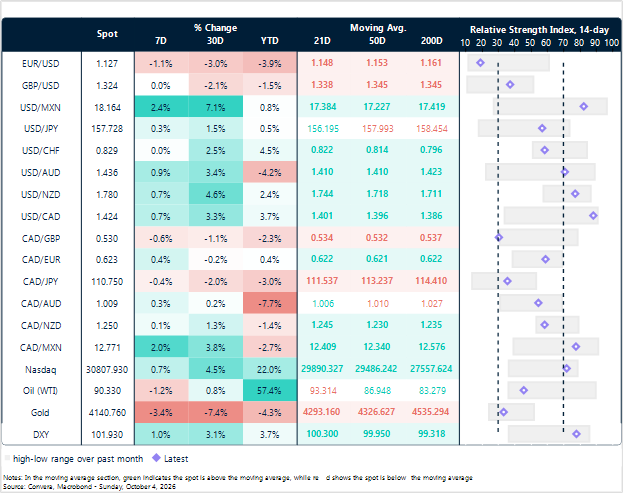
Table: Currency trends, trading ranges & technical indicators
Key global risk events
Calendar: October 05 – 09
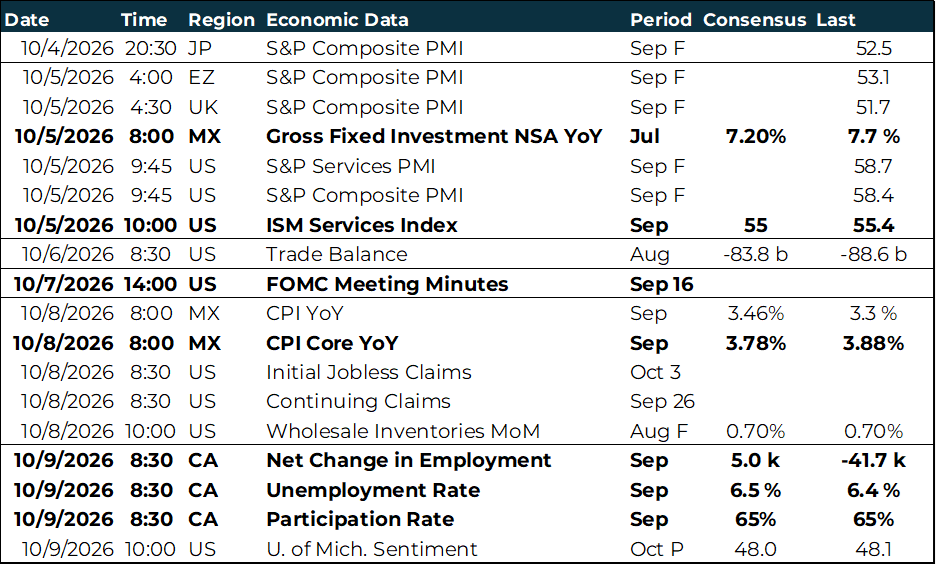
All times are in EST
Have a question? [email protected]
*The FX rates published are provided by Convera’s Market Insights team for research purposes only. The rates have a unique source and may not align to any live exchange rates quoted on other sites. They are not an indication of actual buy/sell rates, or a financial offer.