

USD: Making fresh highs
The US dollar continues to march higher, with the DXY index notching fresh year-to-date highs. However, this remains as much a story of euro weakness as dollar strength, given the euro’s dominant weighting in the index. Indeed, the deterioration in sentiment towards the single currency amid mounting fiscal concerns in France and widening peripheral bond spreads has provided an additional tailwind for the greenback.
Last week’s softer-than-expected US payrolls report failed to materially undermine the dollar’s advance. Markets remain broadly comfortable with the prospect of the Federal Reserve leaving rates unchanged later this month before delivering another rate hike in December. Similarly, Monday’s ISM services survey offered little reason to challenge the prevailing narrative, with both the headline reading and key subcomponents largely meeting expectations.
More broadly, support for the dollar continues to stem from the relative resilience of US growth and interest-rate expectations. While many major central banks are seeing markets scale back tightening expectations, investors remain reluctant to do the same for the Fed. That divergence continues to underpin the dollar’s yield advantage.
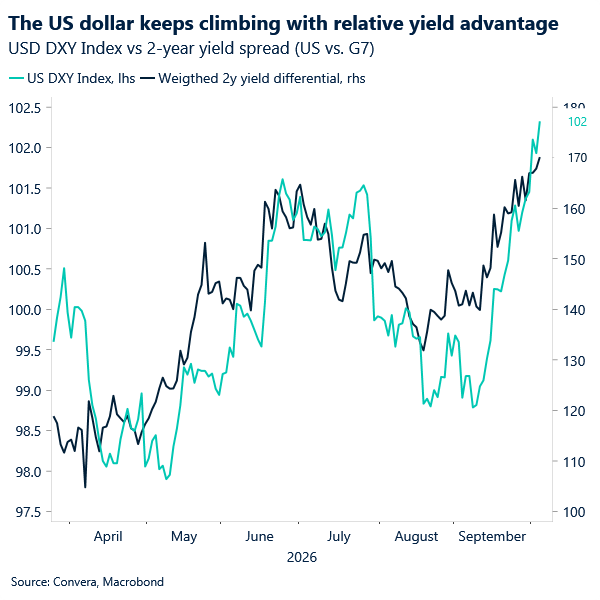
Importantly, the rise in US yields still appears driven more by stronger growth and a higher expected Fed terminal rate than by concerns over fiscal sustainability (like in France). The fact that the US yield curve has generally flattened rather than steepened through the sell-off suggests markets are repricing the path of short-term interest rates higher, with long-dated yields simply following suit.
Elsewhere, equity markets remain remarkably unfazed by the bond market volatility. The S&P 500 and Nasdaq closed last week near record highs, underscoring the view that rising US yields are being driven by stronger growth prospects rather than mounting financial stress. Stronger growth may be negative for bond prices, but it remains supportive for corporate earnings.
EUR: Pause in panic, but plenty of protection
The euro has steadied after Monday’s sharp sell-off, with EUR/USD holding above 1.12 as the liquidation in French bonds temporarily pauses. Markets are now looking ahead to Marine Le Pen’s alternative budget proposals later today, searching for signs that the political and fiscal backdrop in France can stabilise.
However, the mood remains cautious. The absence of fresh selling does not necessarily imply growing confidence; rather, investors appear to be waiting for the next catalyst. With no obvious resolution to concerns surrounding French public finances and potential spillovers across the euro area, sentiment towards the single currency remains fragile.
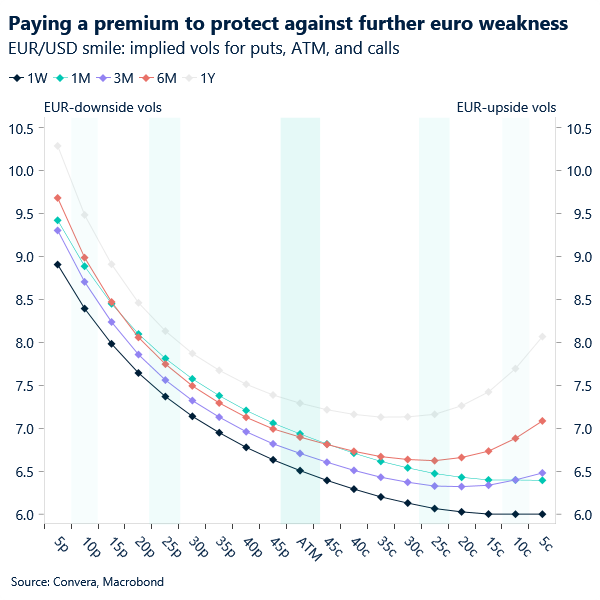
That caution is increasingly visible in options markets. While spot price action has stabilised, investors are paying a premium to protect against further euro weakness, particularly over shorter time horizons. Risk reversals remain skewed towards EUR/USD downside, suggesting traders see near-term political and sovereign bond risks as more important than longer-term structural concerns.
The message from markets is therefore relatively clear: this is not panic, but it is not confidence either. The French bond market remains the focal point, and until investors gain more clarity on the fiscal outlook and contagion risks across the bloc, the euro is likely to remain sensitive to developments in sovereign debt markets.
For now, the euro has found its footing. Whether it can build from here will depend less on the ECB or economic data, and more on whether French assets can avoid another bout of stress.
GBP: At the mercy of broader market dynamics
There has been little fresh news for sterling overnight, leaving the pound largely at the mercy of broader market dynamics. The dominant theme remains a combination of risk sentiment, volatility and relative yield support.
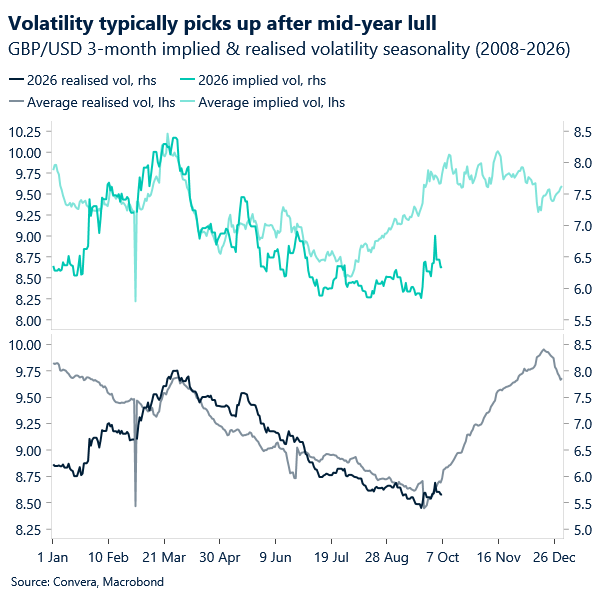
Despite lingering geopolitical tensions and elevated energy prices, investors remain broadly comfortable taking risk. Equity markets continue to trade well, while realised FX volatility remains unusually subdued. That backdrop tends to favour sterling, given its high-beta and carry-friendly characteristics.
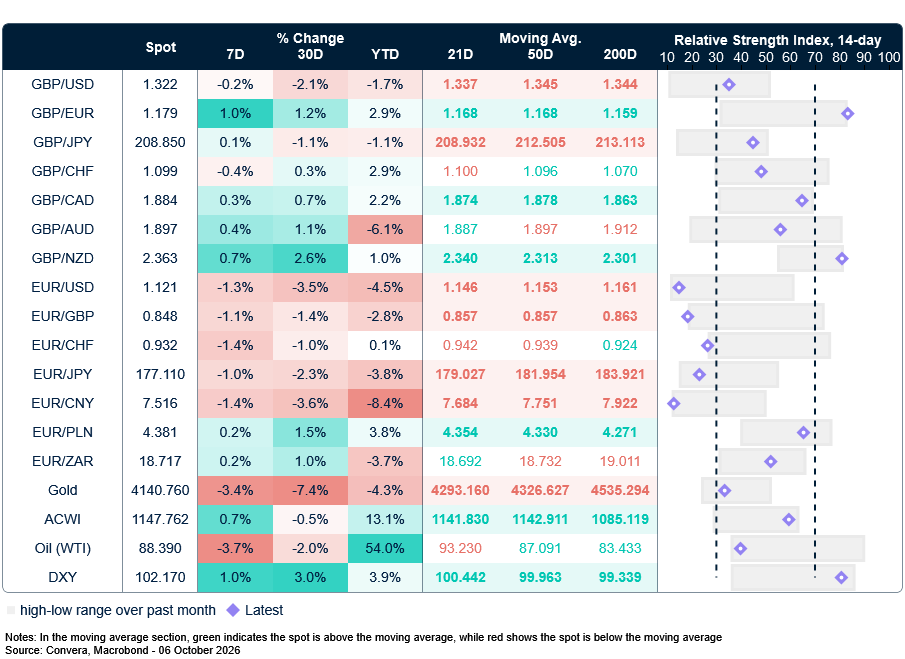
While GBP/USD remains under pressure near the low-1.32s, GBP/EUR still lingers near 1.18, a level the cross has occupied for less than a quarter of the past decade. The move is being driven more by relative dynamics than outright UK optimism, with fiscal concerns elsewhere in Europe helping sterling’s cause.
The key risk remains that a pickup in volatility, a deterioration in risk sentiment or a reassessment of fiscal risks ahead of the Autumn Budget could quickly undermine the carry trade narrative that has supported sterling for much of the year.
Market snapshot
Table: Currency trends, trading ranges & technical indicators
Key global risk events
Calendar: October 05-09
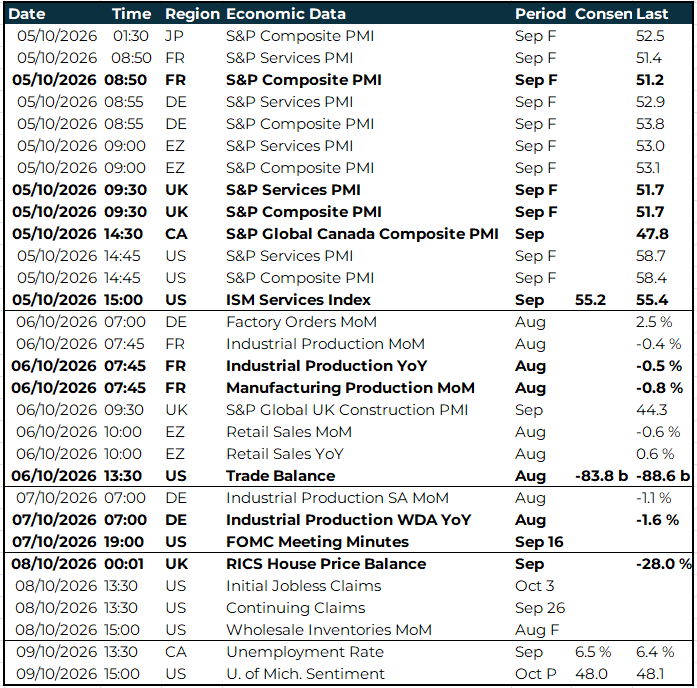
All times are in BST
Have a question? [email protected]
*The FX rates published are provided by Convera’s Market Insights team for research purposes only. The rates have a unique source and may not align to any live exchange rates quoted on other sites. They are not an indication of actual buy/sell rates, or a financial offer.