

Key takeaways
- The US dollar rebounds as AI sentiment stabilizes, with future movements dependent on the Fed’s decisions and Chair Warsh’s framing of inflation paths.
- AUD/USD shows resilience but faces tests from rate expectations and external economic conditions, particularly from China.
- NZD/USD is steady as markets anticipate a RBNZ hike, but negative carry remains a significant constraint against US rates.
- For the dollar, market focus shifts to December, with tech earnings affecting volatility as the Fed’s stance shapes expectations.
- Overall, currency trends reflect a complex interplay of domestic policy and international factors, impacting exchange rates across the board.
Dollar awaits Fed with AI earnings to test yields
The US dollar has rebounded as AI-sentiment stabilizes and investors position before the Fed meeting on Wednesday. The next dollar move will depend less on the widely expected hold than on how Chair Warsh frames the path ahead. Recent US data have strengthened the case for further tightening, with persistent energy and shelter pressures putting core PCE on track to end the year near 3.2%. A weaker September payroll report and downward revisions to historical inflation data have nevertheless given policymakers room to wait without suggesting the inflation problem has passed. With December hike odds still above 70%, Warsh needs to preserve a tightening bias without provoking another disruptive adjustment in rates.
Policymakers have made clear that stronger data alone will not force an immediate move. Vice Chair Williams and Governor Bowman have played down the need for an immediate move, while Warsh has avoided providing a clear roadmap. Regional Fed presidents Hammack and Logan may still favor a 25-basis-point hike, but a divided decision just before the midterms would create volatility without materially changing the broader policy path. The more useful signal will be whether the Fed preserves the case for December or gives markets a reason to question the next hike.
Demand remains firm enough to prevent the pause from becoming an easing signal. Third-quarter growth is tracking at a solid pace, while private domestic demand has held up despite the correction in AI-related equities. That leaves room for the Fed to resume tightening with quarter-point increases in December and January, taking the policy range to 4.25%–4.50%. That sequence depends on inflation remaining sticky without a sharper deterioration in employment, credit or broader financial conditions.
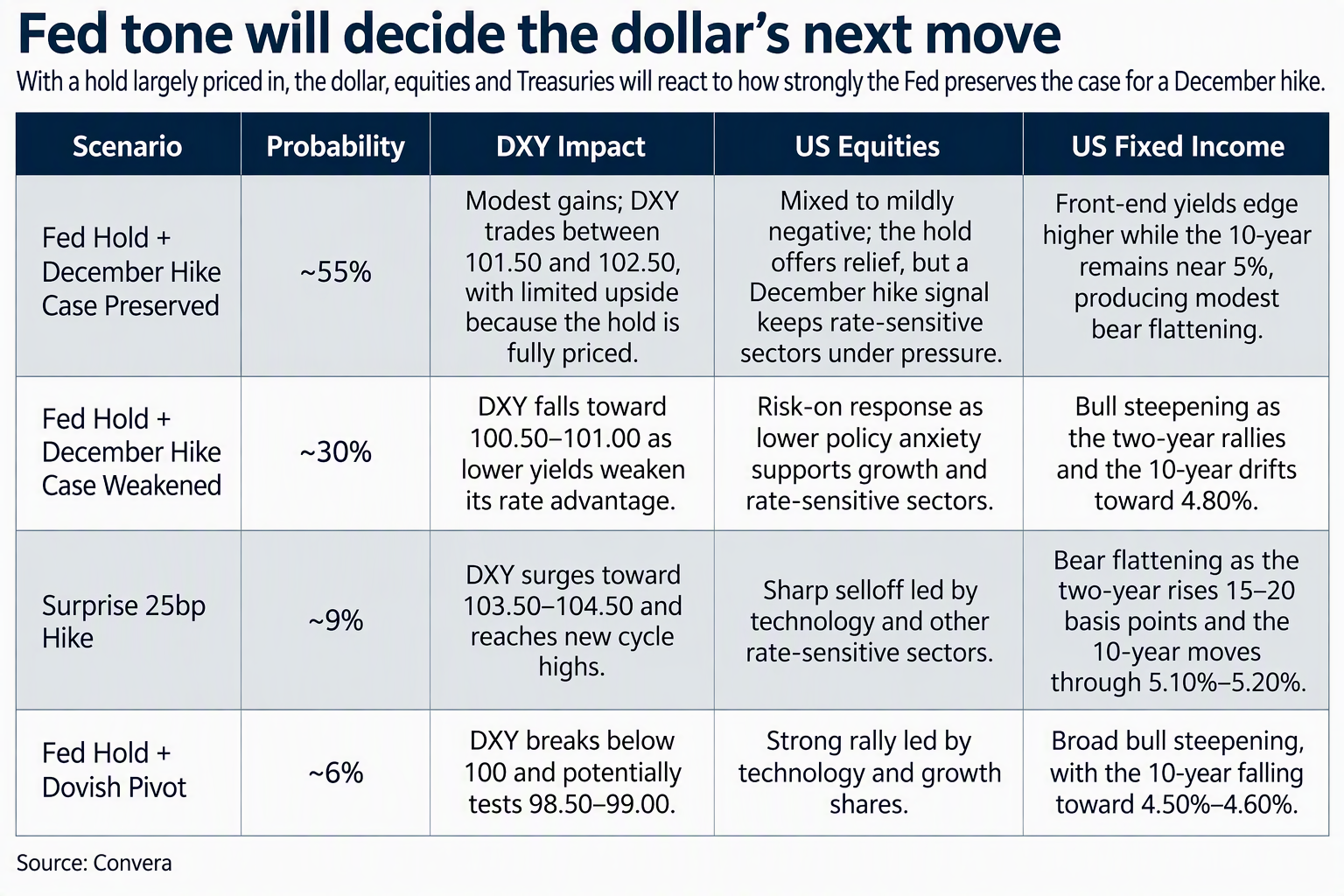
For the dollar, the Fed’s expected pause leaves DXY range-bound until markets turn their attention to December. In the meantime, earnings from the largest US technology companies could drive volatility through Treasury yields, with any renewed doubts about AI investment or returns likely to revive defensive demand for duration and weigh on the currency. Strong results would ease that pressure and allow relative rates to regain control. On Wednesday, a Fed tone that preserves the December hike case should keep DXY supported between 101.5 and 102.5, in line with the table’s base case, while any weakening of that case could bring attention to lower support near 101.
Aussie rate advantage faces policy test
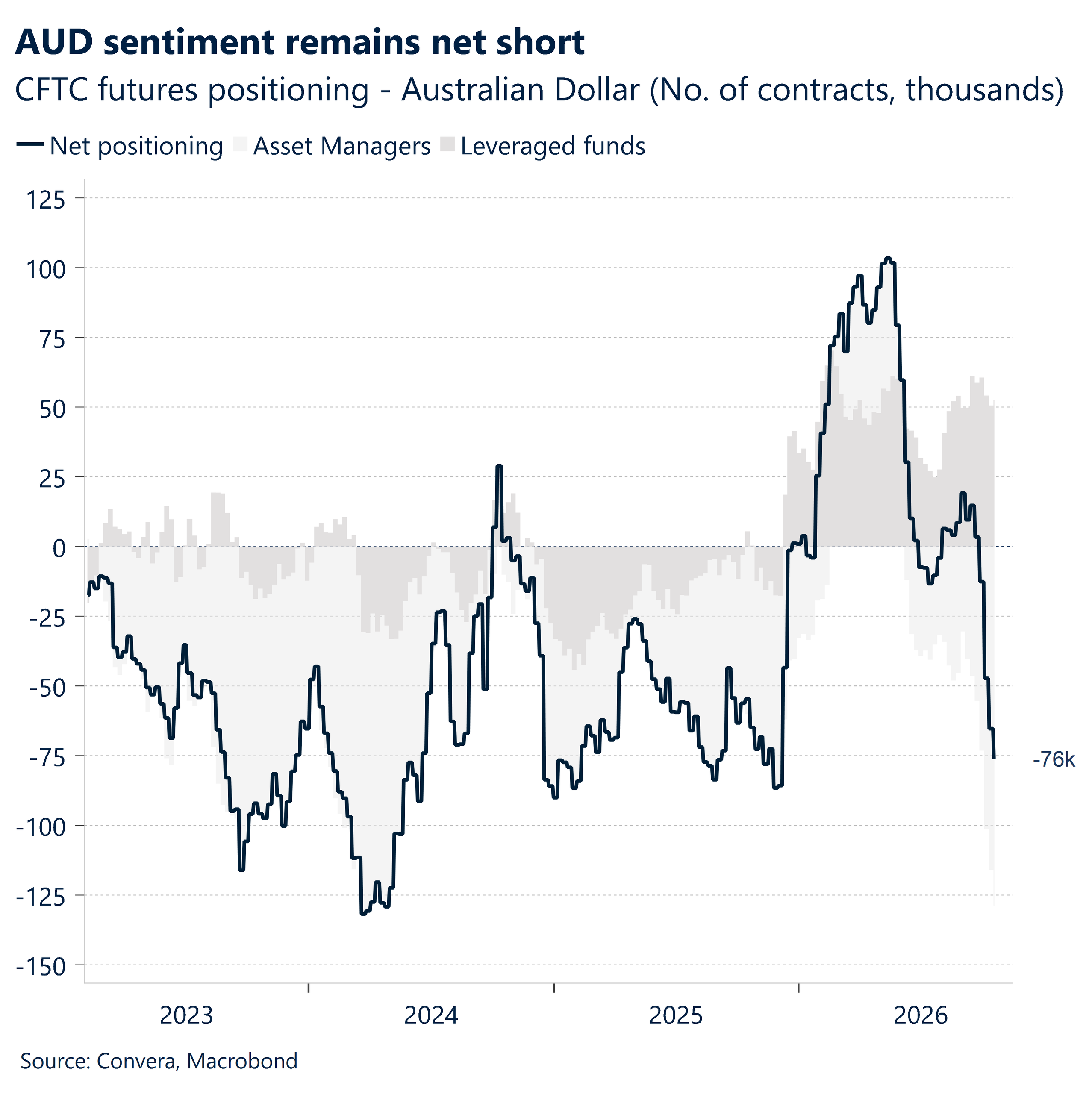
AUD/USD is holding near 0.703, showing resilience above 0.70 despite recent emerging-market volatility and broader US-dollar strength. Markets are leaning toward another quarter-point RBA hike to 4.85% next week, keeping Australian two-year yields roughly 15 basis points above US Treasuries. The rate advantage gives the Aussie a degree of support, while heavily short speculative positioning leaves room for a sharp squeeze if the RBA reinforces its tightening bias.
The external backdrop is less straightforward. Easing tensions around the Strait of Hormuz have pulled oil from its recent highs, trimming some of Australia’s terms-of-trade support. Chinese intervention has helped stabilize local equities and the renminbi, providing an indirect cushion for the Aussie without resolving the underlying growth concerns. China’s manufacturing data later this week will show whether that stabilization is being matched by firmer demand.
AUD/USD remains capped below the 50-day and 200-day moving averages around 0.705–0.707, making that zone the immediate test. A hawkish RBA backdrop combined with a patient Fed tone could trigger a break toward 0.71, particularly given stretched short positioning. A more forceful Fed message or weaker Australian data would instead expose support near 0.695. The rate advantage favors the Aussie for now, but a sustained breakout still requires domestic policy expectations and the external growth backdrop to move in the same direction.
RBNZ hike tests Kiwi’s carry drag
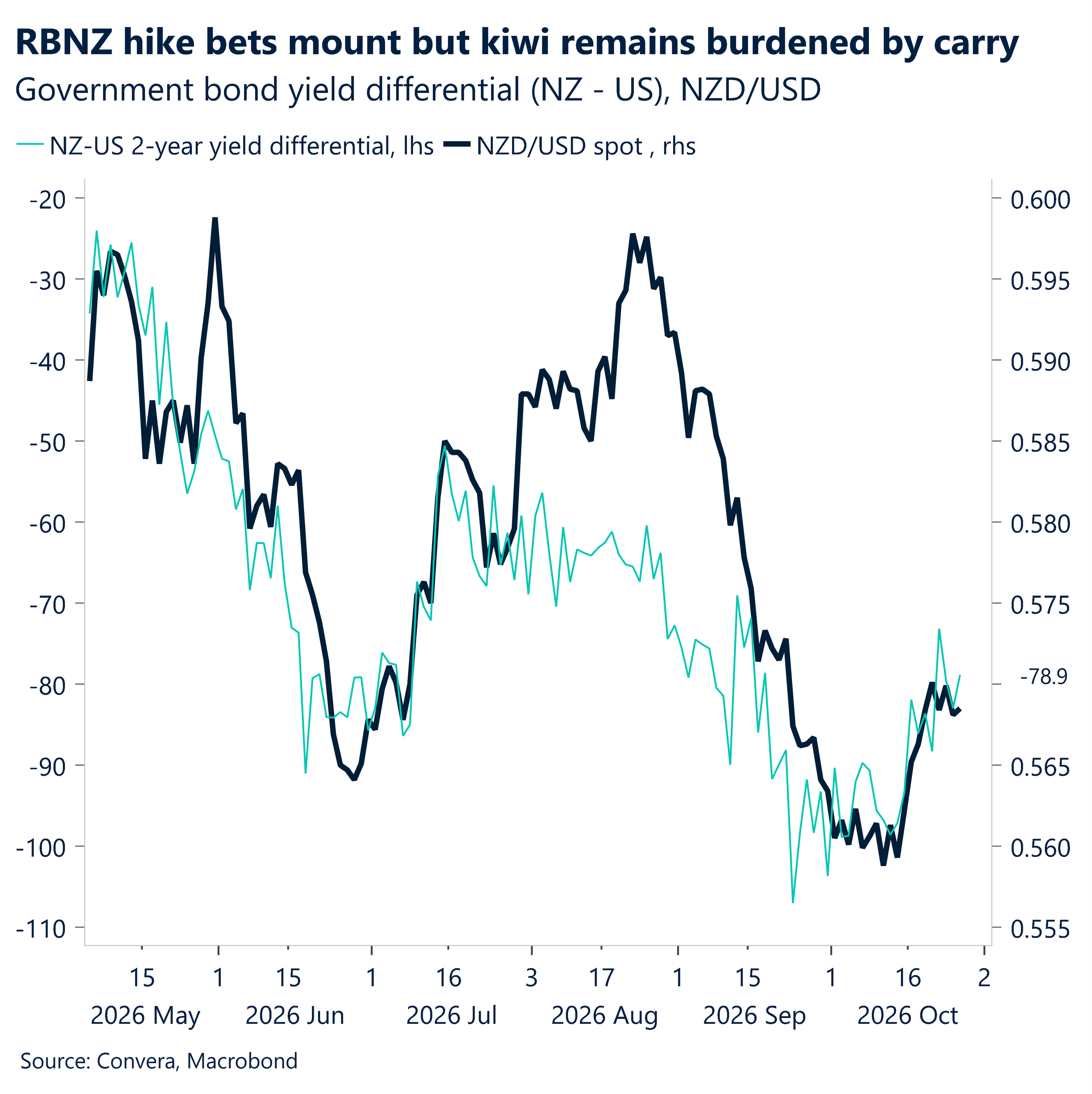
NZD/USD is holding near 0.568 ahead of consecutive RBNZ and Fed decisions, with markets pricing a 25-basis-point RBNZ hike to 3.00% as a near certainty. The decision itself may therefore have limited impact unless policymakers preserve the case for another move in December. Heavy speculative shorts leave room for a sharp squeeze if the RBNZ maintains a clear tightening bias, while anything short of the expected hike would expose the kiwi to immediate selling.
The larger constraint remains New Zealand’s rate disadvantage against the US. Two-year yields sit roughly 78 basis points below equivalent Treasuries, leaving the kiwi with negative carry even if the RBNZ delivers consecutive hikes. Sticky inflation, elevated energy costs and firm business confidence give policymakers room to tighten despite pressure on households ahead of the November election. Yet without a softer Fed stance, higher domestic rates alone are unlikely to turn a tactical kiwi rebound into a lasting recovery.
NZD/USD remains in a broader downtrend, with initial resistance between 0.571 and 0.575. A hawkish RBNZ hike followed by a patient Fed could trigger enough short covering to test that zone, while cautious RBNZ language or a firm Fed tightening signal could bring focus into the 0.549 support level. The outcome depends on both central banks: the RBNZ must preserve its tightening path while the Fed gives the kiwi’s negative carry room to narrow.
Market snapshot
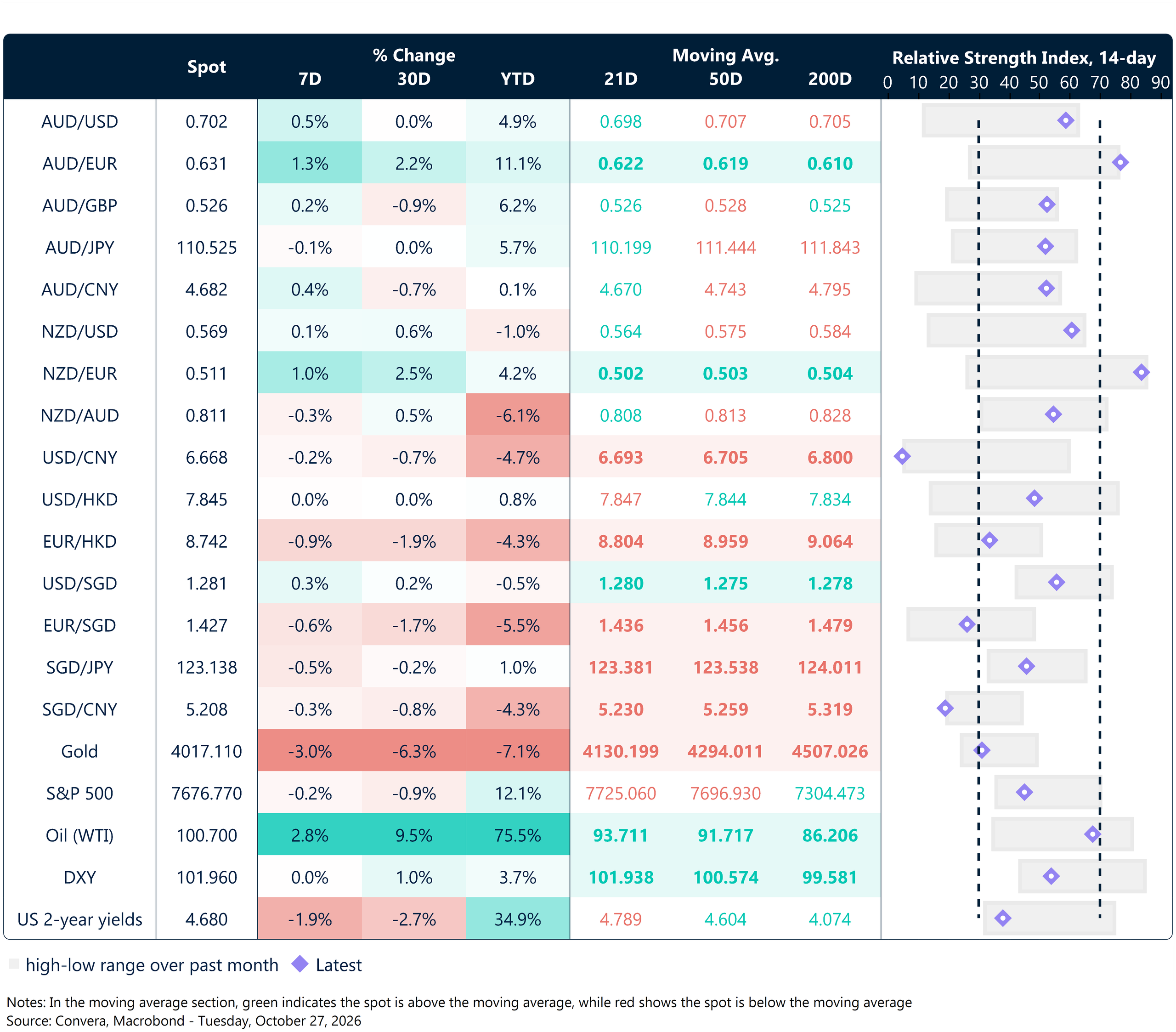
Table: Currency trends, trading ranges & technical indicators
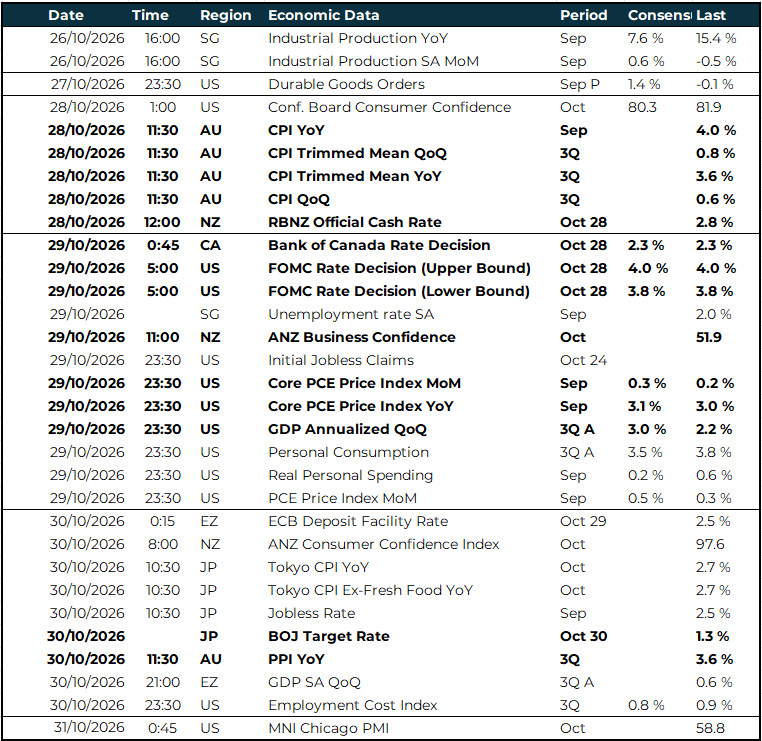
Key global risk events
Calendar: 26 – 31 October
Have a question? [email protected]
*The FX rates published are provided by Convera’s Market Insights team for research purposes only. The rates have a unique source and may not align to any live exchange rates quoted on other sites. They are not an indication of actual buy/sell rates, or a financial offer.