


USD: Fed, fiscal and oil risks remain supportive
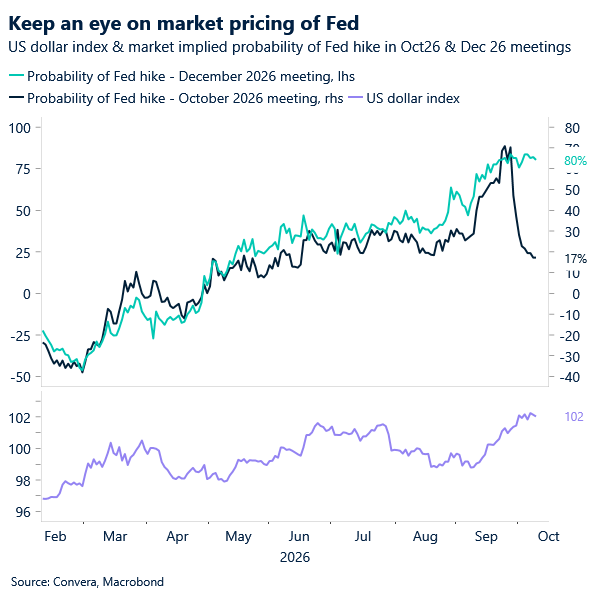
The US dollar is heading for a fourth consecutive weekly gain as hawkish Fed minutes, and renewed energy risks sustain its policy advantage. September’s FOMC minutes showed officials remain concerned that current rates are only modestly restrictive, lifting the implied probability of a December hike to 80%. Treasury yields rose across the curve, with the 10-year reaching 5.25% and the two-year 4.77%, keeping the dollar near three-month highs despite some consolidation following Governor Waller’s more flexible comments on timing.
Renewed attacks on vessels in the Strait of Hormuz added an energy-driven inflation risk as Brent crude approached $104 a barrel. The move in oil fed into Treasury yields by raising concern that another inflation impulse could prolong monetary tightening. President Trump’s decision to rule out strikes on Iran before the November midterms capped the immediate rise in crude but did not remove the supply risk. European fiscal stress has provided another layer of support by keeping EUR/USD under pressure near 1.12.
DXY is consolidating around 102 after clearing its October 1 intraday high of 102.2. The next resistance zone sits between 102.5 and 103, and a sustained break will require more than technical momentum. Monetary policy divergence, Middle East supply risks and European fiscal weakness provide a constructive backdrop, but a close above 103 would be needed to strengthen the case that the dollar has entered a more durable regime.
Next Wednesday’s US CPI report is the clearest catalyst, with annual inflation expected at 3.6%. A firm reading would reinforce December hike expectations and give the dollar another chance to clear resistance, while softer inflation could pull front-end yields lower and expose Waller’s timing caveat. Initial support sits near 101.5. Unless oil prices retreat sharply or inflation slows enough to challenge the Fed’s current stance, the dollar should remain supported into year-end.
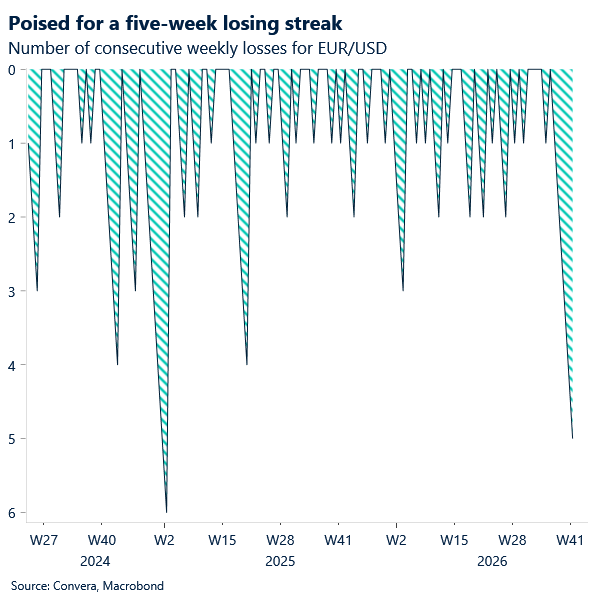
EUR: Five weekly declines on the trot
The euro has remained under pressure this week, with EUR/USD hovering near its lowest levels since May 2025. While the pair is becoming technically stretched and momentum indicators are moving out of oversold territory, the market’s focus remains firmly on European fiscal risks which show no sign of disappearing any time soon.
Concerns surrounding France’s budget negotiations and debt trajectory continue to dominate sentiment. The widening French-German yield spread, now at its widest since 2012, has revived memories of past eurozone fragmentation episodes and pushed sovereign spreads to the forefront of FX pricing. As a result, investors have become far more sensitive to political developments than to otherwise resilient eurozone growth data.
The ECB is offering limited support. Minutes from September’s meeting showed policymakers concerned about upside inflation risks, but equally aware of the growth implications of tighter financial conditions and elevated bond yields. Importantly, the discussion reflected a more balanced stance than President Lagarde’s post-meeting messaging implied, reinforcing the idea that the bar for further tightening is rising.
For EUR/USD, the key drivers remain energy prices, sovereign spreads and Fed expectations. Until confidence in French assets stabilises and concerns around broader eurozone contagion fade, rallies are likely to remain shallow. The euro may be oversold in the short term, but the underlying narrative remains challenging, leaving the balance of risks tilted lower despite the increasingly stretched technical backdrop.
GBP: Rangebound, but risks remain
Sterling has started the day relatively quietly, with the broader narrative largely unchanged. The pound remains caught between supportive carry dynamics and a more challenging external backdrop, as rising oil prices and softer risk sentiment continue to weigh on high-beta currencies.
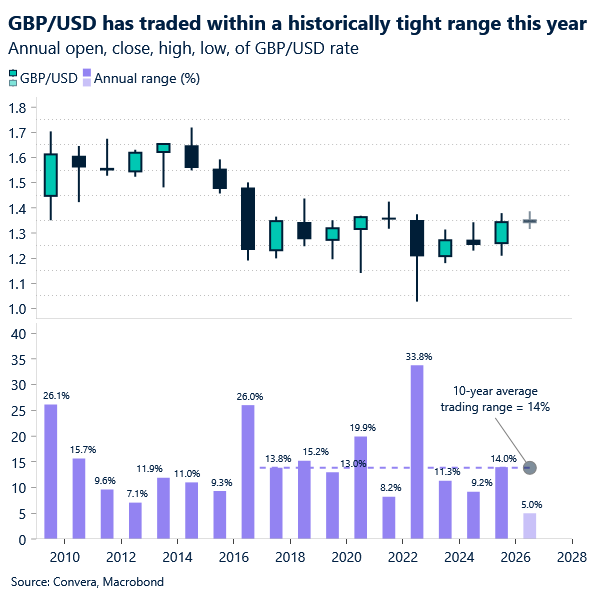
GBP/USD continues to hover around the 1.32 handle, keeping this year’s exceptionally tight trading range intact. Despite breaking lower in recent weeks, the pair has yet to deliver a decisive move beyond the boundaries that have largely contained it throughout 2026. That remains remarkable given the volatility seen elsewhere in rates and bond markets.
Against the euro, the story is more constructive, although momentum has faded somewhat. GBP/EUR has slipped back below 1.18 after briefly trading at levels occupied less than a quarter of the time over the past decade. Importantly, the pair has yet to establish a convincing foothold above 1.18, suggesting the recent rally remains more a function of euro weakness than a decisive re-rating of sterling.
Market snapshot
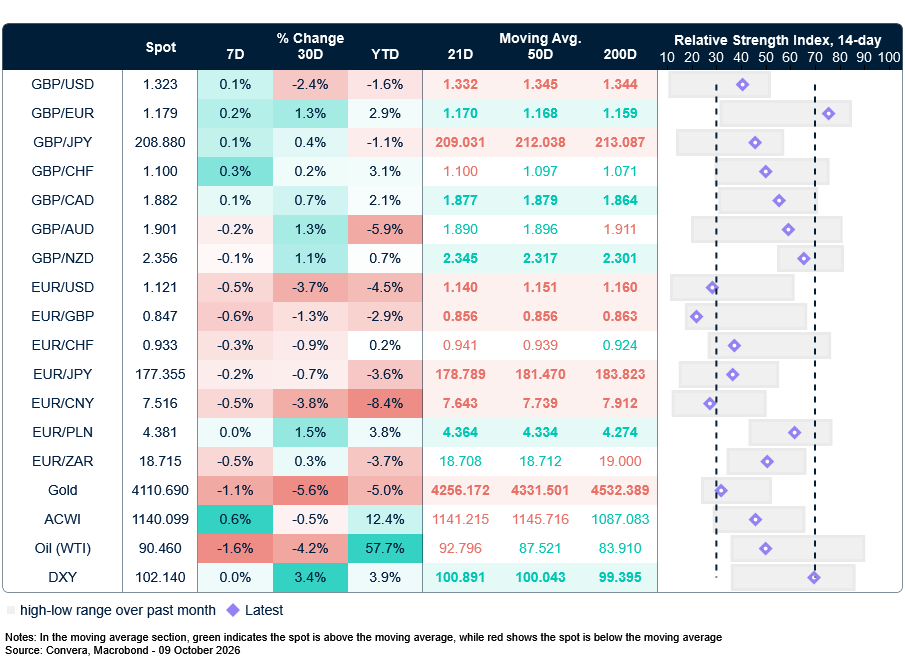
Table: Currency trends, trading ranges & technical indicators
Key global risk events
Calendar: October 05-09
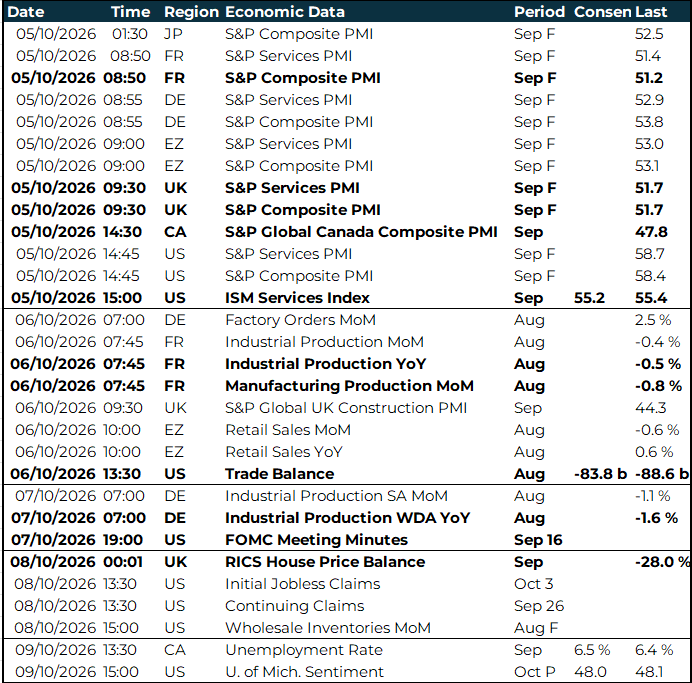
All times are in BST
Have a question? [email protected]
*The FX rates published are provided by Convera’s Market Insights team for research purposes only. The rates have a unique source and may not align to any live exchange rates quoted on other sites. They are not an indication of actual buy/sell rates, or a financial offer.