
Strong jobs report, but not strong enough
The recession calls for the United States continue to be pushed out in time on the back of stronger than expected economic data. The labor market in particular remains the beacon of hope for proponents of the soft landing scenario, in which the US would avoid recession while inflation would continue to ease. However, resilient macro data has also brought back the higher for longer narrative, with markets pricing out all rate cuts from the Fed for this year.
The US labor market report released on Friday has been quite mixed, even though the strong headline number has overshadowed the other secondary data points. The US economy added 339 thousand jobs in the month of May, beating economists’ expectations for the 14th consecutive time. The overall picture has been complicated by the rise in unemployment from 3.4% to 3.7%. Furthermore, the job quite rate, a good indicator of employees willingness to leave their current position, fell to pre-pandemic levels at 2.4%. Our US labor market index has therefore trended down in recent months, even against the backdrop of strong headline jobs growth.
Still, markets have focused more on the labor market than other, more cyclical and interest rate sensitive parts of the economy. The global manufacturing sector has fallen into recessionary territory, led by the US, Germany and China. The ISM purchasing manager index indicated that US manufacturing remained in contraction in May for a seventh consecutive month. We continue to believe that the policy tightening by the Fed and weakening of the manufacturing sector should start impacting labor markets as well going forward. The US jobs report was strong, but probably not strong enough to put a hike at the June meeting back on the table. This is the reason for the Greenback’s muted reaction to the release, with the US Dollar Index falling on the week for the first time since the beginning of May.

ECB in disbelieve about disinflation
The last week has also been shaped by a weaker than expected CPI report out of the Eurozone, confirming that core inflation has indeed peaked in March 2023. The gauge for underlying price pressures rose 5.3% during the last twelve months, down from 5.6% in April and 5.7% in March. While the progress in the fight against core inflation has been slow to materialize, broader price measures have already come down quite a lot. Headline inflation fell to 6.1%, reaching the lowest level since 2021.
Some policymakers have been quick to dismiss any kind of notion of a rate hiking pause in June or July or rate cutting speculations for next year. However, leaving aside some members of the governing council on the right (hawkish) side, a broader chorus of central bankers within the ECB has started talking about peak inflation and how most of the tightening has already occurred. With markets pricing out rate cuts by the Fed and not expecting any from the ECB in the next 6 months, the Euro has lost its positive short-term rate expectations differential.
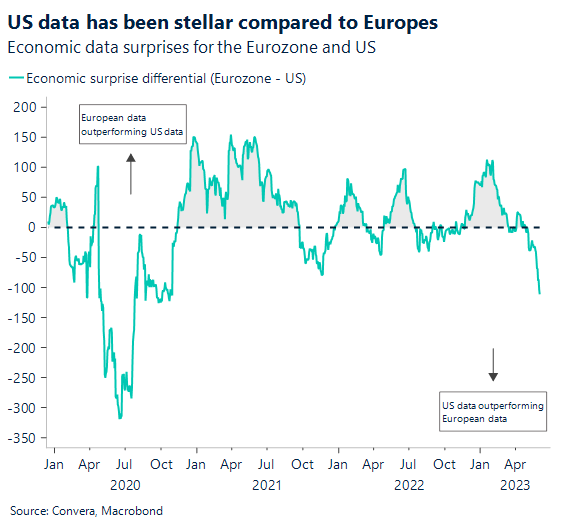
The real push higher for EUR/USD would have to wait for some time, as the differential starts building up again in the time-frame between the 7th and 24th month in the Fed funds futures and ECB deposit rate swaps. For this to happen, the European economy would have to hold up and not fall into a deeper recession that would force the ECB to cut rates earlier than what is now priced in. Macro data as of late has been favoring the Greenback, with the EZ-US economic surprise differential falling to the lowest level since October 2020. Despite that, EUR/USD has only fallen by 3.5% since peaking in April. This might be explained by a continued lack of conviction to move against the common currency, which finally benefits from a positive interest rate carry after years of negative yield.
Pound still benefits from post-CPI boom
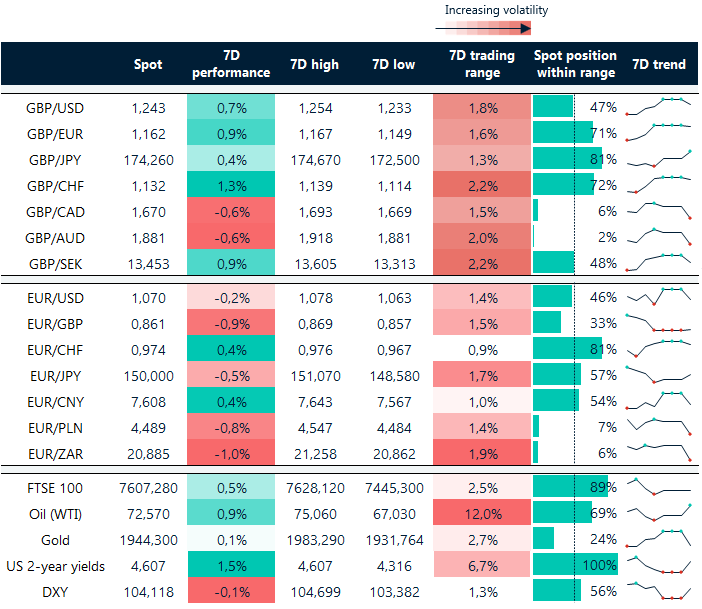
Economic data for the United Kingdom has been scares. But the British pound has benefited from investors’ attention shifting to core inflation, which increased to the highest level in 30 years in May. This stands in stark contrast to regions like the US and Eurozone, where underlying price pressures have eased marginally from their peaks reached in prior months. Markets have seen the latest CPI prints as a call to action for the Bank of England, with around 3-4 rate hikes priced in for the next 6 months. Prospects of higher interest rates have attracted buyers for the pound. GBP/EUR has risen seven weeks in a row to climb to a new yearly high at $1.1670. We have come down a bit since reaching the top on Thursday but remain well above the important $1.16 mark.
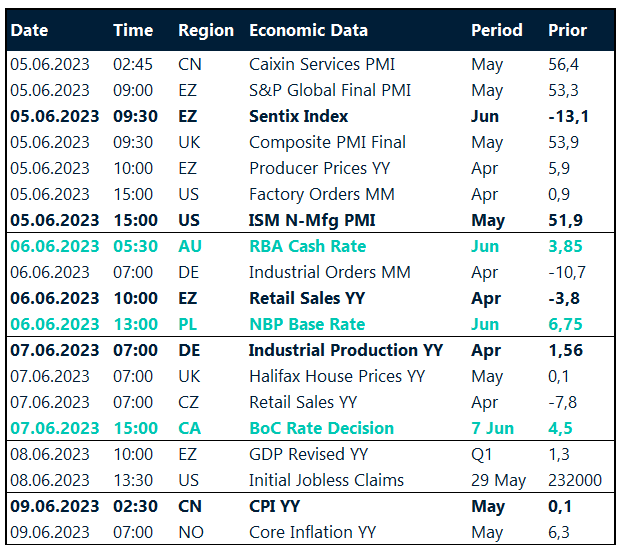
The British currency has had more difficulties against the Greenback but has successfully bounced back from the support line at $1.23 and is in the green year-to date (+2.9%). Looking forward to the upcoming week, the final release of the UK purchasing manager index today will find some attention. The main event will be the BRC retail sales monitor, which functions as a gauge on where consumer spending has been going. Last week showed how mortgage approvals of British households plunged in April, in line with higher financial rates and lower home prices. It will be interesting to see the BoE react to the weaker property market, as mortgage contracts of 1.6 million British households have yet to be rolled over.

EUR/USD fights for $1.07
Table: 7-day currency trends and trading ranges
Key global risk events
Calendar: June 05- June 09
Have a question? [email protected]
*The FX rates published are provided by Convera’s Market Insights team for research purposes only. The rates have a unique source and may not align to any live exchange rates quoted on other sites. They are not an indication of actual buy/sell rates, or a financial offer.