
USD: US dollar pays for treasury yield suppression
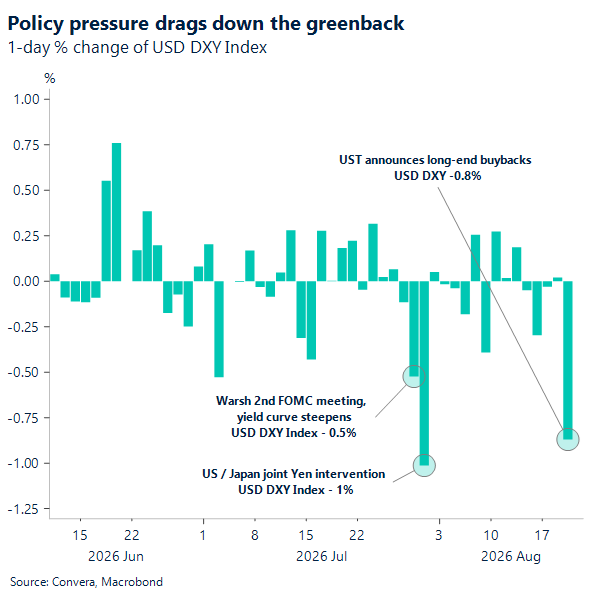
The US Treasury recently caught markets off guard by doubling its bond buybacks to at least $4 billion per operation. These accelerated purchases will officially begin on September 9 and run precisely through November 4. Interestingly, this sudden liquidity campaign conveniently wraps up the exact day after voters head to the midterm polls on November 3. Washington discovered a deep concern for bond market functioning right as rising mortgage rates threatened to anger the electorate. Consequently, this poorly disguised yield-suppression effort triggered an immediate and aggressive market reaction. Long-term yields tumbled, swap spreads widened sharply, and the US dollar suffered its largest single-day decline in weeks.
This aggressive Treasury intervention creates a remarkably complicated environment for the Federal Reserve. Fed Chairman Kevin Warsh famously urged markets to play the ball rather than the referee, but that proves difficult when the referee actively changes the rules mid-game. July FOMC minutes reveal many officials already worry that current financial conditions are far too loose to defeat inflation. Now, the Treasury is deploying its toolkit to suppress yields right when the Fed needs to accurately gauge restrictiveness. Suppressing long rates to juice the economy puts the two institutions at distinct cross-purposes. Ultimately, investors are left navigating higher inflation risks while questioning central bank autonomy, adding to the Fed’s independence premium at the long end—classic Catch-22.
To understand why yields pushed higher in the first place, we must look at the drastically shifting buyer base. The era of price-insensitive central banks blindly absorbing Treasuries is over, leaving private investors to drive marginal demand. These private buyers are highly sensitive to price and demand real compensation for taking on duration risk. Furthermore, Uncle Sam is now competing directly against deep-pocketed tech giants for global capital. Hyperscalers are issuing hundreds of billions in corporate bonds to fund the artificial intelligence boom, offering highly attractive spreads over government debt. This explosive AI investment cycle is actively pulling cheap credit away from the public sector.
Beneath these shifting buyer dynamics lies the ultimate force anchoring yields higher, which is robust nominal economic growth. When real economic expansion combines with sticky inflation, long-term interest rates naturally adjust upward to reflect that broader reality. For years, quantitative easing allowed yields to remain artificially suppressed far below the nominal growth rate. Now that the global economy is accelerating in nominal terms, bond yields are simply catching up to the hard data. Policymakers desperately want the combination of a booming economy and cheap borrowing costs, but financial markets eventually enforce basic arithmetic. You simply cannot maintain structurally lower yields unless you are willing to accept much weaker economic demand. Or avoid wars in key global energy chokepoints.
When viewed together, recent policy announcements have delivered a direct, cumulative blow to the US dollar, as illustrated below. From the curve steepening after Warsh’s second FOMC meeting (-0.5%) to the joint US-Japan Yen intervention (-1.0%) and the latest buybacks (-0.8%), each step has systematically undercut greenback strength. There is no grand strategy at play here—part of this stems from the unintended consequences of Fed Chair Warsh’s “zero guidance” stance, while the rest reflects an administration trying to contain Middle East fallout and steady the bond market ahead of the midterms. Social media has only amplified the noise by treating record debt figures as if they were a new revelation. Ultimately, engineering artificially lower borrowing costs to appease voters comes with a clear trade-off, forcing the US dollar to absorb the full brunt of domestic policy priorities. Because the dollar remains heavily anchored to Treasury yields, this political suppression inherently caps the currency’s upside, ensuring that hard economic data—rather than central bank rhetoric—will dictate the greenback’s true floor.
EUR: Dollar story strikes again
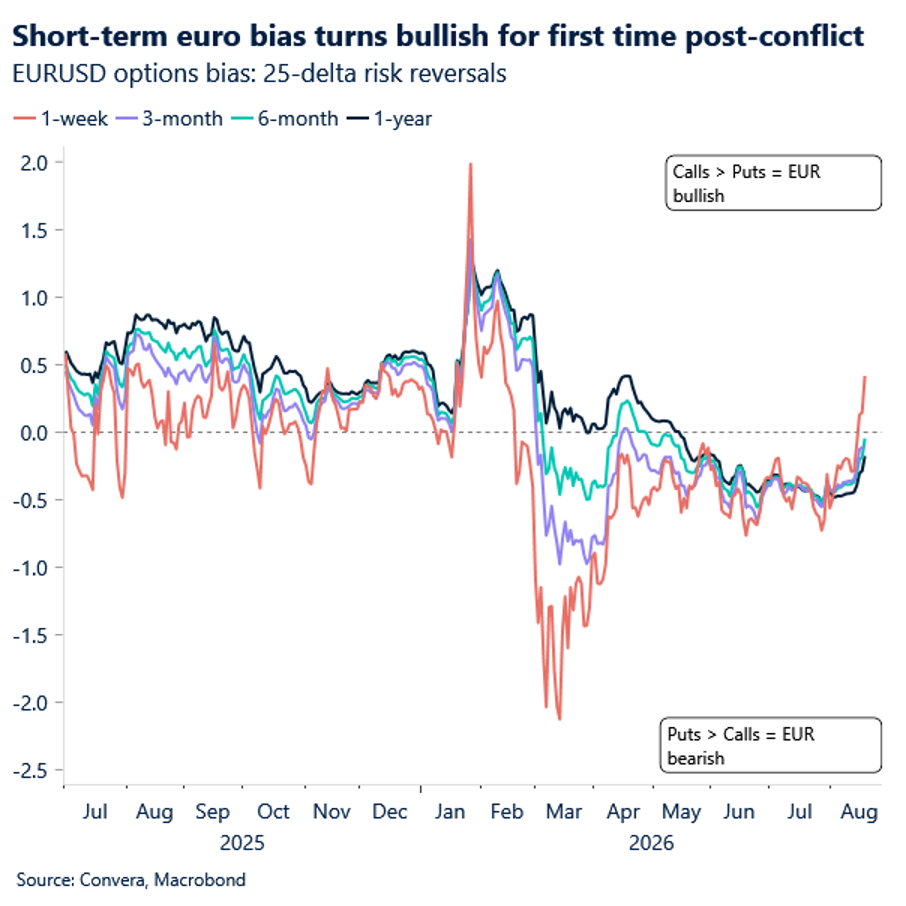
EUR/USD surged through the 1.16 resistance level on Wednesday, posting its largest daily gain since mid‑March. Yet, as has so often been the case in recent months, the move was driven less by anything happening in Europe and more by developments in the US.
The catalyst was the US Treasury’s surprise decision to double the size of its buyback programme, a move that helped pull Treasury yields lower and weighed on the dollar. Combined with recent signs of softer US economic momentum, the announcement reinforced expectations that US rates may be nearing their peak, providing a boost to EUR/USD through the rate differential channel.
The move also comes against a backdrop of increasingly supportive eurozone data, helping to maintain expectations for a September ECB rate hike. However, as we have argued throughout the summer, the euro’s gains continue to rely heavily on the dollar side of the equation.
Indeed, even as the eurozone growth outlook improves, EUR/USD remains more sensitive to shifts in US rates and policy expectations. That was evident again this week, with the break above 1.16 occurring on a distinctly dollar-negative catalyst rather than any major euro-positive development.
For now, momentum has clearly improved and the technical picture looks healthier. EUR/USD recorded its first daily close above the 200‑day moving average since May, a constructive signal that suggests the summer recovery still has room to run. That said, the daily RSI is now in overbought territory, indicating that upside momentum may need a period of consolidation before extending further. But whether EUR/USD can build on the breakout will likely depend on whether dollar weakness persists rather than the euro finding a new source of domestic support.
GBP: GBP beats the dollar, lags the rest
GBP/USD climbed to a three-month high of 1.3630 yesterday as the dollar softened. Markets interpreted an unexpected announcement from the US Treasury to expand its debt buyback programme as a sign that the administration is growing concerned about rising long-end borrowing costs. The dollar took a hit on sentiment, while long-dated Treasuries rallied (read more in USD section above).
This theme is likely here to stay. The intervention remains surgical, while the forces pushing long-end yields higher are far more structural: rising debt burdens, sticky inflation pressures and lingering questions around Fed leadership. A weaker dollar is likely to remain collateral damage, particularly as 2025 strengthened the link between waning confidence in US institutions, the dollar and the broader debasement trade.
That said, we would not chase further GBP/USD upside beyond 1.36 in the coming days on this theme alone. The Fed outlook remains the clearest near-term driver of the pair, and we see few catalysts between now and the end of the week that could materially reshape GBP/USD rate differentials.
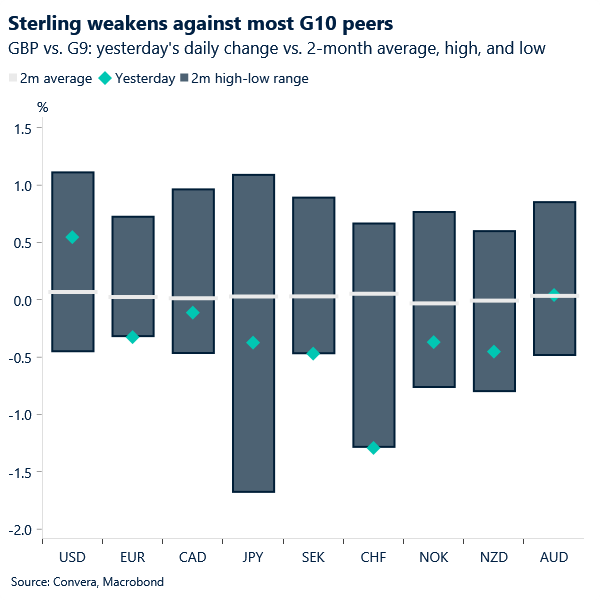
Elsewhere, sterling was moderately softer against the broader G10 complex, with GBP/EUR near two-week lows. An inflation report that largely matched expectations further eroded what little remained of September rate-hike bets for the BoE, now priced at just 13%. The jump in headline inflation was broadly anticipated, while a more benign underlying inflation backdrop reinforced the BoE’s wait-and-see stance.
Even so, with BoE and ECB expectations for September at opposite ends of the spectrum, with a hold priced for the BoE and a hike for the ECB, the risk for more sustained GBP/EUR downside on additional rates spread narrowing appears more contained. As such, we would expect near-term buying interest to emerge around the 1.1650 level.
Market snapshot
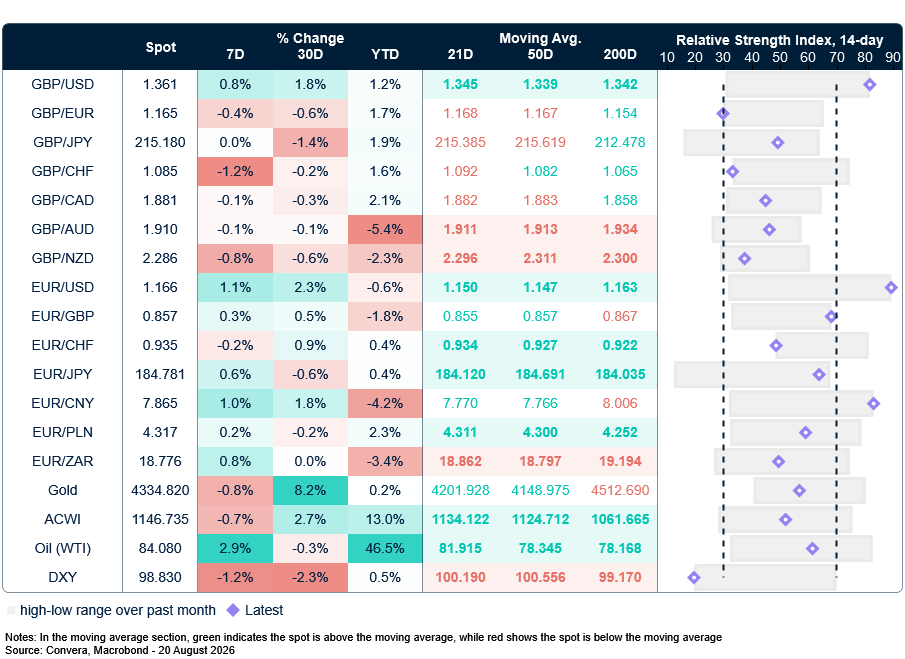
Table: Currency trends, trading ranges & technical indicators
Key global risk events
Calendar: August 17-21
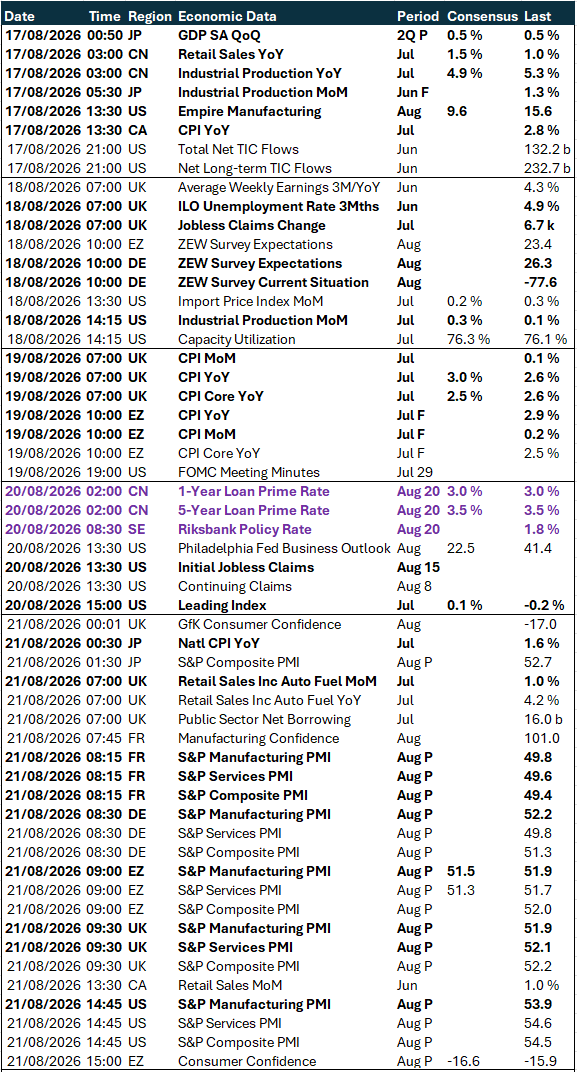
All times are in BST
Have a question? [email protected]
*The FX rates published are provided by Convera’s Market Insights team for research purposes only. The rates have a unique source and may not align to any live exchange rates quoted on other sites. They are not an indication of actual buy/sell rates, or a financial offer.