


Aussie at one-week highs in positive start to Monday trade
The Australian and NZ dollars jumped on Monday morning as markets reacted to news that a US-Iran peace deal is close.
A US official told the New York Times that the US and Iran have agreed “in principle” to a deal, but approval from both countries’ leaders may take several days.
However, the US Navy continued to block ships from using Iranian ports on Sunday, and the Strait of Hormuz remains effectively closed.
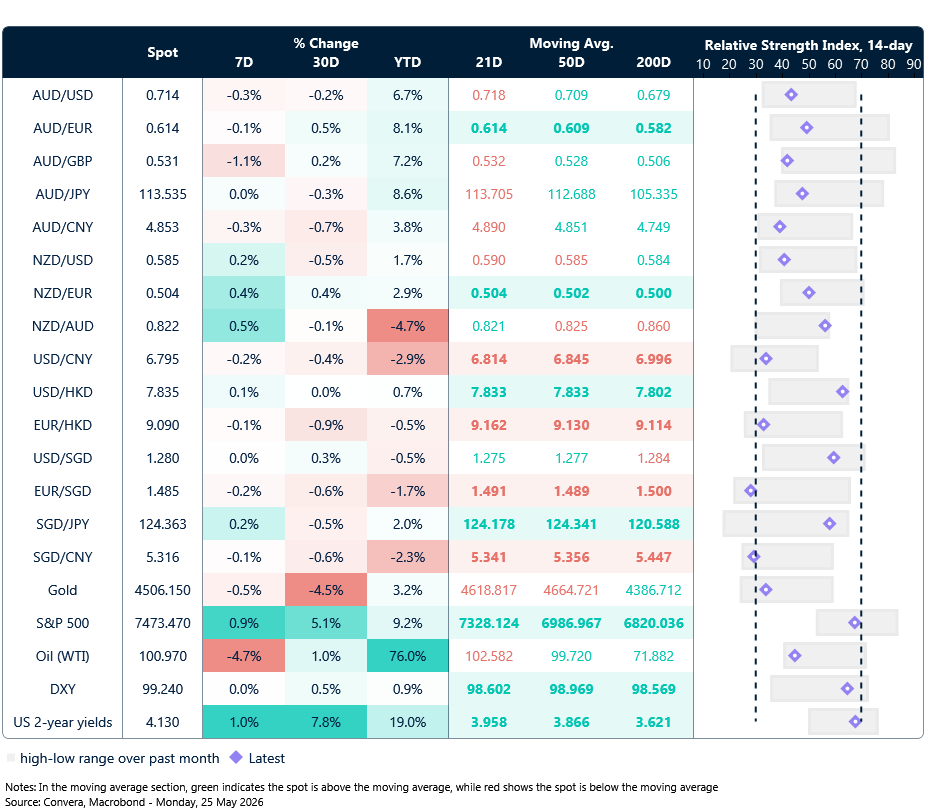
Global markets took the news positively in early Monday trading, with AUD/USD up 0.4% and NZD/USD up 0.5%.
In Asia, USD/JPY fell 0.2%, while USD/CNH and USD/SGD each lost 0.1%.
Crude oil fell about 5.0%, but stock market futures are yet to trade, with the UK and US closed for public holidays on Monday.
Japan inflation slips, clouding the rate hike picture
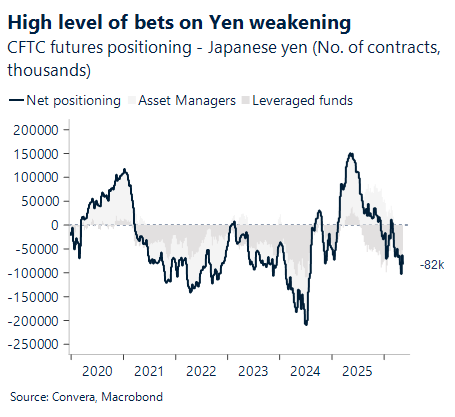
Japan’s core inflation eased to 1.4% in April from 1.8% — the lowest since March 2022 — with all three gauges now below the Bank of Japan’s 2% target. This complicates the case for early rate hikes, though solid growth and a weak yen keep tightening on the table. The market, however, is pricing a 78% likelihood of a June rate hike.
Japanese government bond yields have pulled back from their highs after US President Donald Trump’s latest comments lifted hopes of a near-term resumption of energy flows through the Strait of Hormuz. The 10-year JGB yield still hovers near 29-year highs at 2.76%, supported by rising inflation expectations, spillovers from global rate moves and lingering fiscal concerns.
USD/JPY holds above 159.00 at the time of writing, around 1% below its 30 April high of 160.72. The 21-day EMA near 158.44 and the 50-day EMA at 158.26 offer support, while 160.00 is key resistance.
AUD/JPY remains just below 36-year highs, while NZD/JPY trades only 1.5% below two-year highs. SGD/JPY has climbed to a three-week high and remains near all-time highs.
Singapore sets the tone, US data seals the deal
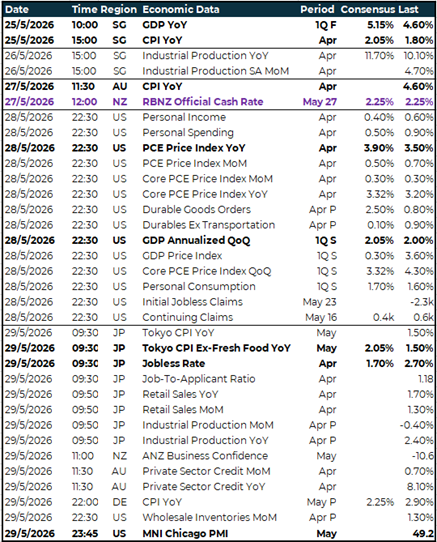
The week opens with Singapore in focus. The final Q1 GDP print and April CPI are released together; a dual read on growth and inflation that will calibrate SGD positioning and test MAS policy settings.
Tuesday is quieter, with Singapore’s April industrial production the sole release — a secondary check on trade-sector momentum.
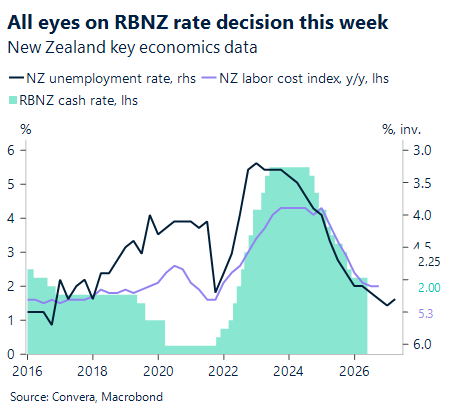
Australia’s April CPI follows mid-morning, a key input for RBA rate expectations. Shortly after, the RBNZ delivers its May decision, with markets pricing a hold at 2.25%. Any surprise or change in guidance could drive sharp NZD moves.
Thursday is the week’s key event. The US Q1 GDP second estimate and April PCE inflation data are released together, combining a growth revision with the Fed’s preferred inflation gauge to give a decisive read on USD direction.
Friday rounds out the week with Japan’s Tokyo CPI and labour data shaping BoJ expectations, alongside Germany’s flash CPI and US Chicago PMI.
Aussie, kiwi boosted by peace hopes
Table: seven-day rolling currency trends and trading ranges
Key global risk events
Calendar: 25 – 29 May
Have a question? [email protected]
*The FX rates published are provided by Convera’s Market Insights team for research purposes only. The rates have a unique source and may not align to any live exchange rates quoted on other sites. They are not an indication of actual buy/sell rates, or a financial offer.