
Aussie lower on China disappointment
Global FX markets were quieter than usual overnight with the US closed for the Martin Luther King Jr holiday.
The US dollar was mostly higher with the largest losses seen in the Australian dollar and Japanese yen.
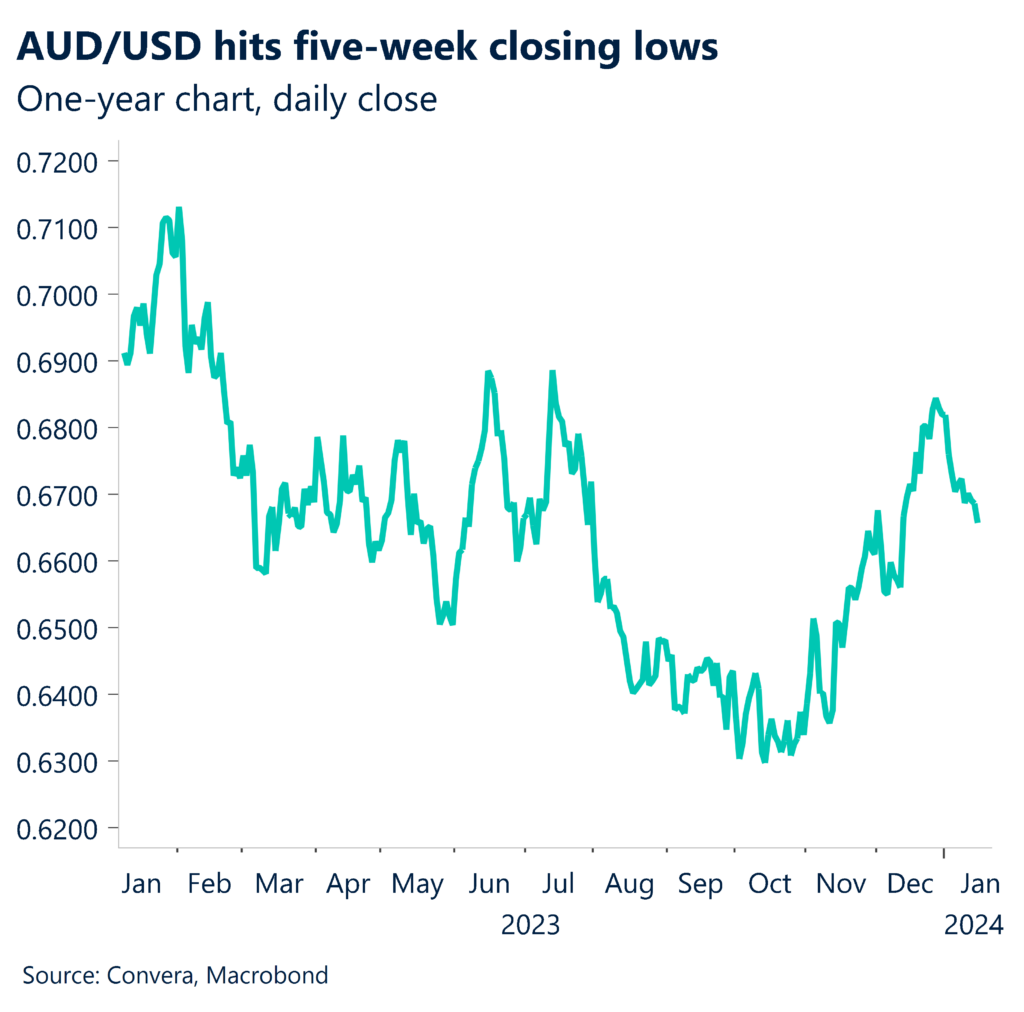
The Australian dollar was weaker with markets disappointed the People’s Bank of China did not cut its key medium-term lending facility yesterday – instead the PBOC introduced some new liquidity operations.
FX markets had hoped Chinese authorities would start the new year with new stimulus.
The AUD/USD fell 0.5% as it neared five-week lows.
The Japanese yen was also weaker with the USD/JPY up 0.6%.
On the other hand, the Chinese yuan received a small boost from the decision to keep Chinese rates steady, with the USD/CNH down 0.1%.
All eyes on US manufacturing
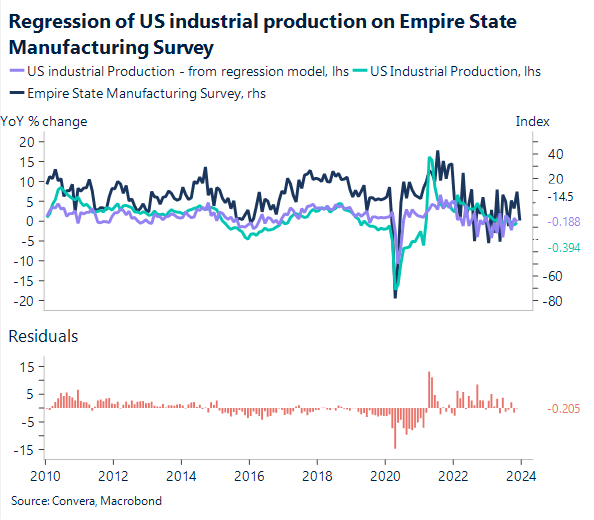
The US returns tonight with all eyes on the latest manufacturing data. The Empire State manufacturing survey is forecast to increase by 9.5 points to -5 in January. The survey has been erratic over the last two years, but as tighter lending conditions put pressure on output, we anticipate that it will finally consolidate in contractionary territory. Three months in a row, the new orders index has decreased, which is probably bad news for upcoming output.
In the end, the development of data will continue to present two-way risks for the FX market, despite the efforts of certain Fed officials to moderate the overall dovish message to little effect.
Furthermore, risk aversion may temporarily strengthen the USD in the event that growth begins to stall more noticeably, especially when compared to higher beta currencies. For the time being, other anticipated concerns pertaining to US elections, commodity prices, and global economy are still there.
Euro supported ahead of ZEW numbers
The euro held up better than most other currencies overnight ahead of key German data. The January German ZEW study will likely find contradictory findings: while expectations may drop by 3.9 points to 8.9, present conditions will only slightly improve, increasing by 0.1 points to -77.
The German Sentix poll, in contrast, revealed current conditions sidestepping and a persistent decline in the expectations component, whereas the Sentix survey for the euro area indicated improvements in both subcomponents.
Short-term weakness in the EUR might result from later and slower central bank rate decreases compared to the aggressive market pricing. The EUR may be affected by a correction as risk values appear bloated.
However, the EUR may increase considerably more than we anticipate if Eurozone GDP surprises to the upside, especially when contrasted to extremely low expectations, or if the ECB lowers rates significantly later or slower than the Fed, despite the market pricing both moves roughly the same. The risks for a stronger EUR remain.

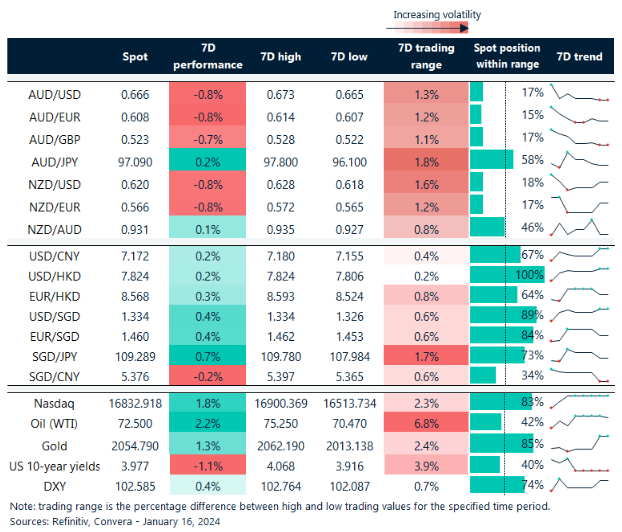
Aussie, JPY weakest. GBP also lower
Table: seven-day rolling currency trends and trading ranges
Key global risk events
Calendar: 15 – 20 January

All times AEDT
Have a question? [email protected]
*The FX rates published are provided by Convera’s Market Insights team for research purposes only. The rates have a unique source and may not align to any live exchange rates quoted on other sites. They are not an indication of actual buy/sell rates, or a financial offer.