


Aussie pushes to highs
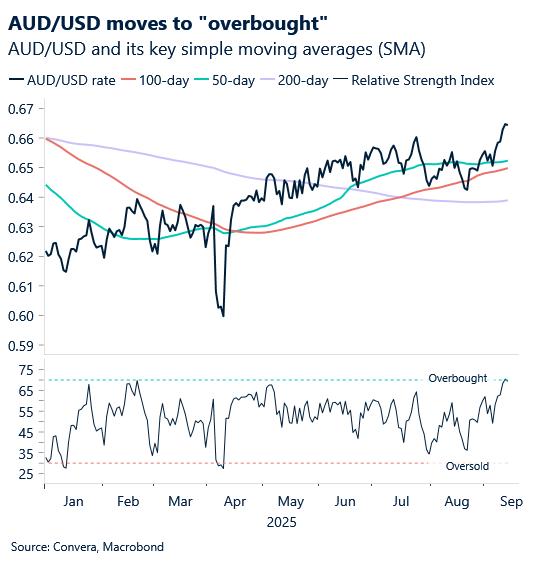
The Australian dollar surged to a ten-month high early Tuesday as markets continued to drive the US dollar lower.
Investors are confident the US Federal Reserve will cut rates by 25 basis points—possibly more—when it announces its decision Wednesday night.
All three major US sharemarkets closed higher, with the tech-heavy Nasdaq gaining 0.9%.
The AUD/USD rose 0.3%, reaching its highest level since 8 November, despite more disappointing data out of China. August retail sales, industrial production, and fixed asset investment all missed expectations.
The Aussie’s move higher is now stretched, with the relative strength index signalling the move is “overbought”, which can sometimes precede a technical reversal.
Kiwi struggles as services slump deepens
New Zealand’s services sector contracted for the 18th consecutive month in August, according to BNZ data released Monday.
The performance index fell 1.4 points to 47.5, well below the long-term average of 52.9. A reading below 50 signals contraction.
Negative sentiment ticked up, with 60% of survey responses expressing concern. Key indicators like sales (46.2), new orders (47.8), and employment (48.3) remained in the red.
Businesses cited inflation, high borrowing costs, rising living expenses, and weak consumer confidence as major drags on demand, alongside seasonal slowdowns and supply chain disruptions.
The kiwi hovered near the 0.6000 mark last week, brushing against overbought territory. Traders are watching the 21-day EMA at 0.5918 for support.
All eyes now turn to this week’s Fed meeting, which could shake up the Kiwi’s next move.

Yuan under pressure as China’s growth slows
China’s economy showed further signs of strain in August.
Industrial output rose 5.2% year-on-year, missing expectations for a 5.7% gain. Retail sales grew just 3.4%, below the 3.9% forecast. Fixed asset investment edged up only 0.5% from January to August, well short of the 1.4% consensus.
Housing continues to weigh on growth, with new home prices falling another 0.3% month-on-month, the fourth straight monthly decline. The annual pace of price drops eased slightly to 2.5%, down from 2.8% in July.
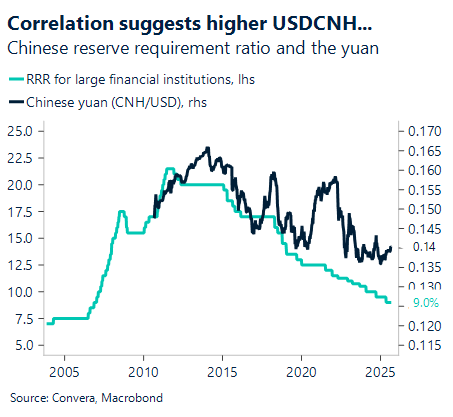
With little sign of bold policy support from Beijing, the yuan remains vulnerable.
China’s central bank appears more tolerant of a weaker currency, and state banks may only intervene if the dollar softens.
Traders are watching the 21-day EMA at 7.1398, followed by the 50-day EMA at 7.1600 as key levels for dollar-yuan movement.
Aussie reverses from highs
Table: seven-day rolling currency trends and trading ranges

Key global risk events
Calendar: 15 – 19 September
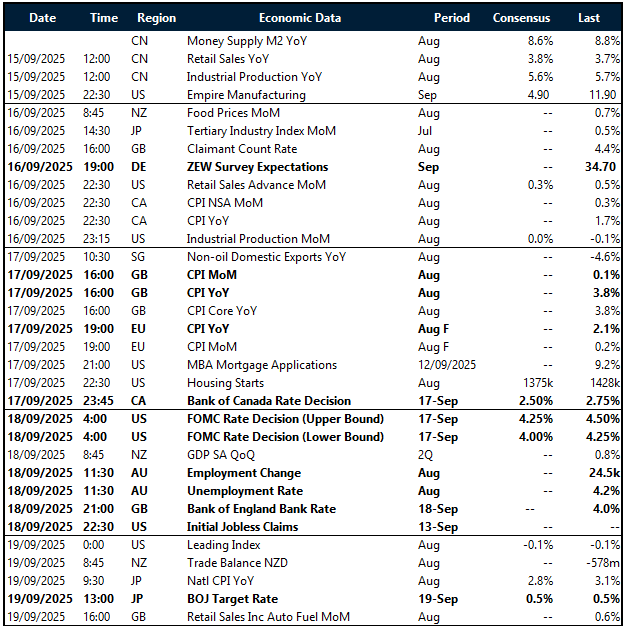
All times AEST
Have a question? [email protected]
*The FX rates published are provided by Convera’s Market Insights team for research purposes only. The rates have a unique source and may not align to any live exchange rates quoted on other sites. They are not an indication of actual buy/sell rates, or a financial offer a unique source and may not align to any live exchange rates quoted on other sites. They are not an indication of actual buy/sell rates, or a financial offer.