

The global economy is ending 2026 in better shape than many expected, despite energy shocks and sticky inflation. Global economic data beat consensus expectations for the longest run since the recovery from the 2008 financial crisis. But beneath the stronger-than-expected numbers, new risks are building.
Our new report, Are You Ready for 2027?, sets out Convera’s global economic outlook for the year ahead. Download it today to get an in-depth look at the 2027 base case and what it means for businesses managing currency exposure.
A 2026 recap: What changed
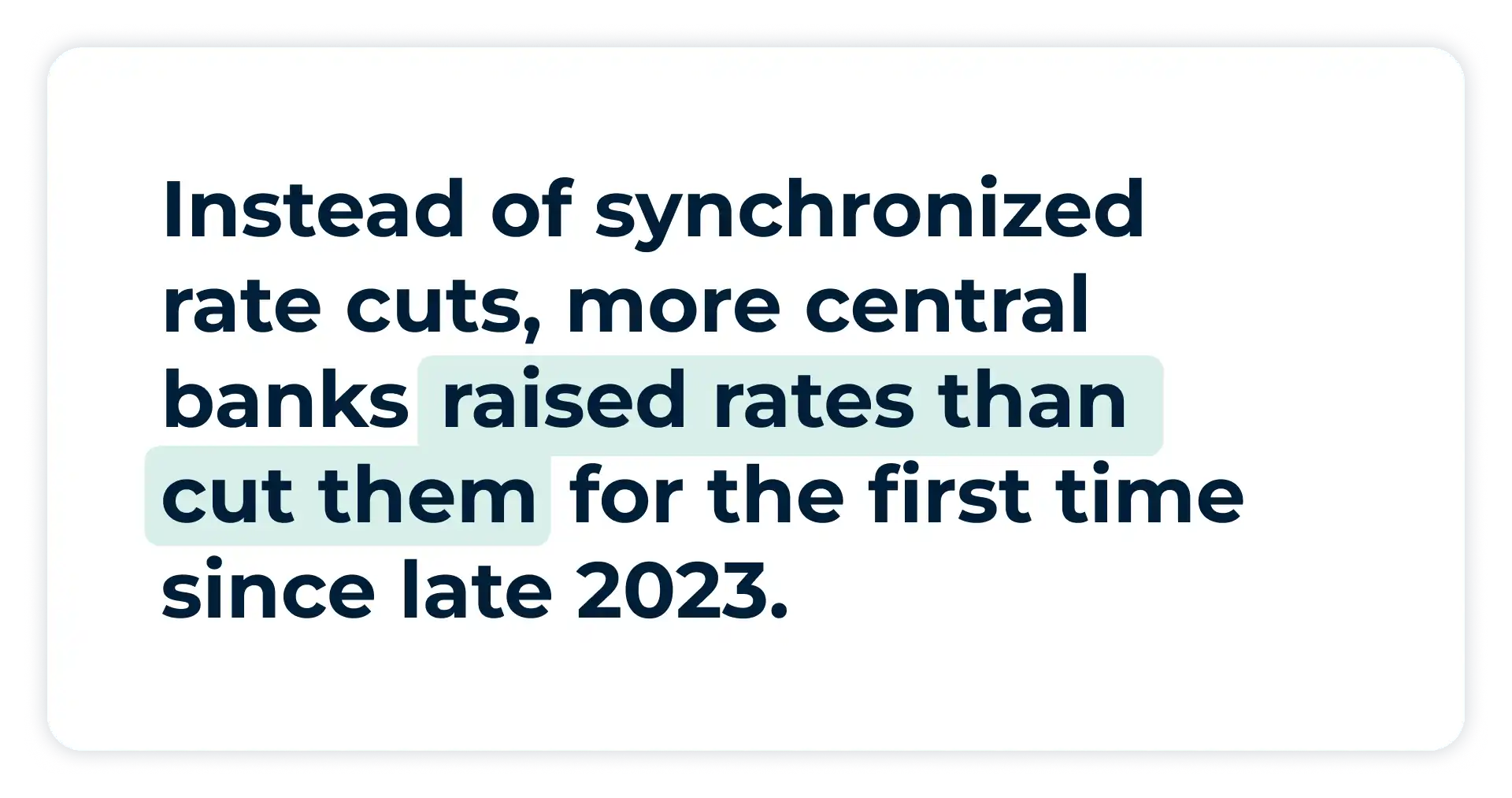
Entering 2026, we expected tariffs to slow global growth, with lower inflation and easier monetary policy softening the blow. Growth broadly followed this path, but the forces shaping the economy shifted. AI-led investment passed $1 trillion, and the closure of the Strait of Hormuz triggered an energy shock that stalled disinflation. Instead of synchronized rate cuts, more central banks raised rates than cut them for the first time since late 2023.
Policy, supply shocks, and fiscal strain
The 2010s were a decade of low growth and cheap money; the 2020s look different. Governments are increasingly prioritizing economic security over efficiency, using tariffs, reshoring, defense spending, and energy policy to advance strategic goals. That has made major economies more resilient, but it has also raised costs and fragmented trade.
Supply shocks are becoming a bigger part of the picture. The Strait of Hormuz carries roughly one-fifth of oil and liquefied natural gas (LNG) trade — and when it closed, energy-importing economies faced both higher costs and weaker currencies. Our report looks at how trade chokepoints move energy prices and foreign exchange rates.
Businesses also have to contend with policy threats that may never become reality. Markets learned to bet that aggressive policy threats would be walked back, but businesses making decisions months in advance can’t make that assumption. Meanwhile, government support has come at a cost. US federal debt has passed $40 trillion, up by roughly one-third in under five years, and federal interest payments now exceed defense spending. The question is no longer just how much governments can borrow, but how much they’ll have to pay for it.
Capital competition and borrowing costs
The defining theme of our 2027 global macro outlook is the competition for capital. Governments, AI developers, energy projects, and strategic industries are all competing for the same pool of global savings.
That competition can push up the term premium — the extra yield investors demand to hold long-term debt — raising borrowing costs for governments and companies alike. AI data center investment alone is set to run into the trillions this decade. As a result, businesses now compete not just for customers, but also for the capital they need to grow.
Global economic outlook: The 2027 base case
Our base case is for global growth to strengthen modestly in 2027 as the drag from the energy shock fades and supply chains continue to adjust. Inflation should ease, giving central banks more room to cut, though interest rates are unlikely to return to pre-pandemic lows.
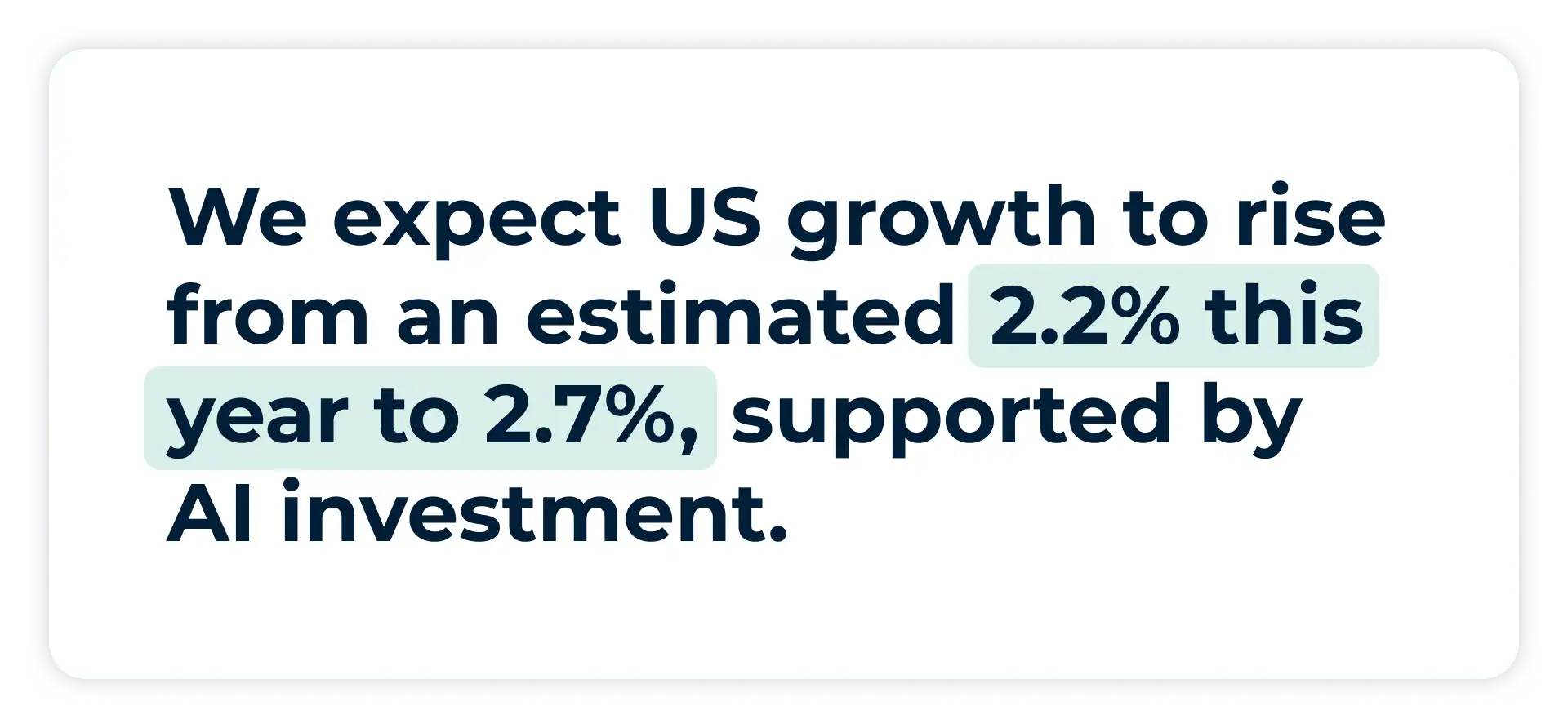
Growth will be uneven. We expect US growth to rise from an estimated 2.2% this year to 2.7%, supported by AI investment, while eurozone growth picks up to 1.4% as inflation eases. China should grow 4.5%, and the UK is the outlier among major economies at 0.9%.
But lower policy rates won’t necessarily mean lower borrowing costs. We expect the US Fed to cut to 3.00–3.25%, yet US 10-year yields to stay near 4.5%. Across most economies we track, long-term yields are expected to hold steady or rise even as policy rates fall. The gap reflects the competition for capital.
Key risks to growth and yields
Several risks could upset our 2027 outlook. Another energy shock, geopolitical escalation, or extreme weather event could reignite inflation and delay interest rate cuts.
Meanwhile, heavy government borrowing is putting more pressure on bond markets. Long-term yields could rise even without central bank action, making it more expensive for businesses to borrow. Add in the enormous capital demands of AI infrastructure, and financing costs may remain well above pre-pandemic levels.
Foreign exchange risk for corporates
Higher US yields used to support the dollar fairly consistently — but now, the reason yields rise matters as much as the direction.
Yields driven by growth and credible monetary policy tend to help the dollar, while yields driven by heavy government borrowing or policy uncertainty offer weaker support. The dollar keeps its liquidity and yield advantage, but the USD outlook for 2027 depends on confidence in policymaking as much as on interest rate differentials.
For businesses, foreign exchange risk can arrive well before a policy outcome is clear. Currency swings during negotiations can hit margins and cash flows, and a late compromise doesn’t reverse costs that were already incurred.
Currency risk management in 2027
With so much uncertainty around the 2027 outlook, businesses need FX strategies that account for multiple scenarios.
Currency risk management in 2027 can include:
- Scenario-based rolling forecasts that test different exchange rates and funding costs
- Layered hedging that reduces dependence on a single market level or policy date
- Flexible pricing and liquidity buffers to protect margins when volatility arrives early
Faster payments can improve cash flow, but they can’t protect a business from exchange rate movements. Protecting against currency movements requires a hedging strategy aligned with the timing of payments and the underlying currency exposure.
Get access to Convera’s full global economic outlook in Are You Ready for 2027?