
A decade of payments innovation — from real-time rails to stablecoins and richer standards — has solved many of the operational problems businesses once tolerated. However, none of these innovations addresses currency risk.
Convera’s newest report, The Volatility Gap: Why payments innovation doesn’t solve currency risk, explores the divide between how efficiently money moves across borders and how effectively businesses protect its value when it’s due. Download your copy today.
What is the volatility gap and why does it exist?
The volatility gap is exactly this divide. It’s the difference between moving money efficiently across borders and protecting its value.
For much of the last decade, businesses could expand into familiar markets and transact primarily in dollars or euros, treating basic currency controls as sufficient. But now, rising interest rates, shifting trade policy, and geopolitical tension have closed that window.
The volatility gap is the exposure that remains even after payments become more efficient. This is exposure that a fast rail does not reduce. When businesses treat payments and currency risk as separate functions, they can absorb FX losses that speed and cost savings can’t offset.
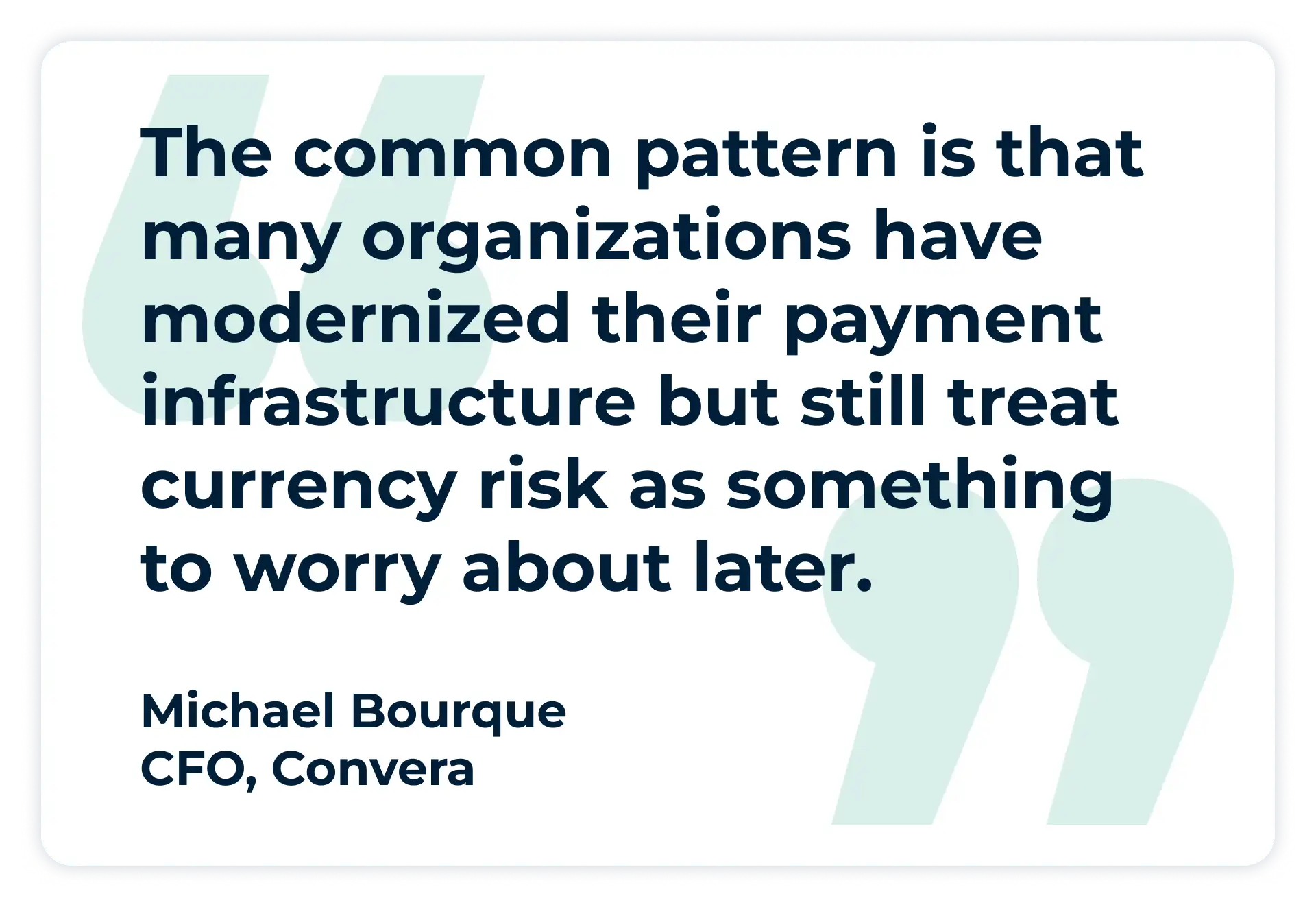
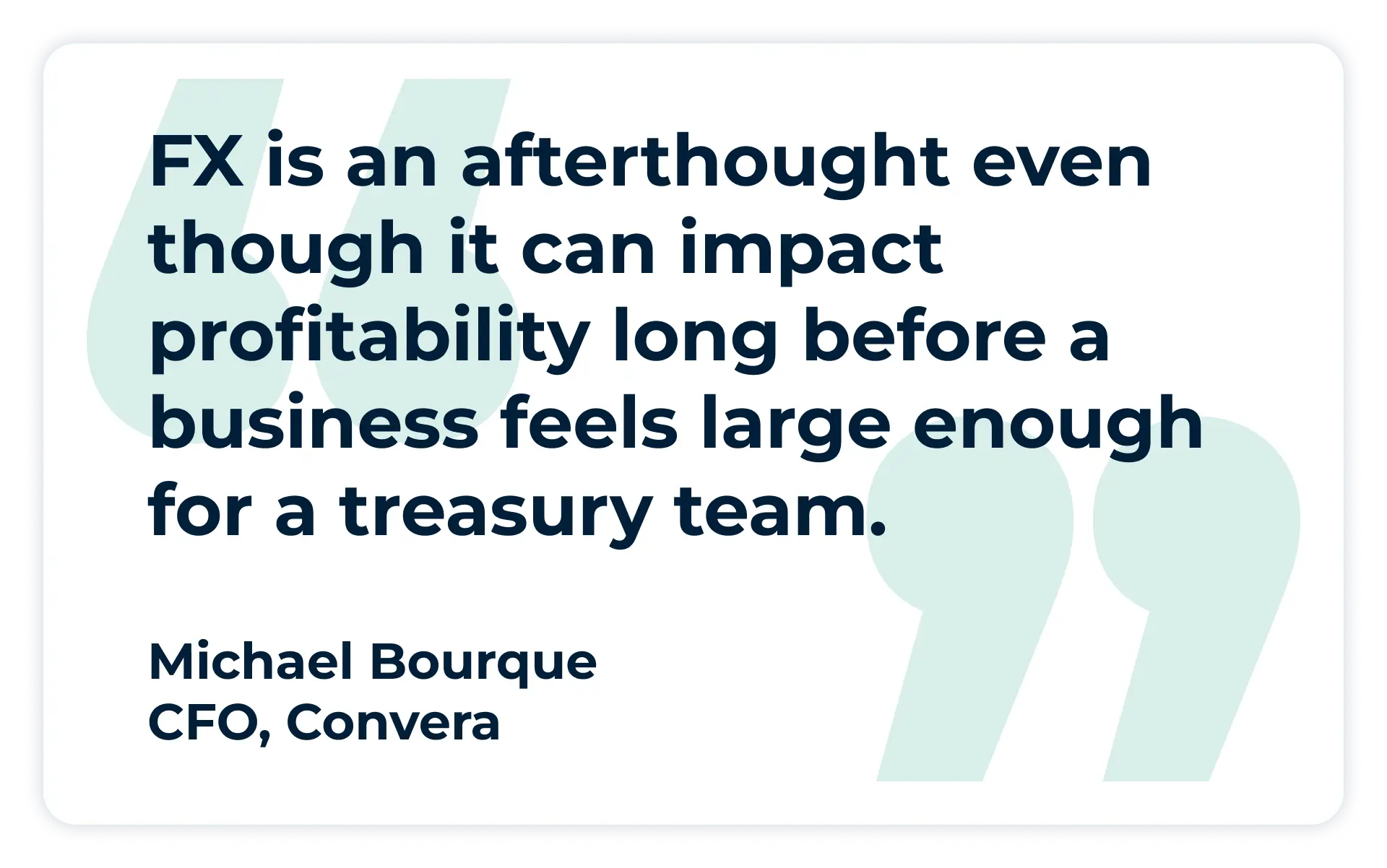
“The common pattern is that many organizations have modernized their payment infrastructure but still treat currency risk as something to worry about later, or once they reach a certain scale,” says Michael Bourque, Convera’s CFO. “FX is an afterthought even though it can impact profitability long before a business feels large enough for a treasury team.”
Why real-time payments, stablecoins, and ISO 20022 don’t solve currency risk
Each major advancement in payments infrastructure — such as RTPs, stablecoins, and ISO 20022 — has removed a different layer of friction, yet none of them touches currency exposure.
Learn how the infrastructure shift is reshaping the global payments movement.
Real-time rails now operate in over 80 countries, and Swift reports that up to 75% of payments on its network reach the beneficiary’s bank within 10 minutes. But a real-time payment is still a spot transaction, priced at whatever rate prevails the moment it’s sent. For businesses making recurring supplier or customer payments, exchange-rate movements can compound from one payment cycle to the next.
With stablecoins, it’s a similar story. B2B stablecoin payment volume has grown 60-fold over the past three years, and market capitalization passed $300 billion in 2026. Most of that growth comes from fintechs using stablecoins for settlement later — meaning funds are converted to stablecoin, transferred across a blockchain, then converted back into local currency. It’s faster and more transparent, yes; however, it doesn’t change the exchange rate relationship between countries at either end.
Finally, ISO 20022 has cut the manual intervention and delays ahead of its November 2026 deadline. Better data makes a transaction more efficient, yet it has no bearing on the currencies involved.
The real cost of unhedged currency risk
The B2B cross-border payments market is on track to reach $50 trillion by 2032, but faster payment rails don’t eliminate the currency exposure that comes with that growth. In fact, currency volatility is currently shaping business decision-making. According to the Bank for International Settlements (BIS), global foreign-exchange turnover reached $9.5 trillion per day in April 2025, up 27% from 2022, as market participants increased their use of currency markets to manage currency exposure amid heightened volatility.
For businesses, the currency exposure shows up in three distinct areas of financial management:
- Margins priced today and paid on 60- or 90- day terms that erode by settlement
- Budgets built on last quarter’s rate that become their own forecast error
- Cash flow planning that gets harder to trust the more currency corridors a business operates across
What’s more, the International Monetary Fund (IMF) warns that periods of elevated uncertainty can potentially increase hedging costs, impair market liquidity, and amplify exchange-rate volatility, creating additional challenges for organizations operating across borders. Meanwhile, 44% of SMEs say currency movements have eroded their margins, with global conflict now outranking tariffs, inflation, and interest rates as their top economic concern.
Efficiency isn’t the same as risk reduction
A fintech platform that executes payments flawlessly isn’t reducing currency risk by default. Tools built for high-volume, low-value transactions — things like consumer remittances, marketplace payouts, or freelancer payments — often lack the FX support and hedging infrastructure that recurring, high-value payments require. As a result, businesses save on transfer fees while leaving a six- or seven-figure invoice unhedged, thus reducing transaction costs but not FX risk.
Payments innovation addresses the operational side by reducing delays, manual errors, and poor visibility. It still doesn’t answer what happens when a currency moves against a business between the moment a price is agreed and the moment funds are converted. Risk management instruments like forward contracts can help close that gap.
Aligning payments and hedging strategies, not just speed and cost
Closing the volatility gap, in practice, means payment timing and hedging work together instead of being two distinct exercises. A business paying a supplier on 90-day terms can match a forward contract’s maturity to that exact payment date, helping to manage the impact of currency moves on margins.
Global currency accounts are another tool closing the gap. Businesses can hold balances in currencies they actually transact in, rather than converting immediately and repeatedly; this cuts unnecessary conversion costs and creates natural hedges between inflows and outflows, helping businesses manage global cash flow.
Building an integrated FX risk management solution
An integrated approach combines three key pieces:
- Payments infrastructure with the currency coverage and licensing to operate where a business actually operates
- Hedging expertise that adapts as exposure and markets change rather than a strategy set and left static
- FX decisions built directly into accounts payable/accounts receivable workflows instead of bolted on after the fact
Implementing this type of strategy doesn’t require a business to build a large risk function overnight. The first step is to establish a basic, flexible framework early, treating payments and currency risk as one discipline rather than two.
It’s important to note that hedging products are derivative financial instruments, which may expose your business to risk should the underlying exposure you are hedging cease to exist. If you are not confident about your understanding of derivative financial instruments, or foreign exchange and related markets, we strongly suggest you seek independent advice before deciding to use these instruments.
Closing the volatility gap with Convera
No matter how fast payment rails become, the volatility gap won’t close on its own. That’s why businesses need to combine payments infrastructure with FX strategy.
Convera combines a payments network spanning more than 140 currencies and 200 countries and territories with hedging expertise most fintechs can’t offer. Derivative instruments carry compliance and balance-sheet requirements that put them out of reach for platforms built solely around high-volume, low-value transfers.