


USD: Hawkish Fed, softer dollar
The Federal Reserve left rates unchanged at 3.50%-3.75%, with a 7-3 vote split and three policymakers voting in favour of a rate hike. At the June meeting, the decision to keep rates on hold was unanimous. The US dollar and two-year Treasury yields declined.
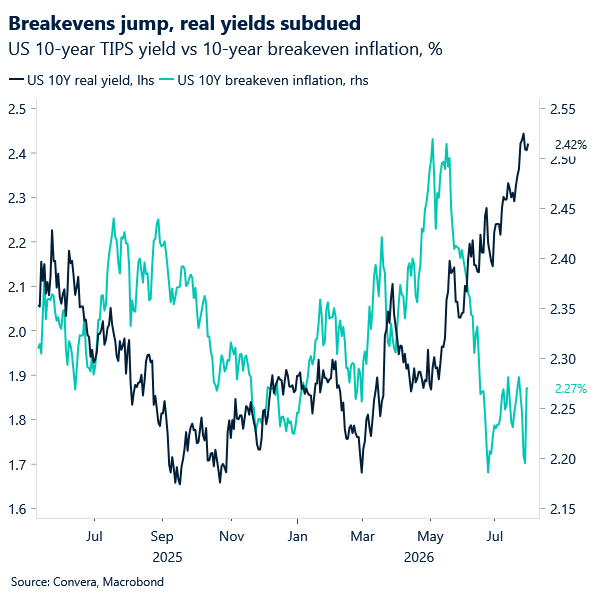
The market reaction had the hallmarks of a bear steepener, with longer-dated yields pushing higher as investors grew increasingly concerned about the inflation outlook amid a renewed rise in oil prices. Some skepticism over Warsh’s ability to curb inflation through hawkish rhetoric without policy action also helped drive demand for higher pay-outs on longer-dated debt.
Looking beneath the surface, the move at the long end was driven primarily by rising inflation breakevens, while real yields dipped.
Thirty-year Treasury bonds bore the brunt of the sell-off, with yields climbing to their highest level since 2007.
We had expected markets to look through a modest hawkish tilt in the vote split, given the extent of hawkish positioning ahead of the meeting. Short positioning in SOFR and fed funds futures remains near record highs for the eight-year history of the SOFR contract. In other words, the bar for a hawkish surprise, and by extension further dollar gains, was already set high.
The June inflation miss, a shortened policy statement that was virtually unchanged from June’s, and the absence of updated projections or a dot plot also made it harder for a meaningful hawkish surprise to materialise.
The roughly 9bp of tightening priced into yesterday’s meeting then provided the final catalyst for hawkish positions to unwind sharply, sending the dollar lower.
We doubt yesterday’s developments will be enough to push the DXY out of its recent 100.500-101.500 range, although it will be instructive to monitor whether bond vigilantes continue to drive sell-offs at the long end of the Treasury curve.
More broadly, the policy message remained hawkish while preserving flexibility to respond to incoming data. July inflation data, due on 12 August, is likely to be the next key test for the dollar.
We doubt yesterday’s developments will be enough to push the DXY out of its recent 100.500-101.500 range, although it will be instructive to monitor whether bond vigilantes continue to drive sell-offs at the long end of the Treasury curve.
EUR: Fed frustrates hawks, euro gains
EUR/USD received a much-needed boost yesterday as the Fed’s policy meeting failed to satisfy stubborn hawks. The pair climbed to its highest level since mid-July, re-establishing itself more comfortably into the 1.14 handle.
Rates have re-asserted themselves as an important driver of EUR/USD, while the pair has shown little sensitivity to the latest swings in geopolitical headlines. Yesterday oil rebounded sharply from its worst three-day decline since 2020 as a fresh round of fighting erupted across the Middle East.
Whether EUR/USD can extend its gains this month will depend on incoming data and geopolitical developments. Meaningful progress towards de-escalation, coupled with a softer-than-expected July US inflation, would provide the ideal backdrop for a meaningful break above 1.15.
Today is a big day for eurozone data. Focus will be on the preliminary July CPI releases from Spain and Germany, alongside the advance Q2 GDP estimates for France, Germany and the euro area as a whole. Meaningful upside surprises in either release should help keep the euro supported at the margin.

GBP: All eyes on BoE today
The Bank of England takes centre stage today, with the pound facing its most important domestic risk event in weeks. While markets assign only a modest probability to a rate hike, the decision itself is largely a sideshow. For sterling, the vote split, updated forecasts and Governor Bailey’s guidance matter far more.
The backdrop remains finely balanced. Since the June meeting, renewed Middle East tensions and higher oil and gas prices have lifted inflation risks, yet domestic data has softened. Inflation expectations have eased, wage growth has slowed and recent activity indicators point to an economy losing momentum. That should allow the MPC to maintain its cautious, wait-and-see approach, even if energy markets remain a source of uncertainty.
The key question is whether support for tighter policy broadens within the Committee. Markets expect rates to remain unchanged, but investors will be watching closely to see whether additional policymakers join Huw Pill and Megan Greene in pushing for tighter policy. The accompanying Monetary Policy Report is equally important, as it will provide the Bank’s latest assessment of how much of the recent energy shock is likely to feed through into inflation over the coming quarters.
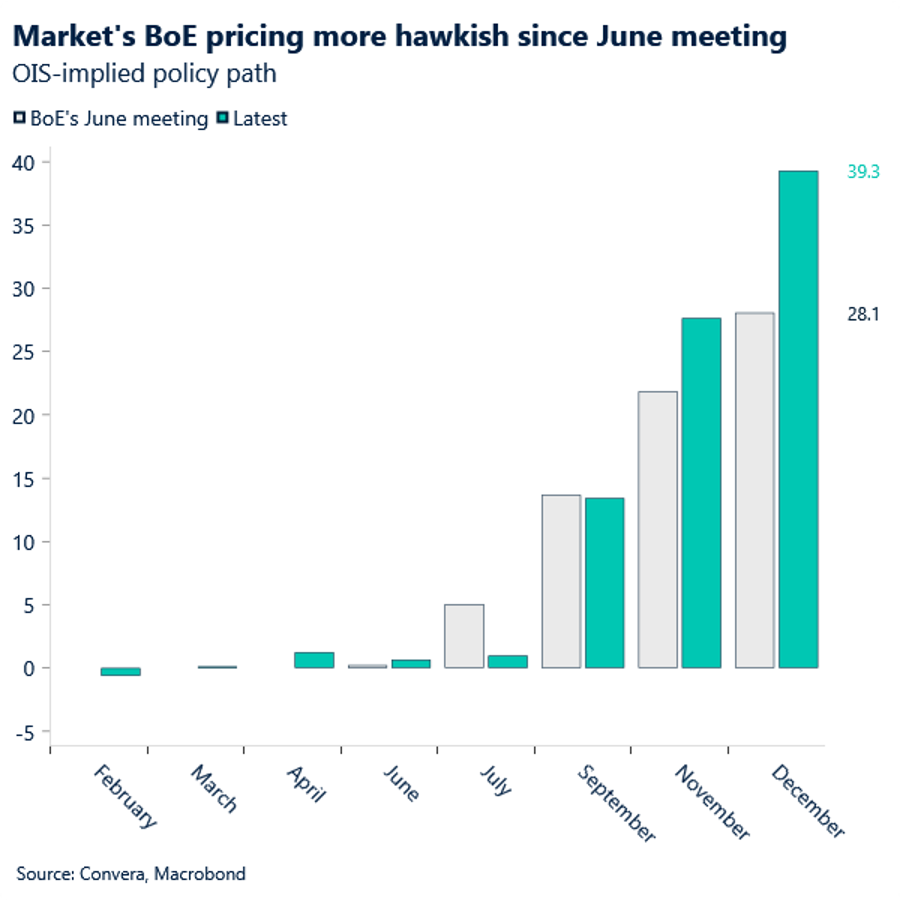
For sterling, the implications are nuanced. A more hawkish message would normally support the currency through the rates channel. However, after the Fed’s inflation-focused message last night, a BoE willing to lean against second-round inflation risks could also reassure gilt investors that policymakers remain committed to preserving price stability.
Conversely, if the MPC appears reluctant to respond to rising energy-driven inflation risks, markets may conclude that inflation will remain above target for longer. That risks pushing gilt yields higher for the wrong reasons, particularly given ongoing concerns around UK fiscal policy under the new Burnham government.
Options markets underline the importance of today’s event. Overnight implied volatility briefly jumped to its highest level of 2026, suggesting traders are braced for a larger-than-usual move in GBP, with positioning still showing a modest bias towards hedging sterling downside. For a pound already grappling with softer risk sentiment and doubts over whether BoE pricing has become too hawkish, today’s communication may prove more important than the rate decision itself.

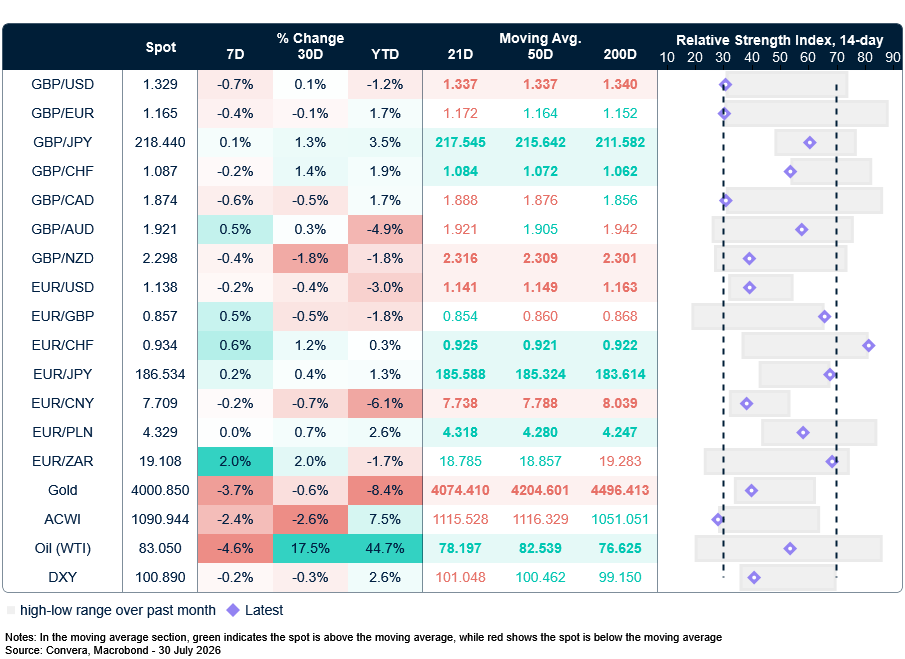
Market snapshot
Table: Currency trends, trading ranges & technical indicators
Key global risk events
Calendar: July 27-31
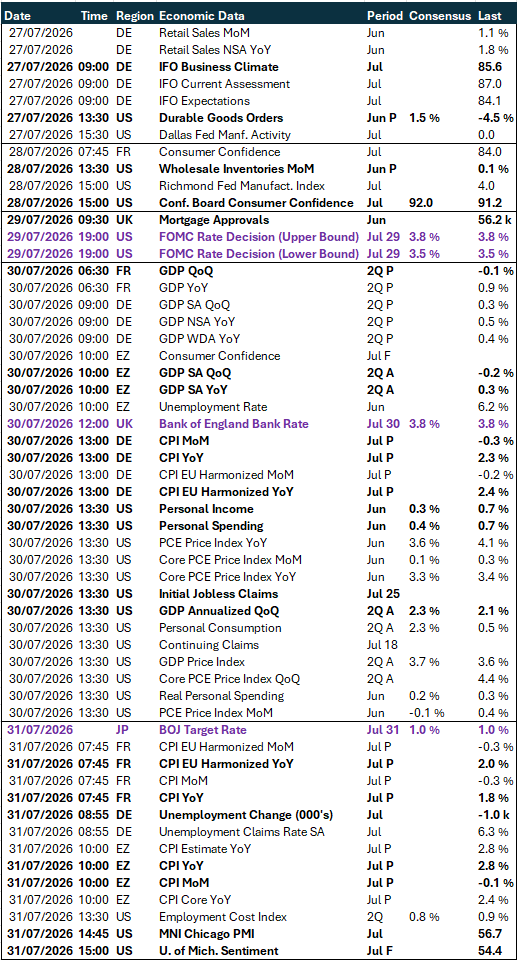
All times are in BST
Have a question? [email protected]
*The FX rates published are provided by Convera’s Market Insights team for research purposes only. The rates have a unique source and may not align to any live exchange rates quoted on other sites. They are not an indication of actual buy/sell rates, or a financial offer.