

USD: Higher crude cushions dollar
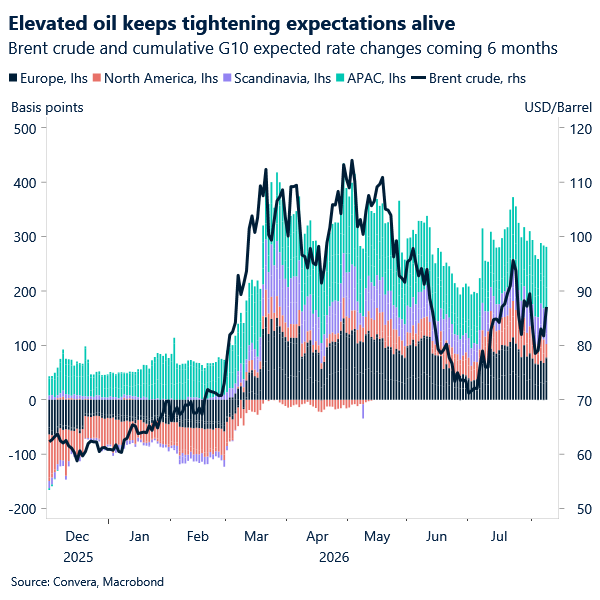
The dollar started the week firmer as renewed doubts over a near-term reopening of the Strait of Hormuz pushed Brent crude back above $88 a barrel, reviving inflation concerns and lifting global bond yields. President Trump signalled a willingness to maintain economic pressure on Iran rather than force a breakthrough through military escalation, while Tehran reiterated that conditions remain unsuitable for the full resumption of shipping flows.
The result has been a renewed focus on the inflation implications of higher energy prices. Following last week’s softer payrolls report, markets scaled back expectations of an imminent Fed hike. However, that repricing now looks vulnerable ahead of Wednesday’s CPI release. With 10-year Treasury yields back near 4.7% and German Bund yields approaching 3.2%, rates markets are again pricing the risk that energy-related inflation proves more persistent than hoped.
For the dollar, the story remains one of competing forces. Lower hiring momentum and softer labour data have tempered expectations for tighter policy, but resilient growth and higher oil prices continue to favour the greenback through both the growth and terms-of-trade channels. That balance has left the dollar broadly supported despite easing expectations for near-term Fed action.
With little of significance on today’s calendar, attention is firmly on Wednesday’s inflation report. A softer reading would reinforce the recent dovish repricing, while an upside surprise could quickly revive expectations that the Fed’s next move remains higher rather than lower.
EUR: Wait-and-see mode ahead of US CPI
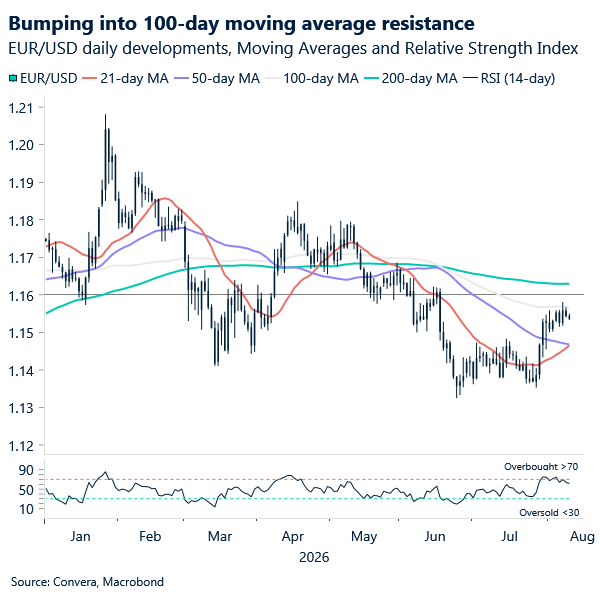
EUR/USD has seen a modest pullback after last week’s rally, with the 100-day moving average near 1.1570 once again proving a tough resistance level to overcome. The pair continues to trade above 1.15, but momentum has faded as markets await tomorrow’s US inflation report for clearer direction.
Not much has changed in the underlying narrative. The euro remains supported by a softer dollar backdrop following the weaker US jobs report, which lowered Treasury yields and reduced expectations for further Fed tightening. At the same time, recent Eurozone growth and inflation data have surprised positively, helping to maintain expectations that the ECB could tighten further before year-end.
However, the rally still looks more dollar-driven than euro-driven. As we’ve noted over recent weeks, the euro’s recovery has been largely built on a narrowing in US-Eurozone rate differentials rather than a convincing improvement in the euro area’s long-term fundamentals.
Technically, EUR/USD appears to be transitioning from the sharp downtrend seen through May and June into a period of consolidation/recovery. The rising 21-day moving average reinforces that view, but a sustained break above the 100-day moving average is likely required to signal a more meaningful recovery.
For now, markets remain in wait-and-see mode. Tomorrow’s US CPI release is likely to determine whether recent dollar weakness extends further and allows EUR/USD to challenge the 1.16 area, or whether Fed tightening expectations revive and push the pair back toward the middle of its recent range.
GBP: Shrugging off global concerns
Sterling has started the week on a firmer footing, helped by the dollar’s hangover from softer US labour market data last Friday, and shrugging off some softer-than-expected domestic data overnight. UK retail sales growth slowed to 1.0% y/y in July, below the 1.5% consensus and the weakest reading since February, adding to signs that the consumer recovery remains uneven despite improving confidence and easing inflation.
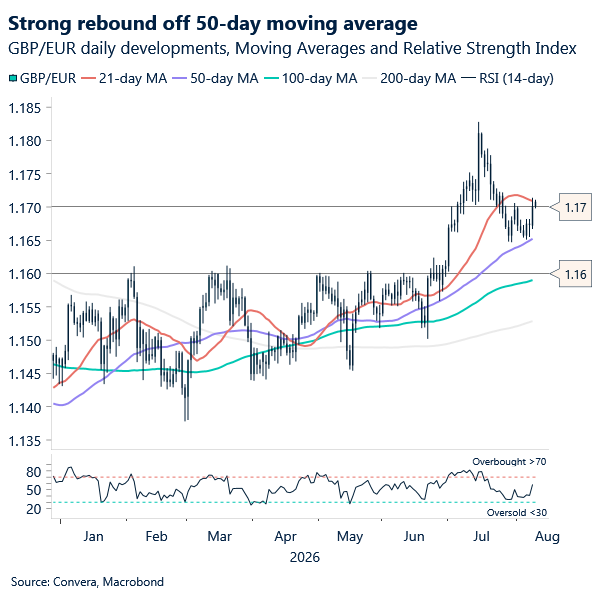
Even so, the pound has performed relatively well across the G10 since thew start of the week. GBP/USD remains above 1.35, but the US inflation data tomorrow will be a key test. Notably, GBP/EUR has returned to the 1.17 area after finding support around 1.1650, a level we flagged as an important floor. The move suggests that July’s correction has stabilised without inflicting meaningful technical damage, with the pair back up over 2% year-to-date.
Sterling’s resilience is noteworthy given the broader global backdrop. Global bond yields remain elevated amid heavy sovereign issuance, while AI-driven capex and energy-related spending continue to absorb liquidity. The UK remains particularly sensitive to these dynamics because investors typically demand a larger risk premium to hold gilts. As a result, moves in global yields often translate disproportionately into UK borrowing costs.
For now, sterling is showing resilience – we think due to an absence of fresh domestic negatives. However, the medium-term challenge remains unchanged. Markets have largely looked through the early days of the Burnham government, but fiscal questions have not disappeared. The next major test arrives this autumn, when Budget preparations begin to reveal whether the market’s current confidence in the UK’s fiscal trajectory is justified.
Market snapshot
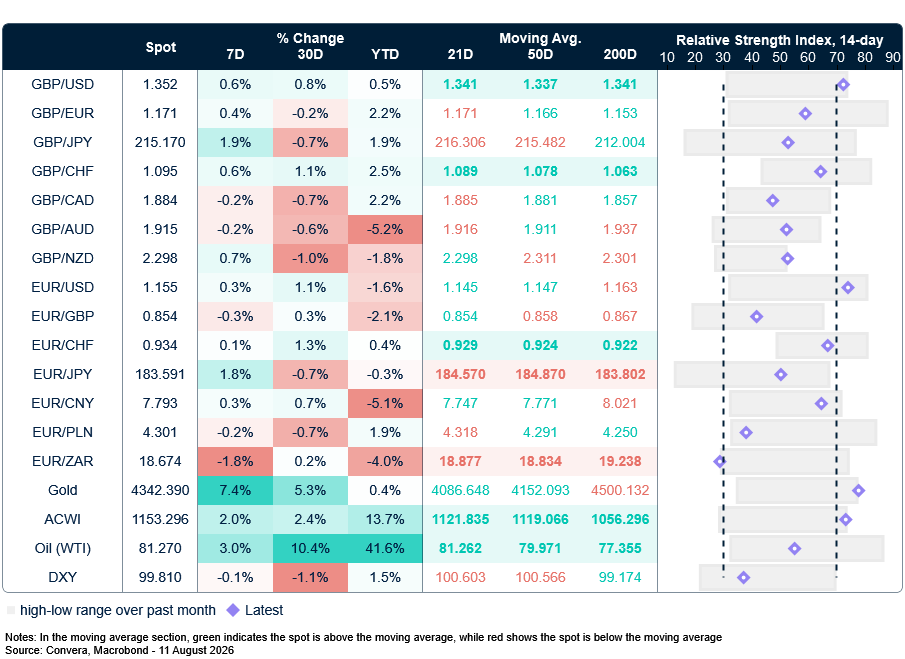
Table: Currency trends, trading ranges & technical indicators
Key global risk events
Calendar: August 10-14
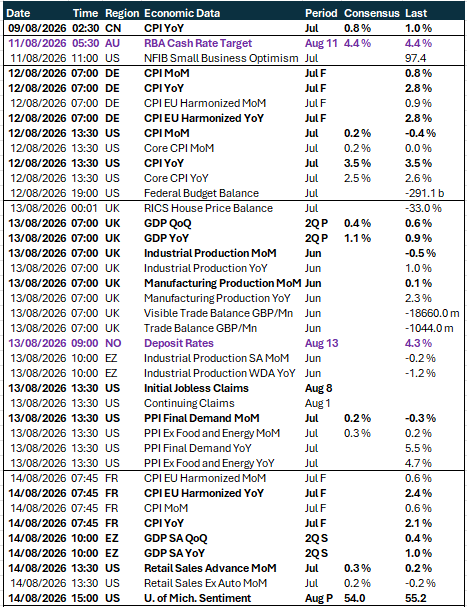
All times are in BST
Have a question? [email protected]
*The FX rates published are provided by Convera’s Market Insights team for research purposes only. The rates have a unique source and may not align to any live exchange rates quoted on other sites. They are not an indication of actual buy/sell rates, or a financial offer.