


Key Takeaways
- The US dollar faces mixed signals as strong economic data competes with declining Treasury yields and AI investment doubts.
- The euro rebounds from recent lows but consumer sentiment remains weak, limiting growth potential before 2027.
- GBP experiences selling pressure amidst AI concerns, with no clear catalyst to push above 1.20.
- Overall, economic risks include continued tariff uncertainty and fluctuating investor sentiment regarding AI-related growth.
USD: Bullish fundamentals meet fading momentum
The US dollar is caught in an increasingly balanced tug of war. On one side, the US macro backdrop remains difficult to argue against. Third-quarter GDP was revised up to a 4.3% annualised pace, consumption strengthened to 4.2%, and core PCE remains elevated at 3.3% y/y. December’s Fed hike is therefore still almost fully priced, supporting the USD through the rates channel.
Yet the dollar seems to be extracting less benefit from each positive data surprise. Treasury yields have fallen despite resilient growth and sticky inflation as renewed doubts around the AI investment cycle pull down inflation expectations and revive demand for bonds. Thin Thanksgiving liquidity may be amplifying those moves, with defensive Treasury positioning looking relatively attractive ahead of the long weekend.
That matters because much of US exceptionalism has increasingly rested on the AI capex boom. A sustained deterioration in that theme would weaken both the growth premium and capital inflows supporting the dollar.
Renewed tariff uncertainty adds another constraint, recalling the policy-risk channel that has previously undermined foreign appetite for US assets.
Risk appetite has improved this morning as technology stocks rebound, but volatility remains elevated after the recent AI-led correction. For the dollar, that creates competing forces: strong growth and a hawkish Fed remain bullish, while tariff uncertainty and doubts around the AI investment cycle limit enthusiasm for chasing the currency higher.
The support structure remains intact; the marginal return from good news appears to be fading.

EUR: Recovery still on shaky ground
EUR/USD has extended its rebound from Tuesday’s 1.0880 low, hovering less than 30 pips below 1.10 this morning. Notably, yesterday’s sticky US inflation and resilient GDP data failed to derail the recovery, with US Treasury yields instead remaining under downward pressure as fragile equity sentiment and lower energy prices supported bond demand. Markets nevertheless retain more than a 90% probability of both Fed and ECB hikes in December.
The euro’s own growth story remains mixed. Recent German PMI and Ifo surveys point to a cyclical recovery, but consumers are yet to buy into it. The latest GfK survey shows spending appetite near historic lows amid labour-market uncertainty, weaker real wages and elevated energy costs. That suggests consumption is unlikely to become a meaningful growth engine heading into 2027, limiting the scope for domestic fundamentals to drive EUR/USD materially higher.
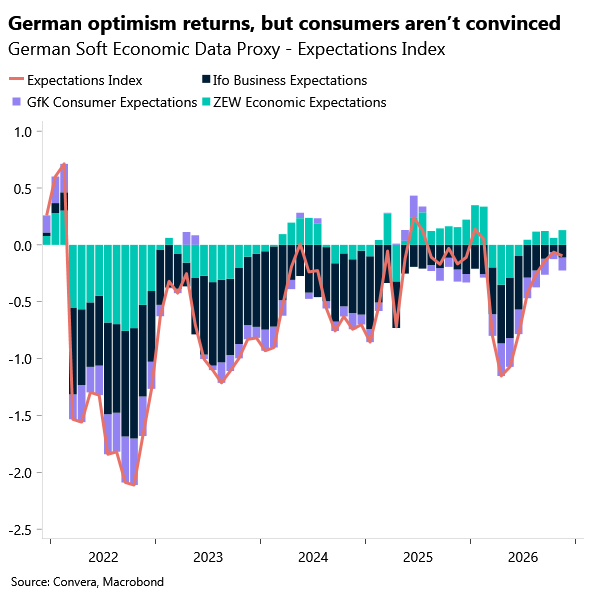
Attention today shifts away from data and toward liquidity conditions. With US markets closed for Thanksgiving and EUR/USD volatility subdued recently, thinner trading could exaggerate moves if equity sentiment deteriorates again.
For now, the rebound from 1.0880 looks constructive, but perhaps more like consolidation after an extended sell-off than the start of a durable recovery. A sustained break above 1.10 remains the first test for euro bulls.
GBP: 1.20 still out of reach
Amid continued AI angst, GBP/CHF is experiencing pronounced selling pressure as investors look to the safe-haven franc.
The pair is down ~0.8% so far this week, hitting a four-month low.
Meanwhile, GBP/USD has been relatively flat, as the dollar’s safe-haven status remains less clear-cut, with Fed hawkish expectations being questioned amid intensifying fears around the AI trade.
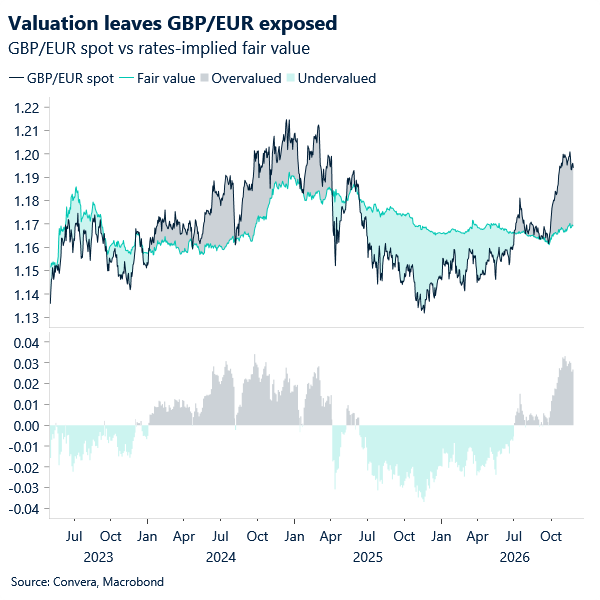
GBP/EUR closed flat yesterday after toying with fresh-1month lows. Buying interest near 1.1930 persists, but a clear catalyst to test 1.20 remains absent.
Investors have little data in the coming days to become more convinced of a BoE hike in December. Markets price an 80% chance of a hike, up nearly 10bp from the November policy meeting.
The increase came mostly in the first half of the month, after a unanimous decision to hike, with one dissenter favouring a 50bp move, caught markets by surprise. Bets were later trimmed in the latter half as inflation and labour-market data came in relatively orderly.
Yesterday, we heard from Governor Andrew Bailey, who, alongside Deputy Governor Lombardelli and external MPC member Mann, told Parliament’s Treasury Committee that they would have to respond if there is no sudden resolution to the Middle East conflict that brings energy prices down.
They reiterated the same message as on 5 November, dashing BoE doves’ hopes that the sharp decline in oil prices this month may have sufficed to allow for a less forceful monetary stance.
Other remarks that stood out and added fuel to the hawkish camp included an acknowledgement of strong economic momentum and signs that second-round effects from the oil shock may be starting to show up, threatening to make the inflation shock more entrenched and persistent.
Yet markets didn’t rush to pile on December hawkish wagers following the remarks, appearing willing to wait for another round of key economic data before the vote.
In the meantime, GBP/EUR consolidating near current levels looks right to us. However, its overvaluation relative to rate differentials leaves risks skewed to the downside should incoming data fail to validate the hawkish path priced in.
Market snapshot
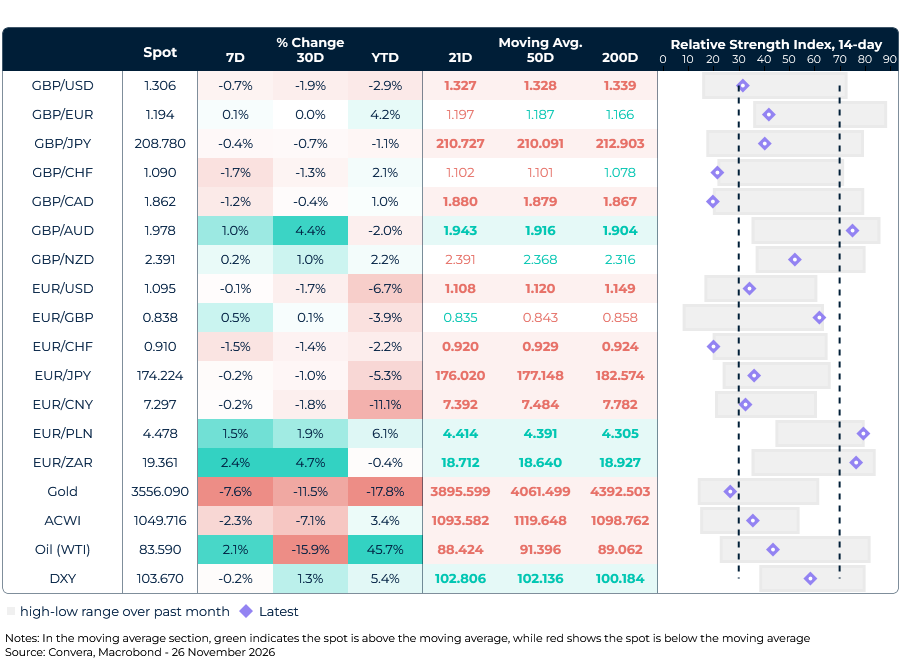
Table: Currency trends, trading ranges & technical indicators
Key global risk events
Calendar: November 23-27
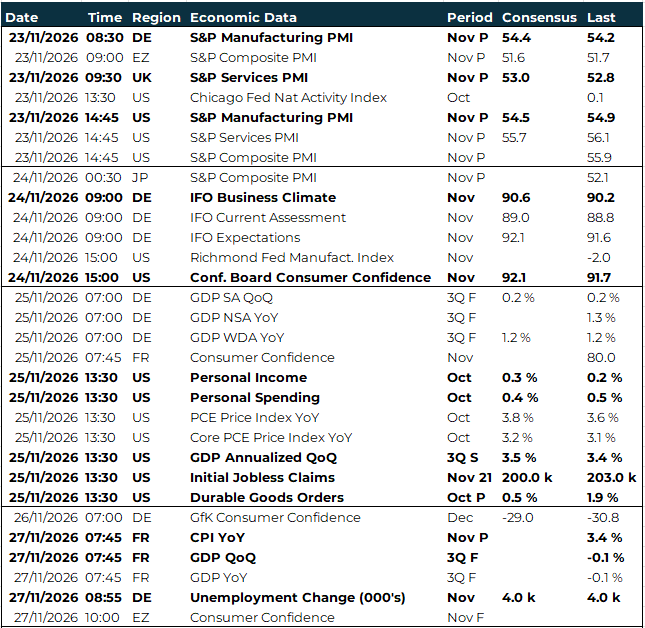
All times are in GMT
Have a question? [email protected]
*The FX rates published are provided by Convera’s Market Insights team for research purposes only. The rates have a unique source and may not align to any live exchange rates quoted on other sites. They are not an indication of actual buy/sell rates, or a financial offer.