
USD: Shutdown risk and data watch
George Vessey
The US dollar is on the backfoot this morning as investors weighed the growing risk of a government shutdown and braced for a pivotal week of economic data. With the fiscal year ending Tuesday and no funding bill yet approved, parts of the federal government could shutter by Wednesday. President Donald Trump is expected to meet with congressional leaders in a last-minute effort to avoid disruption, but uncertainty continues to pressure the dollar.
Markets are also laser-focused on September’s employment figures, including nonfarm payrolls, job openings, and private sector hiring, alongside the ISM manufacturing PMI this week. These indicators will shape expectations for future Fed policy, especially after last week’s stronger-than-anticipated data tempered hopes for aggressive rate cuts, which gave the dollar a strong cushion. Traders have scaled back their forecasts, now pricing in roughly 40 basis points of easing by year-end – a shift that has added volatility to USD positioning.
August’s PCE inflation data offered few surprises, though modest gains in both income and spending hinted at resilient consumer demand. Inflation ticked up slightly, but not enough to suggest a tariff-driven surge is imminent. Combined with upward revisions to second-quarter consumption, the data paints a picture of an economy still humming, complicating the case for deeper rate cuts. Equity markets responded with cautious optimism, while bond yields held steady, reflecting a wait-and-see stance.
The Fed’s recent rate cut – the first of the year – was driven by concerns over labour market softening. Yet with inflation hovering near 3%, well above the Fed’s 2% target, the decision underscores the delicate balancing act policymakers face. Most officials anticipate price pressures will ease by early next year, but they remain vigilant. Any unexpected spike in inflation could force a reversal in policy, potentially lifting rates and strengthening the dollar.
For now, the trajectory of the USD hinges on upcoming data. A disappointing jobs report or signs of cooling consumer prices could reignite dovish momentum and weigh further on the dollar. Conversely, any upside surprises may reinforce the Fed’s cautious stance and offer support to the currency. Either way, the stakes are high – and the dollar is caught in the crossfire.

GBP: Fragile fortunes
George Vessey
The British pound remains caught in a tug-of-war between fiscal fragility and shifting global capital flows. With the UK’s public finances under scrutiny, the upcoming Budget announcement looms as a potential turning point. If the government fails to convince markets that its fiscal roadmap is credible and sustainable, sterling could face renewed pressure – particularly against the dollar, where recent gains have been hard-won.
While a currency repricing alone may not drastically alter the UK’s growth trajectory, it could trigger a broader policy response. A sharp move in sterling would likely prompt fiscal recalibration, which carries more meaningful implications for the economic outlook. Investors are watching closely: the pound’s August slide following disappointing public finance data underscored just how sensitive it is to fiscal signals.
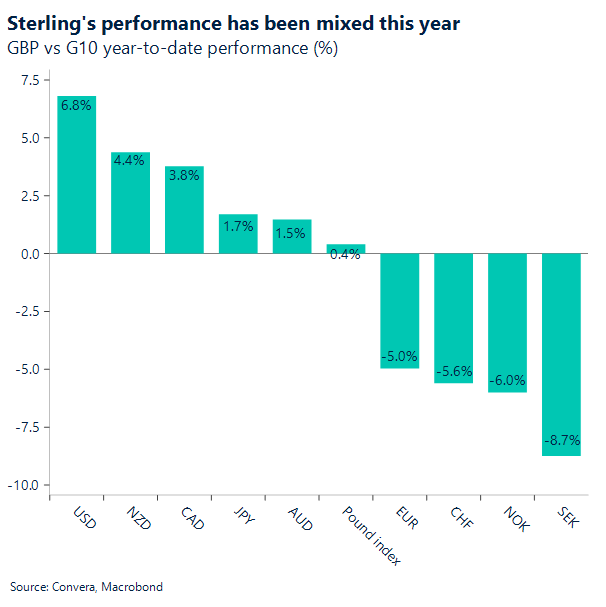
On a trade-weighted basis, sterling’s movement over the past year has been modest. But beneath the surface, divergent trends have emerged. The euro has gained ground as Eurozone inflation normalizes and investor confidence returns, drawing capital away from the UK and weighing on GBP/EUR. Meanwhile, since early 2025, the pound has managed to strengthen against the dollar – a reflection of relative resilience in UK assets and shifting expectations around U.S. monetary policy.
That said, the durability of sterling’s gains against the dollar is far from assured. With fiscal credibility in question and global investors increasingly selective, the pound’s path forward hinges on more than just macro data – it depends on political clarity and policy discipline. The Budget could either reinforce sterling’s footing or expose fresh vulnerabilities. For now, the pound walks a fine line between optimism and fragility.
EUR: Euro’s edge wears thin
Antonio Ruggiero
EUR/USD closed the week just above 1.17 at 1.1703, down 0.4%, as a string of upward revisions to U.S. macro data – most recently August’s stronger-than-expected personal spending – hint that the U.S. economy may be regaining momentum. The pair, however, began the week on a more positive note, buoyed by renewed concerns over a potential U.S. government shutdown due to the failure to agree on a short-term spending bill – potentially putting a hold on the one factor that could meaningfully drag EUR/USD lower today: US official economic releases.
The pair hasn’t reacted this sharply to U.S. data surprises in years. Assuming a resolution to the funding bill impasse, if the current trend persists – especially with this week’s labour market report in focus – the pair could break below $1.1650, then $1.16. Beyond that, technical support is sparse until $1.14, a level briefly tested in late July before rebounding.
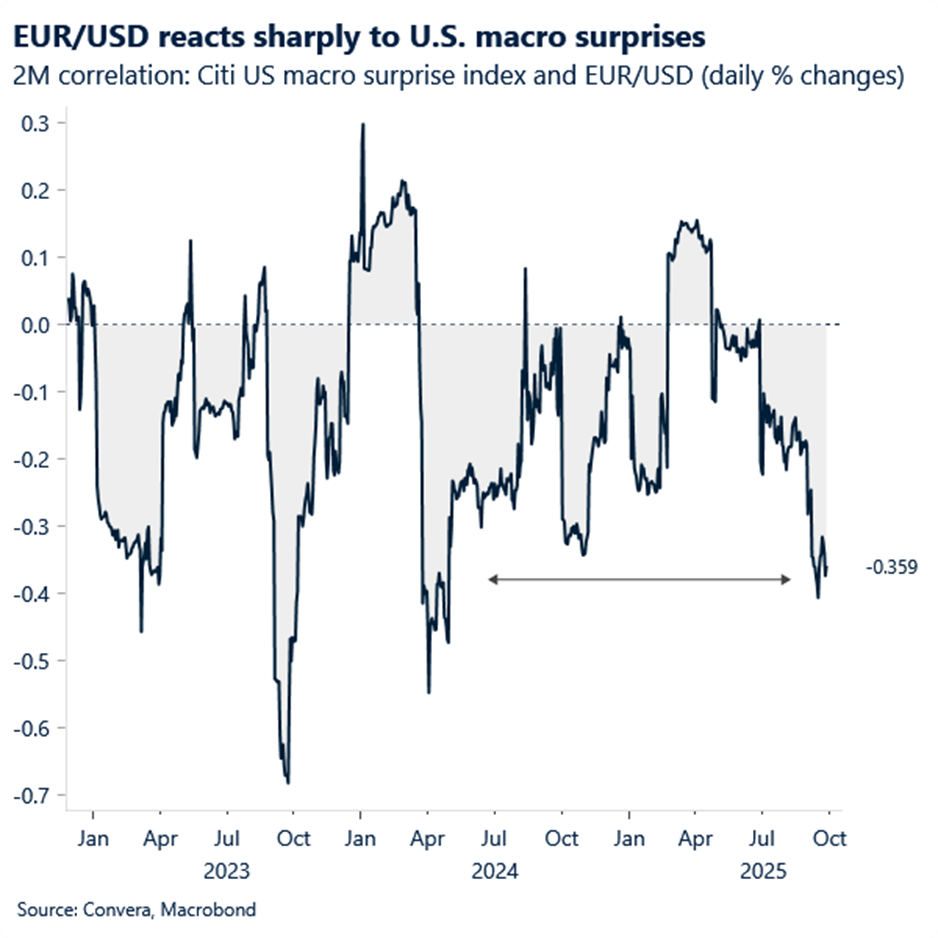
Still, for this pullback to evolve into a broader correction, we’ll need more convincing evidence of a sustained U.S. rebound. The euro’s rally began with USD-negative tariff headlines, then shifted toward fundamentals, morphing into a “bad data validates tariff fears” narrative that justified dollar selling. But if this narrative culminates in an economy that’s not just stabilizing – but outperforming – then the euro’s fuel evaporates, setting the stage for a deeper decline. That said, given these dynamics, the decline can be as sharp as precarious, meaning that a constant streak of upside surprises are warranted to win untrustful investors back.
On the domestic front, EU confidence indicators are due today, alongside CPI releases from key eurozone members and the broader bloc later in the week. While inflation is worth watching – especially after last week’s ECB upward revisions to 1-year and 3-year inflation forecasts – these prints are not expected to have significant traction in FX markets.
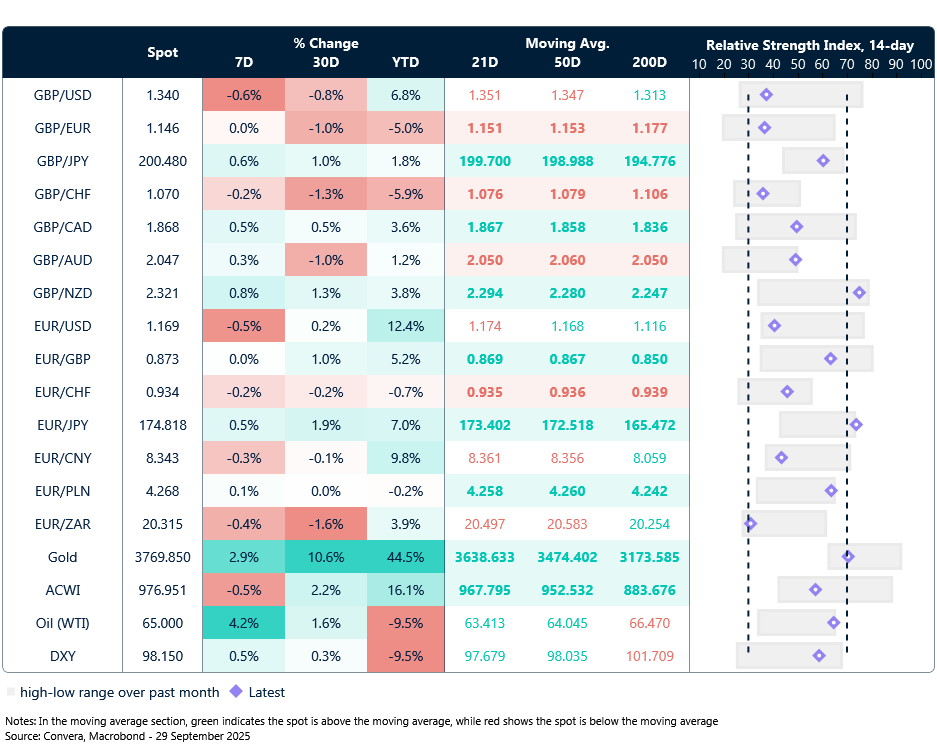
DXY shows stronger upbeat momentum
Table: Currency trends, trading ranges and technical indicator
Key global risk events
Calendar: September 29 – October 3
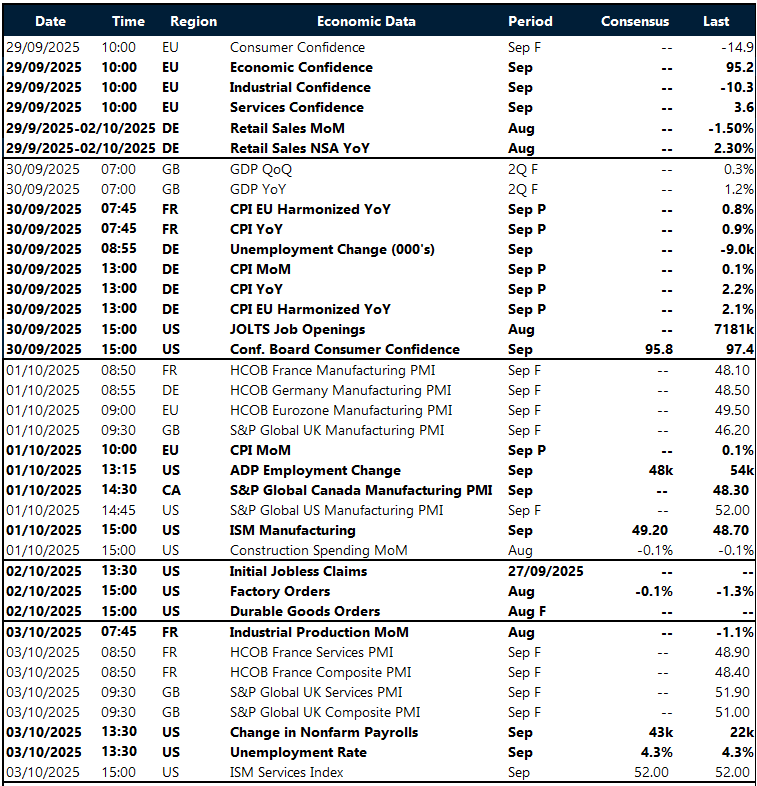
All times are in BST
Have a question? [email protected]
*The FX rates published are provided by Convera’s Market Insights team for research purposes only. The rates have a unique source and may not align to any live exchange rates quoted on other sites. They are not an indication of actual buy/sell rates, or a financial offer.