


Greenback nears highs as oil gains almost 10%
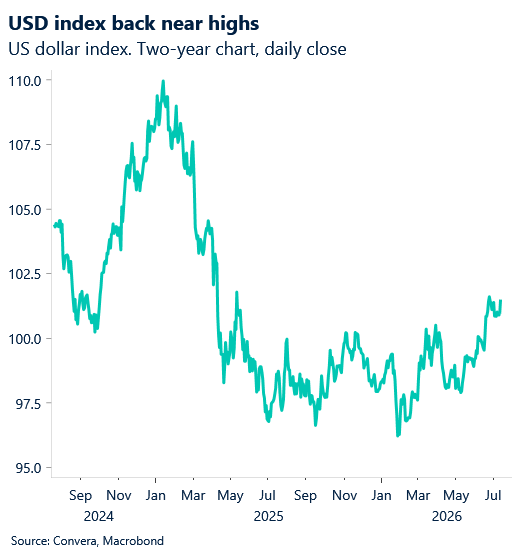
The US dollar was higher overnight, with the key USD index back near 14-month highs, as renewed tensions between the US and Iran unsettled markets.
The US struck Iran for the third consecutive night after Iran earlier attacked ships passing through the Strait of Hormuz, with Tehran claiming it has the right to control passage through this key global chokepoint.
US shares fell, with the S&P 500 down 0.8% and the Nasdaq losing 1.6%.
In FX markets, the US dollar gained, with the USD index climbing 0.3%.
AUD/USD fell 0.5%, while NZD/USD lost 0.2%.
In Asia, USD/JPY gained 0.5%. USD/SGD climbed 0.2%, while USD/CNH was flat.
Aussie falls from three-week highs
Tensions in the Middle East remained elevated after US Central Command reported additional strikes against Iran. Earlier, Washington and Tehran gave conflicting signals on the status of shipping through the Strait of Hormuz, adding to uncertainty around global energy supplies.
Oil prices moved higher in Asian trading on Monday, with Brent crude rising to around USD79 per barrel and WTI climbing above USD74 per barrel.
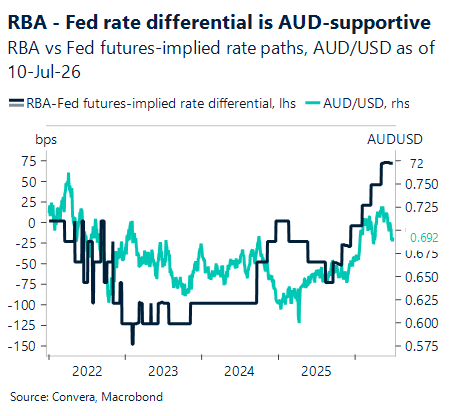
AUD/USD remains about 5% below its 6 May peak of 0.7278. Near-term resistance is located at the 21-day moving average of 0.6962, while the 100-day moving average at 0.7008 is the next level to watch if momentum strengthens.
On the downside, 0.6900 remains an important support level.
Elsewhere, AUD/EUR climbed to a two-week high.
Kiwi steady as services activity returns to growth
New Zealand’s services sector edged back into growth in June, with the Performance of Services Index (PSI) rising to 50.6 from 48.0 in May. It marked the first reading above 50 since January, although activity remains only marginally in expansion territory and well below the long-run average of 52.7.
All key components improved during the month. New orders led the gains, climbing to 53.0, while supplier deliveries rose to 51.2. However, activity/sales remained below the 50 threshold at 49.3, and employment also stayed in contraction at 48.8.
The latest figures point to a gradual improvement in economic activity, but they do not yet signal a broad-based recovery in consumer spending.
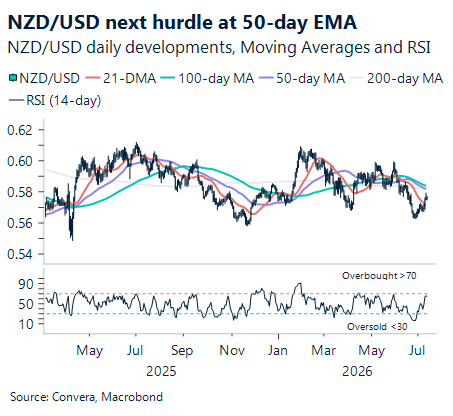
For NZD/USD, the next upside hurdles are the 50-day EMA at 0.5781, followed by the 100-day EMA at 0.5815. On the downside, initial support is seen at the 21-day EMA at 0.5733.
Elsewhere, NZD/EUR traded near a one-month high.
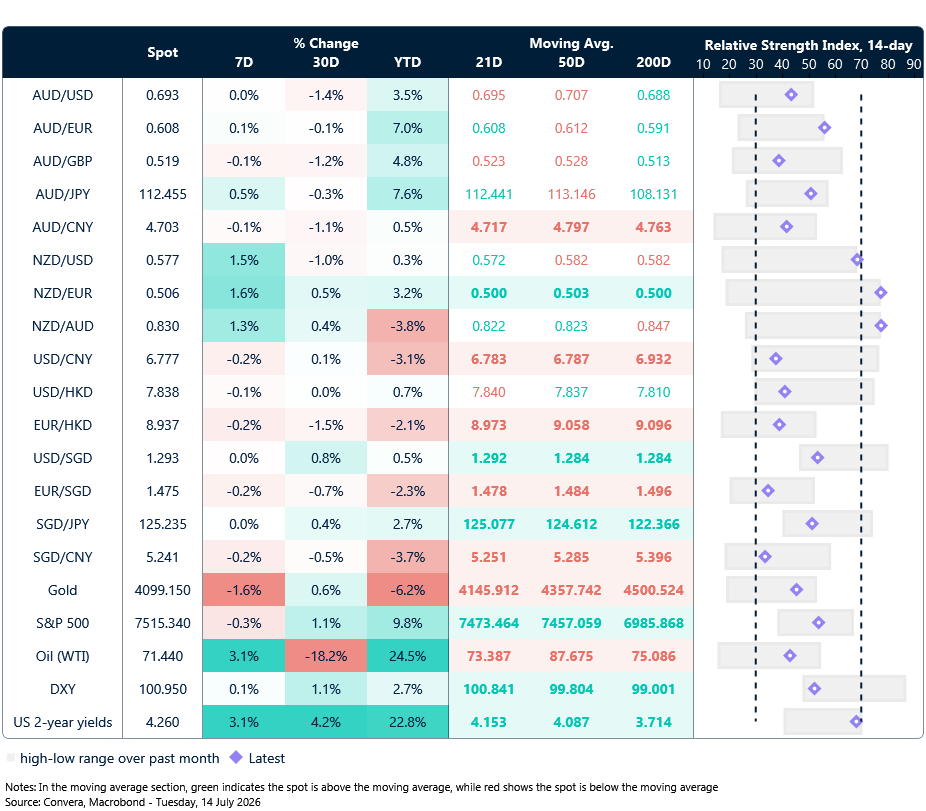
Greenback higher after Iran strikes
Table: seven-day rolling currency trends and trading ranges
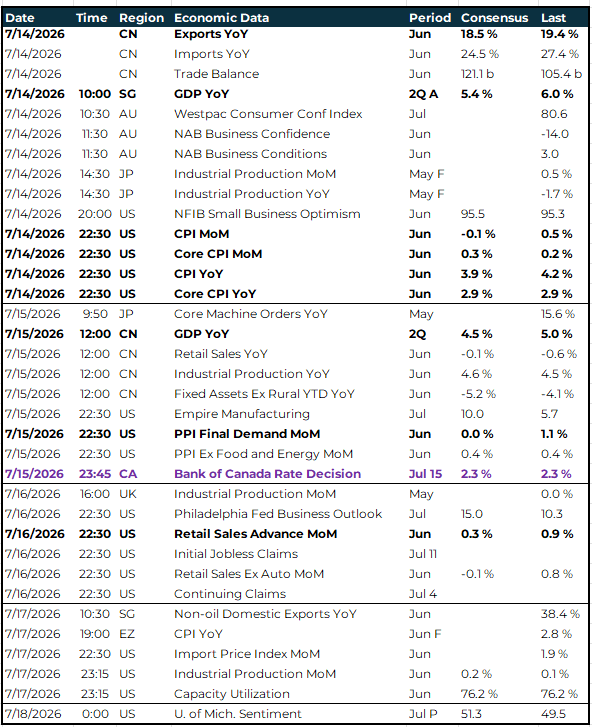
Key global risk events
Calendar: July 13-17
Have a question? [email protected]
*The FX rates published are provided by Convera’s Market Insights team for research purposes only. The rates have a unique source and may not align to any live exchange rates quoted on other sites. They are not an indication of actual buy/sell rates, or a financial offer.