


Key Takeaways
- The US dollar strengthens as inflation rises more than expected, cementing bets on a December Fed hike.
- Markets are even pricing a small chance of a jumbo 50bps Fed hike.
- EUR/NOK rises as falling oil prices alleviate pressure on the euro despite ongoing bearish trends.
- GBP/USD declines due to rising US yields and Fed hike expectations, overshadowing benefits from lower oil prices.
USD: Hot CPI supercharges Fed hike bets
The US dollar is back on the front foot after US inflation surprised to the upside, reinforcing the case for further Fed tightening. Markets had already been jolted by Governor Christopher Waller, who said a 50bp move in December could be considered if inflation proved hotter than expected. Short-end US yields and the US currency pushed higher, whilst stocks suffered another day in the red.
The CPI report subsequently delivered that inflation warning. Headline prices rose 0.4% m/m against 0.3% expected, while core CPI also beat by a tenth at 0.3%. More importantly, the strength was broad-based, with most major components contributing for a third consecutive month. Inflation diffusion measures are deteriorating too, suggesting energy-related pressures are increasingly feeding through into the wider economy rather than remaining isolated.

Coming just days after a strong jobs report, the data reinforce the picture of an economy still resilient enough to withstand tighter policy. Markets now fully price another 25bp Fed hike in December, with a small probability attached to a larger 50bp move. Treasury yields are edging higher across the policy-sensitive end of the curve Treasury yields, restoring the dollar’s rate advantage.
The main counterweight remains energy. Oil and US gasoline prices continue to retreat as markets grow more optimistic about a potential Middle East off-ramp, potentially easing future inflation pressure.
For now, however, hard US data are winning the argument. With growth resilient and inflation broadening, the near-term balance of risks has shifted back towards further dollar strength.

EUR: Oil pullback takes pressure off EUR/NOK
EUR/NOK continues to march higher, hitting a three-week high as oil prices fall. The pair’s trajectory this year has been broadly bearish, with the krone benefiting from higher energy prices given Norway’s status as a net exporter.
Momentum behind US-Iran de-escalation has picked up since the US midterms, pushing crude back below $90 a barrel, more than 20% lower than its October peak. Understandably, EUR/NOK has pared back some of its losses amid the more benign energy backdrop. Of course, a more sustained correction would likely require the two sides to reach a more durable resolution to the conflict. We have little confidence that this will happen in the near term. For now, 10.70 looks like an important resistance level to watch.
Elsewhere, the euro weakened against the dollar. A hotter-than-expected US October inflation report strengthened the case for a Fed hike in December, which is now fully priced by markets.
That should weaken the case for EUR/USD to break sustainably above 1.1250. The release has triggered a re-widening of rate differentials in favour of the dollar, leaving less EUR/USD misvaluation relative to its rates-implied fair value to unwind. Persistently weak sentiment towards the euro further reduces any immediate pressure for spot to converge on fair value.

GBP: Rates trump the oil relief
Sterling is back under pressure against the dollar after the latest US inflation surprise reinforced expectations of further Fed tightening. GBP/USD fell more than 0.7% on Tuesday, despite oil prices continuing to retreat. Ordinarily, cheaper energy would provide a meaningful tailwind for the UK via the terms-of-trade channel, but relative rates are firmly in control for now as rising US yields and Fed hike expectations support the dollar.
The technical picture has deteriorated too. GBP/USD has slipped back below its 21-day moving average, having only recently reclaimed it, and opened below the level again this morning. That puts 1.33 back in focus as the next downside test. Tomorrow’s UK GDP release therefore carries added weight. A material upside surprise versus the 0.7% consensus could revive expectations of another BoE hike in December and provide some rate support for sterling.

GBP/EUR has also lost momentum after its recent surge towards 1.20. Falling European energy prices are providing some relief to the euro, with Dutch TTF gas threatening to break below its 50-day moving average as hopes of diplomatic progress in the Middle East build.
Some consolidation was overdue. GBP/EUR’s 14-day RSI has fallen below 70, finally exiting overbought territory after remaining stretched since early October. The broader uptrend remains intact, but near-term momentum has clearly cooled, as we expected.
Market snapshot
Table: Currency trends, trading ranges & technical indicators

Key global risk events
Calendar: November 09-13
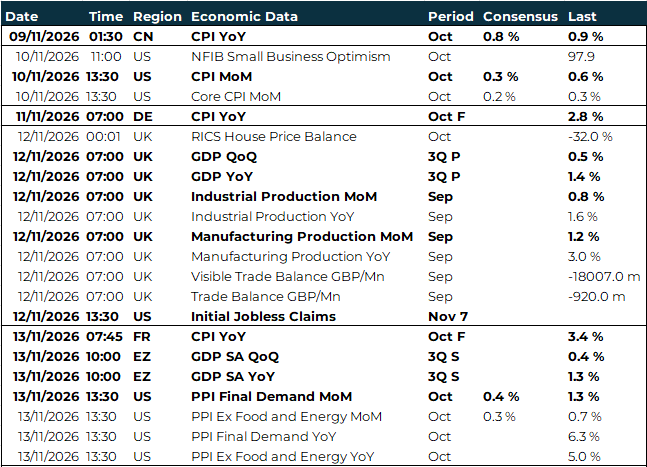
All times are in GMT
Have a question? [email protected]
*The FX rates published are provided by Convera’s Market Insights team for research purposes only. The rates have a unique source and may not align to any live exchange rates quoted on other sites. They are not an indication of actual buy/sell rates, or a financial offer.