


USD: A balancing act for the Fed
The US dollar has had a softer start to this week, amid improved risk sentiment and oil prices stabilising somewhat. But the dollar index remains 2% higher month-to-date ahead of the Federal Reserve’s (Fed) policy decision today, as the US central bank navigates a policy trade‑off shaped almost entirely by the Middle East conflict. Markets have rapidly unwound expectations for easing: what had been two 25bp cuts priced before the war has collapsed to barely one, and investors are fully backing a hold at today’s meeting. That repricing has supported the USD, but the story is more complex than a simple hawkish shift.
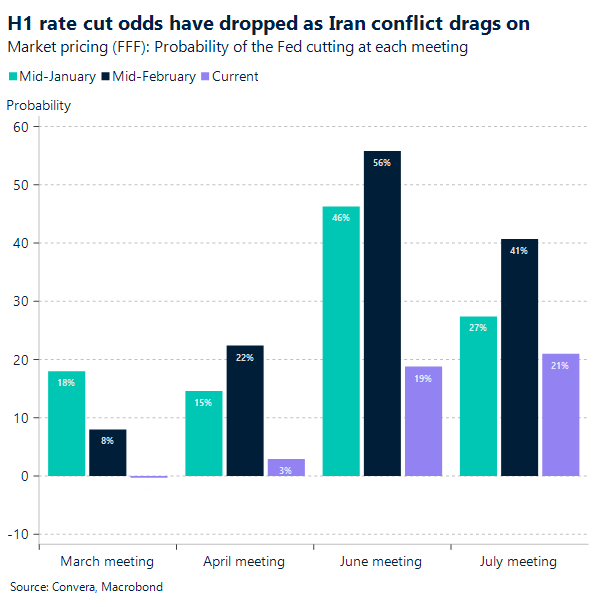
The Fed is now facing a stagflationary shock, making today’s forecasts unusually important. Growth is likely to be marked down, inflation nudged higher, and the longer‑run rate path left deliberately non‑committal. With the duration and intensity of the conflict unknowable, policymakers will have little conviction in their projections — and Chair Powell will underline that uncertainty. Energy prices have surged, but unlike in 2022, officials appear more inclined to look through a temporary inflation bump and focus on the risks to activity and the labour market.
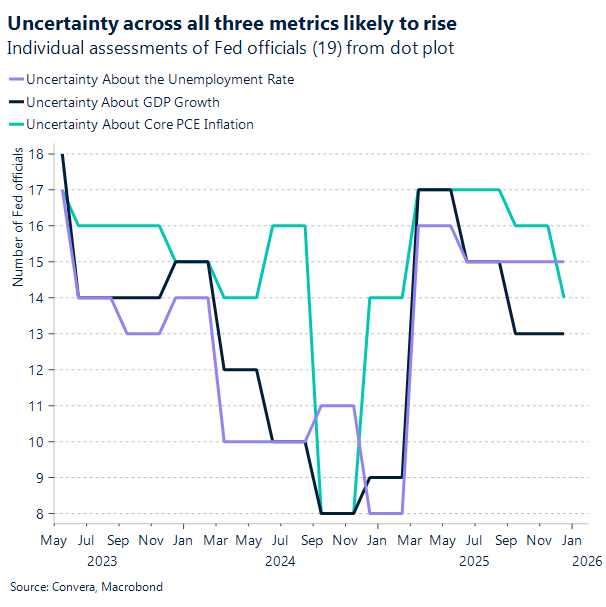
This backdrop raises the odds that the Fed stays on hold for longer, but it also changes the rationale for eventual cuts. Instead of easing to manage disinflation, policymakers may ultimately cut to insure against a sharper rise in unemployment. That shift in emphasis matters for the dollar.
The front end of the Treasury curve has already repriced aggressively, and a hawkish dot plot today would keep upward pressure on yields. The long end is more constrained: a prolonged oil shock is inflationary, but it also hits demand, acting as a tax on households at a time when real income growth is already soft.
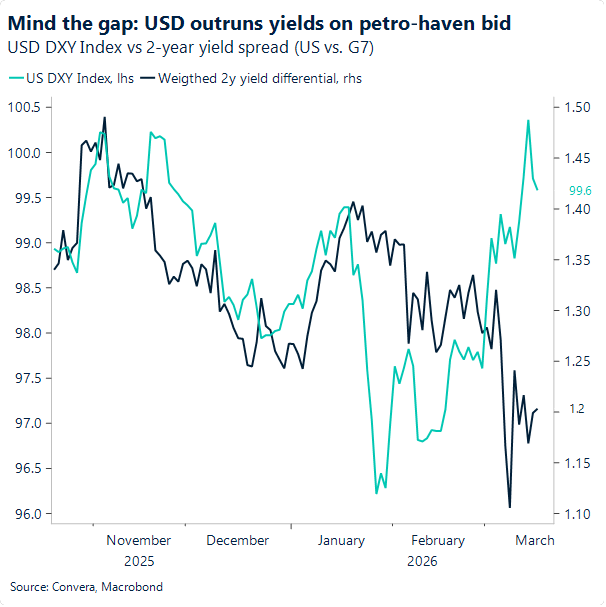
For the USD, these crosscurrents are supportive. The repricing in Fed expectations has increased demand for the greenback, but relative yield spreads suggest the move is overdone. However, the gap is explained by the US’s improved terms of trade and the dollar’s role as the market’s preferred hedge when geopolitics trigger an oil‑price shock.
A hawkish tilt today could extend the dollar’s gains, but the bigger driver remains the conflict itself — and the USD’s position as the cleanest expression of global uncertainty for now.
EUR: Recovery lacks conviction
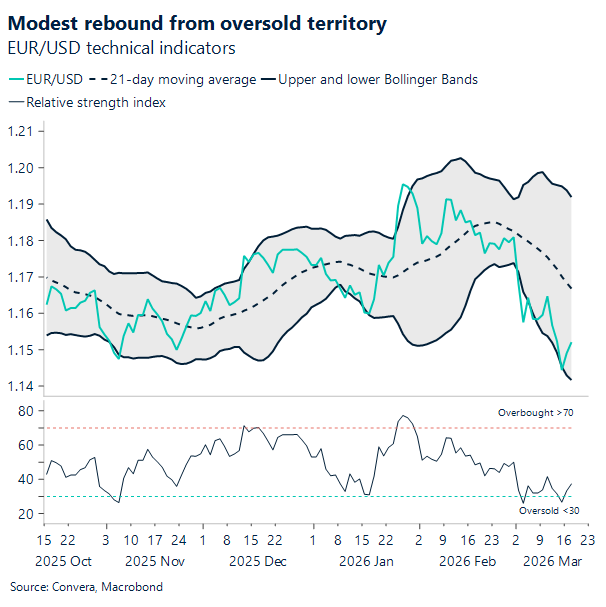
The euro extended Monday’s rebound yesterday, edging further away from its six‑month low near $1.14, but the move still looks fragile. Without progress on ceasefire talks or clearer NATO coordination around securing Hormuz, EUR/USD’s recovery risks stalling. With a heavy run of central bank meetings ahead, the downside bias may re‑emerge quickly.
The ECB is widely expected to stay on hold this week. The macro backdrop is very different from the 2022 energy crisis: inflation is at target, growth is subdued, and the latest shock is driven by geopolitics rather than domestic overheating. Even so, the council faces a more complicated landscape than at the previous meeting. The surge in energy prices tied to the conflict raises the likelihood that inflation drifts above 2% in 2026, but the duration of supply disruptions and the scale of second‑round effects remain highly uncertain.
That uncertainty is precisely why a pre‑emptive hike is off the table. Volatility is too high, the shock is assumed to be temporary, and the ECB will argue for more data before committing to any shift in stance. Still, the tone is likely to harden: policymakers will acknowledge that rate hikes are now more plausible than cuts, and warn that persistent energy disruptions or signs of wage‑price spillovers could warrant a policy response.
Overall, for EUR/USD, the combined weight of the Fed and ECB meetings keeps risks tilted lower this week, especially given Europe remains more exposed to the terms‑of‑trade shock too. Unless the Gulf backdrop improves, the pair could re‑test $1.14. A weekly close below this level could expose $1.12 as the next key downside target/support.
GBP: Oil rebound complicates BoE’s path to target
Sterling has closed higher against the dollar for a second straight session, supported by tentative optimism after reports of isolated vessels transiting the Strait of Hormuz with Iran’s permission. Meanwhile, Iraq has begun redirecting crude through alternative routes to offset the disruption, helping keep oil anchored near $100 a barrel.
The geopolitical backdrop is feeding an increasingly two‑sided risk profile the BoE will be acutely aware of going into tomorrow’s policy meeting. On one side, inflation – previously expected to return to target by April – is now likely to face renewed upward pressure as the conflict pushes oil and gas prices higher. On the other, a softening labour market that would benefit from a less restrictive rate environment. In fact, continued easing across gilt yields for a third straight day signals the growing proximity to the Bank’s policy decision, reflecting a shift that better captures the two‑sided risk profile and moves away from the earlier, more knee‑jerk one‑sided tightening bias driven by the conflict’s inflationary impact.
But the easing in rates also reflects a market that, even as the conflict rages on, has – blindsided as it may be – shifted its focus almost exclusively to tanker passage through the Strait. Reports that Iran may be selectively allowing vessels through have calmed nerves, with markets reading the current shock as more temporary than structural. Pressure on oil prices persists, reflecting shorter‑term dynamics, while longer‑term implications – better captured by the yield curve – are attempting to revert toward more “normal” levels, reflecting the market’s more transitory‑shock interpretation.
For the UK specifically, these whipsaw moves have been particularly sharp. Brent crude is the primary benchmark for oil pricing in the Atlantic Basin and is closely linked to North Sea production. By sitting at the centre of this pricing ecosystem, UK wholesale fuel prices track Brent very closely. As a result, the broader UK financial‑asset landscape and macro backdrop show heightened sensitivity to oil‑related shocks. Compared with the eurozone and Switzerland, the UK also has a more liberalised retail fuel market, meaning price spikes feed through more quickly. The eurozone (via taxes) and Switzerland (via a strong currency and a more diversified energy mix) have buffers that dilute the pass‑through.
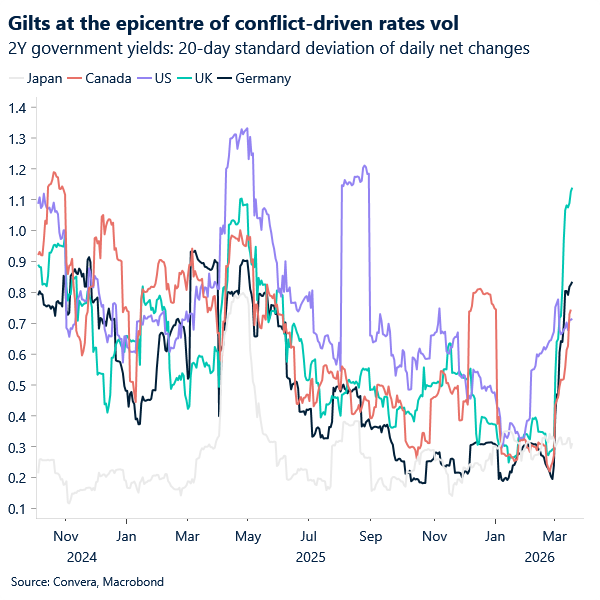
In fact, the rapid pricing‑in of rising oil prices, and the subsequent partial unwind, has been most evident in the UK: the yield curve has risen more sharply across maturities than in peer markets, and inflation expectations have moved higher more aggressively as well.
Market snapshot
Table: Currency trends, trading ranges & technical indicators

Key global risk events
Calendar: March 16-20
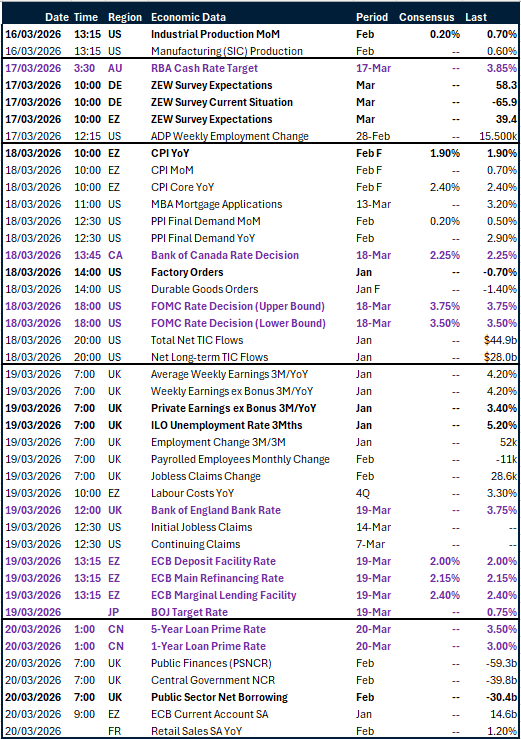
All times are in GMT
Have a question? [email protected]
*The FX rates published are provided by Convera’s Market Insights team for research purposes only. The rates have a unique source and may not align to any live exchange rates quoted on other sites. They are not an indication of actual buy/sell rates, or a financial offer.