
Euro ignores recession as Fed dominates
The Eurozone has officially fallen into a mild recession, following two consecutive quarters of negative growth. The broader Eurozone fell by 0.1% in Q4 and Q1 in what can be described as the mildest recession possible. Germany as a country and government spending as a category have put the most significant drags on the 20-nation economy, given the sharp manufacturing downtrend and stimulus programs being cut back. However, the recession itself most likely won’t have any impact on the policy path of the European Central Bank.
Not only does the data point lie well in the past and is therefore not market moving, high inflation continues to limit policymakers room for nuance. Bringing down core inflation remains all that matters for Lagarde and Co. Leading indicators for Q2 and Q3 will play a larger role as potential FX catalysts, which is why next week’s sentiment data will be of importance. So far, data for April and May have been lackluster, suggesting that a quick post-recession rebound remains out of sight, at least in the short-term.
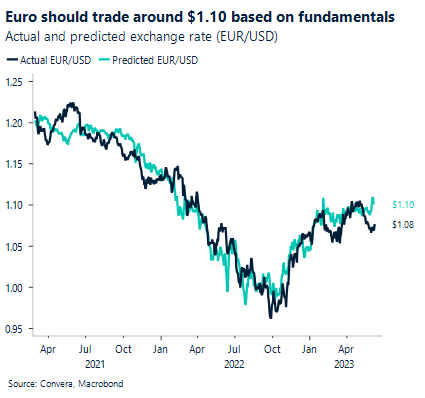
So, why did the common currency appreciate in yesterday’s session despite the darker macro outlook? As we have discussed recently, the missing nuance in the ECB’s policy setting puts the Fed in the driver’s seat when it comes to EUR/USD. The unexpected rise in US jobless claims was enough to create some uncertainty about the resilience of the labor market, weakening rate hiking bets for the Fed’s June meeting and therefore putting upward pressure on the pair. The 0.75% jump to $1.0770 was the largest daily advance in one and a half months.
Data sensitivity bites the dollar
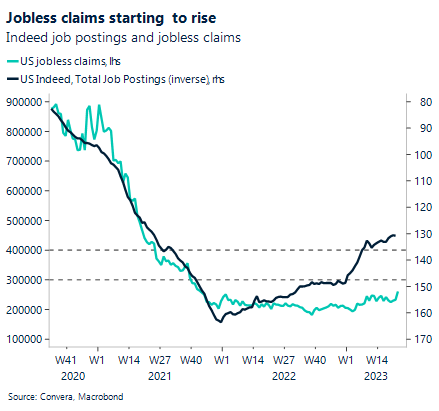
How strong is the US labor market? This question has been at the center of most short- to medium-outlooks for the world’s largest economy. While the latest nonfarm payrolls report showed that the US economy added 379 thousand jobs in May, the increase of the unemployment rate and fall of the quits rate and average hours worked brought some uncertainty back into the so far one-sided conversation. Most leading indicators have suggested a weakening of the labor market ahead.
This has so far not happened, most likely because of post-pandemic effects like government stimuli leading to excess savings and early retirees creating a labor shortage. Yesterday’s release of the initial jobless claims shows how the number of Americans filling for unemployment benefits jumped to 261 thousand in the week ending June 3rd. This was the highest level since October 2021, even if the number has to be taken with a grain of salt given the holiday shortened week. However, the trend of a peaking labor market is starting to broaden.
The dollars immediate weakening following the jump of initial jobless claims shows us how sensitive FX has become to the incoming data. Markets repriced their expectations for a Fed hike in June from 33% to 25%, pushing dollar pairs down. A lackluster day on the data front will most likely lead the Euro to its first weekly appreciation since the beginning of May.
Sterling pounds its peers
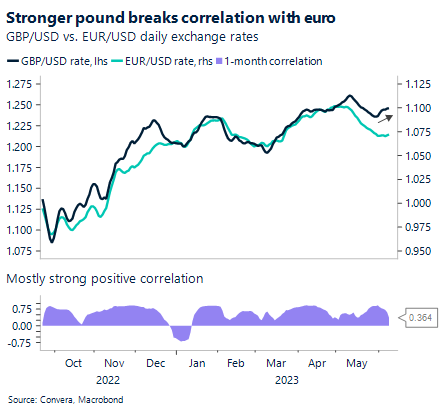
The one-year correlation between EUR/USD and GBP/USD remains a strong positive one but analysing a shorter one-month time frame we see that the resilience of the British pound has resulted in a decoupling of the aforementioned exchange rates as a result of markets pricing in a more hawkish Bank of England (BoE) relative to both the Federal Reserve (Fed) and European Central Bank (ECB).
After struggling to hold above its 50-day moving average this week, GBP/USD eventually broke north on Thursday, clocking its biggest one-day gain in over a month. The catalyst was a jump in US claims data, which softened Fed rate expectations and bolstered bets of a Fed pause ahead of the BoE. The upward move saw GBP/USD break above a key resistance level of $1.2545 as volumes in the currency pair surged, indicating a desire to push the pound towards fresh 2023 peaks. Although the euro also printed a strong daily gain against the dollar, the common currency has recently come under more selling pressure than the pound as bets on a hawkish divergence favouring the ECB have drifted lower. This is a result of weaker European macro data and falling inflation across the bloc.
As rate differentials move in the UK’s favour, this divergence should help support the pound further in the short-term, hence the rise in GBP/EUR to six-month highs this week and GBP/JPY extending its climb to its highest point since January 2016. The risk for the pound in the medium term is that the remedy may be worse than the disease, as excessive hiking may send the UK into a deep recession.
Euro, pound jump on higher initial claims
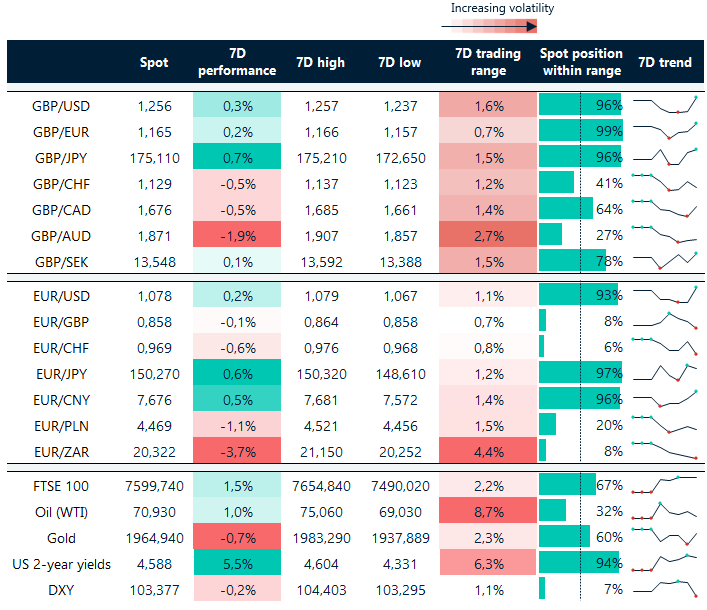
Table: 7-day currency trends and trading ranges
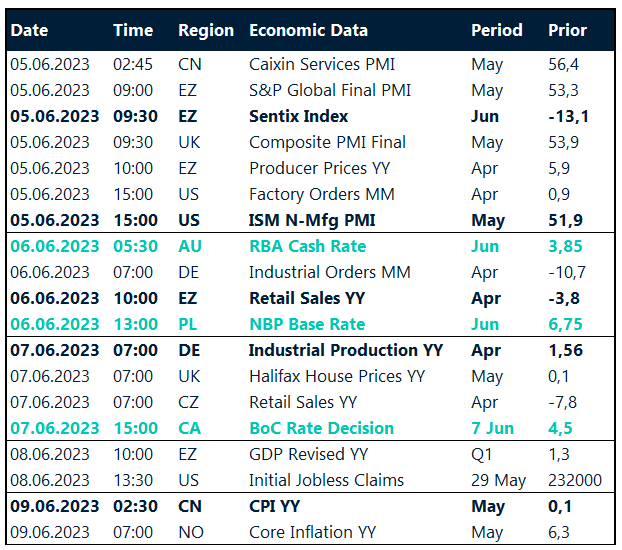
Key global risk events
Calendar: June 05- June 09
Have a question? [email protected]
*The FX rates published are provided by Convera’s Market Insights team for research purposes only. The rates have a unique source and may not align to any live exchange rates quoted on other sites. They are not an indication of actual buy/sell rates, or a financial offer.