
USD: When doves turn hawkish
Antonio Ruggiero
The dollar regained strength yesterday, with its index – the DXY – rising nearly 0.7%. It may have been Austan Goolsbee, a well-known dove, who sealed the cautious tone echoed by several Fed speakers this week, notably Chair Powell. When a dove speaks hawkishly, markets pay close attention. In an interview reported by the Financial Times, Goolsbee remarked that the labour market remains solid despite recent cooling, while inflation continues to tick higher. He ultimately expressed discomfort with cutting rates now, especially if the assumption is that inflation is merely a transitory by-product of tariffs.
As this week’s remarks sink in, investors are increasingly recognising that the Fed’s path remains highly data-dependent – and that the dollar may emerge as a medium-term winner: if the cautious Fed tone is validated by an uptick in the labour market and lingering price pressures – considered the Achilles’ heel of the U.S. economy – it could further support the dollar. After all, August’s and September’s weak NFP prints (covering July and August respectively) seemed more a product of uncertainty than a direct result of tariffs, many of which hadn’t yet taken effect. As these trade measures settle into the economic landscape and businesses begin to adjust, a rebound in labour market conditions remains plausible.
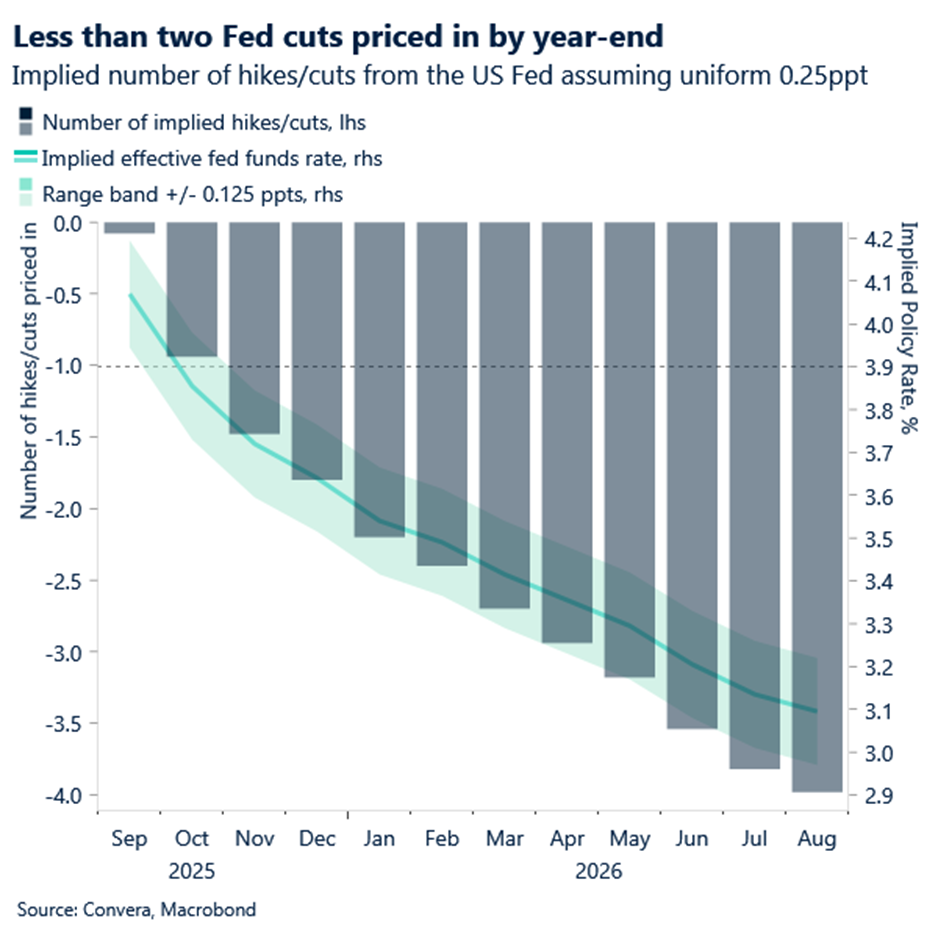
Markets are currently pricing in a ~43 basis-point cut by year-end – just shy of two full quarter-point reductions. In our view, the probability of two cuts is overpriced. With only two meetings remaining, a clearly data-dependent Fed, and an economy that isn’t exactly flashing recession warnings, we expect further easing expectations to be priced out.
Let’s keep an eye on weekly jobless claims today and the PCE report tomorrow as we try to pinpoint the pace at which the Fed may proceed with cuts.
EUR: Euro’s balancing act
Antonio Ruggiero
1.1725 appears to be the new short-term support level for EUR/USD, emerging from a shift in policy expectations from the Fed – one that markets took time to digest. Initially, there was aggressive pricing of easing, which later transitioned to a more moderate and conservative outlook. In response, the euro rallied, reaching new year-to-date highs, before paring back gains as hawkish repricing took hold.
Yesterday, the euro fell approximately 0.65% against the dollar, catching up with re-priced expectations. We expect the support level to hold as we await macroeconomic data from the U.S. that could further clarify the Fed’s policy trajectory – tomorrow’s PCE report being a clear case in point. Markets are currently pricing in a 43 basis-point cut by year-end, which we believe may be overly optimistic (see USD section).
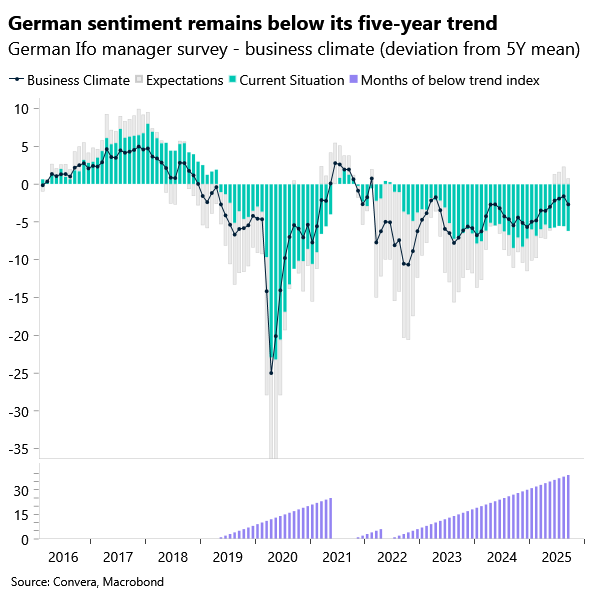
Meanwhile, weaker-than-expected German Ifo data added further pressure on the common currency, with both the current conditions and expectations components falling short of forecasts. This may reflect the long-awaited catch-up between sentiment – still buoyed by early optimism following the debt ceiling relaxation – and a much gloomier macroeconomic backdrop. That backdrop is marred by U.S. tariffs and a stronger euro, which remains a threat to export competitiveness.
GBP: Dovish Bailey adds to sterling’s strains
George Vessey
With no major data releases to provide direction, sterling slipped against the rebounding US dollar, falling to a three‑week low and breaking below key daily moving averages. GBP/USD slipped about 0.6% on Wednesday to suffer its third worst session of the month as downside momentum gathered pace after failing to sustain a recovery above its 21-day moving average.
The latest move reflects a broader dollar rebound that continues to weigh on most currencies and still has scope to extend. Support for the USD came from Fed Chair Jerome Powell, who offered little sign that policymakers are prepared to accelerate rate cuts, prompting traders to scale back easing bets. Fiscal tailwinds are also beginning to brighten the U.S. outlook, which so far has not been materially dented by Trump’s tariff regime.
By contrast, the UK’s slowing economy leaves sterling vulnerable. Even with markets pricing a relatively hawkish Bank of England (BoE) stance, growth differentials remain unfavorable. Sterling’s yield‑driven support is also looking fragile as long‑end gilt yields climb on fiscal concerns. Adding to the pressure, BoE Governor Andrew Bailey signaled that rates still have “further to fall,” expressing confidence that inflation is peaking and will decline into next year. Should rates traders adjust their expectations to price in another BoE cut this year, expect further GBP selling pressure to emerge.
Immediate support for GBP/USD is located at $1.3400, with a break below exposing the September swing low at $1.3333. On the topside, a recovery through the 21‑day moving average at $1.3520 would be needed to ease selling pressure, opening the way toward resistance near $1.3600.

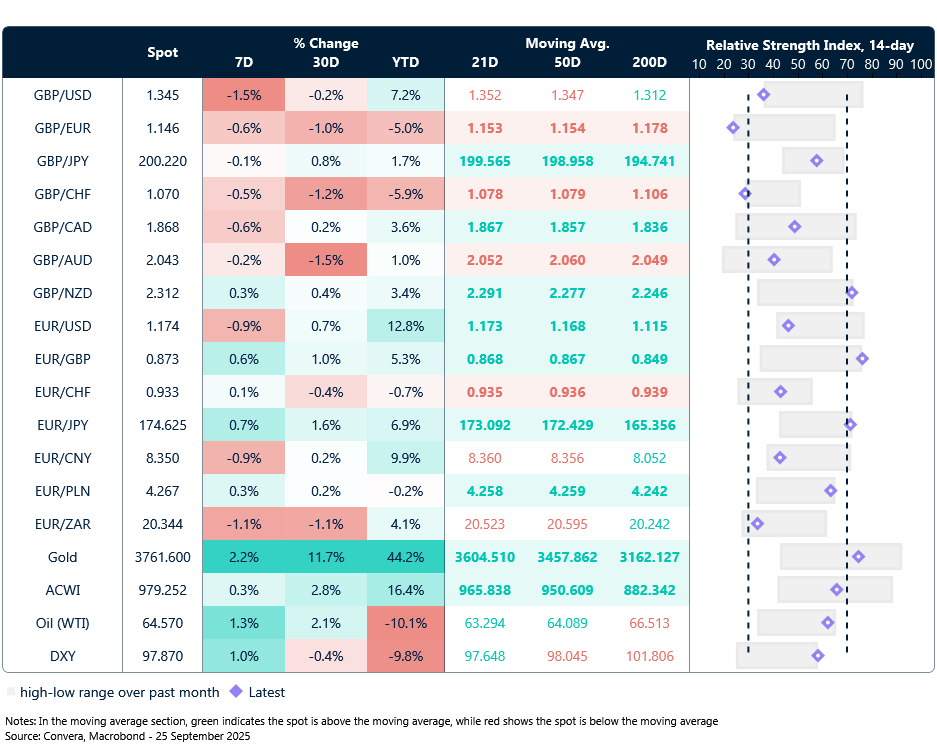
Sterling and euro crosses show selective bullish momentum, as indicated by RSI
Table: Currency trends, trading ranges and technical indicators
Key global risk events
Calendar: September 22-26

All times are in BST
Have a question? [email protected]
*The FX rates published are provided by Convera’s Market Insights team for research purposes only. The rates have a unique source and may not align to any live exchange rates quoted on other sites. They are not an indication of actual buy/sell rates, or a financial offer.