
Written by Steven Dooley, Head of Market Insights, and Shier Lee Lim, Lead FX and Macro Strategist
Euro rebounds after German election
The euro was higher on Monday after the centre-right CDU (Christian Democratic Union) won the largest vote in German national elections. The CDU now looks likely to form government with Friedrich Merz best positioned to be named as chancellor. The far-right AfD party came second with almost 20% of the vote. The current government, the centre-left SPD led by Olaf Scholz, came third with a record low 16% of the vote.
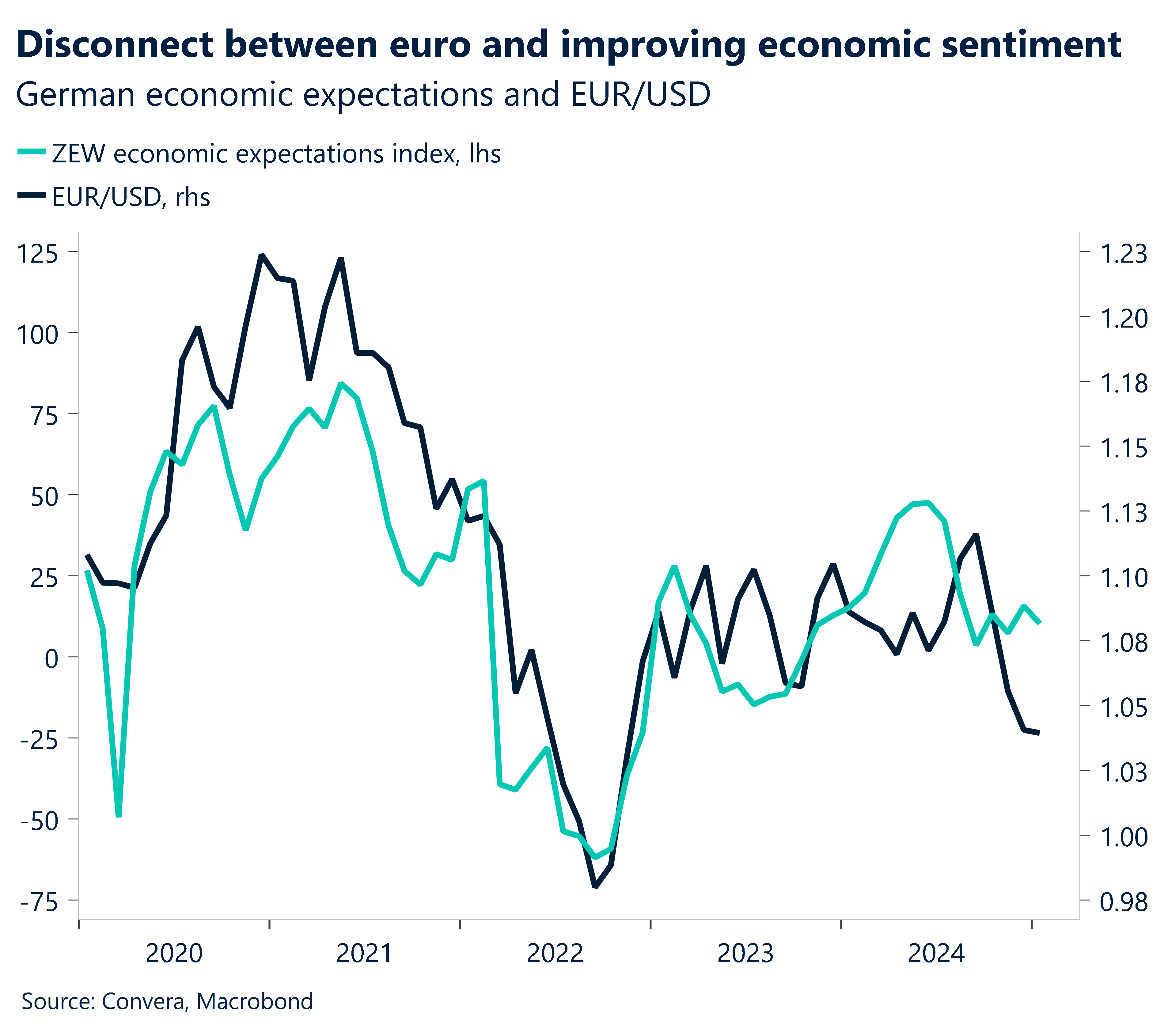
The euro has been recently pressured due to the uncertainty surrounding the German election but the single currency gained in early Monday trading.
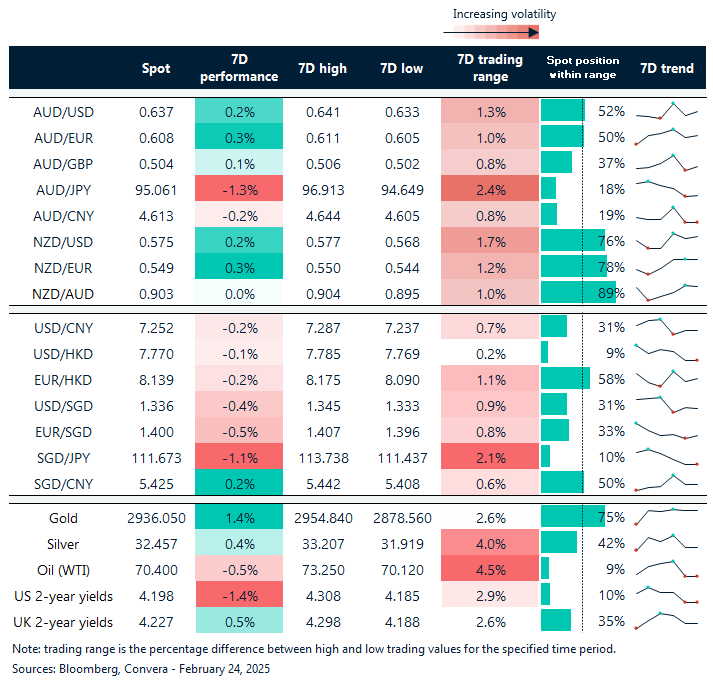
The EUR/USD neared two-month highs while the AUD/EUR fell from two-month highs. The EUR/SGD climbed from two-month lows.
Earlier, the US dollar was stronger on Friday, with the USD index climbing from two-month lows.
The AUD/USD fell from two-month highs with key resistance now seen at 0.6400.
The NZD/USD was also lower on Friday
The USD/SGD and USD/CNH both rebounded from recent lows.
Data wave to rock major FX
FX markets this week turn to inflation and growth data from major economies.
Key releases include US GDP, German CPI, Tokyo inflation, and Canadian GDP. These data will shape expectations for central bank actions and influence currency movements.
Key US data this week includes Q4 GDP, durable goods orders and personal income and spending figures. Strong growth metrics could support the USD.
The euro faces headwinds ahead of preliminary February CPI data from Germany and France. Weak Q4 GDP data from France highlights growth challenges, keeping EUR/USD under pressure after a flattish performance last week.
JPY traders will watch Friday’s Tokyo CPI and industrial production. A stronger yen could materialize if inflation surprises to the upside.
The AUD will react to January CPI data and China’s February PMIs.
Singapore CPI risks for SGD
Today, the CPI for Singapore will be revealed. Due in part to base effects from the final tranche of the GST tax rise, we anticipate core inflation to decline from 1.8% in December to 1.5% year over year in January.
Considering the phased-in 10% increase in public transportation fares starting on December 28 that counterbalanced the 3.4% decrease in the power rate in January, this would indicate a sequential pickup of 0.4% m-o-m sa following a 0.5% pickup in December.
While raw food inflation should continue to rise, mostly due to the Chinese New Year (CNY) effect, food price inflation should slow down in order to ease service inflation. In accordance with growing certificate of entitlement (COE) premiums, we anticipate headline inflation to increase from 1.6% to 2.4%.
In January, the MAS shocked us by softening the slope. A further increase in international tariffs would have a detrimental effect on H2 growth and perhaps result in another lowering of the S$NEER policy band later this year.
The USD/SGD climbed from three-month lows on Friday in a sign of potential further gains after 3.1% fall since mid-January. A weaker CPI number today could weigh on the Singapore dollar and see further USD/SGD gains.

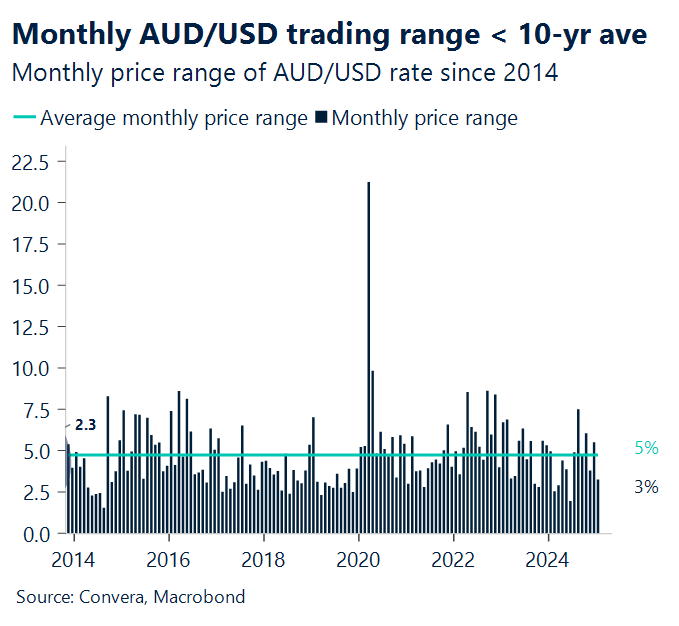
Aussie turns from highs
Table: seven-day rolling currency trends and trading ranges
Key global risk events
Calendar: 24 February – 1 March
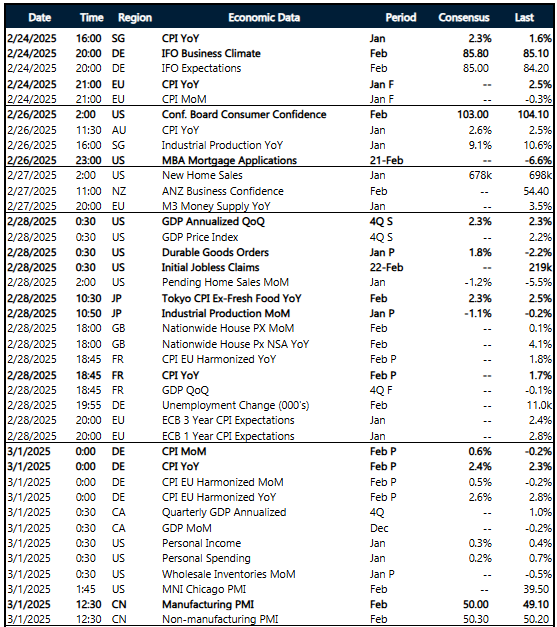
All times AEDT
Have a question? [email protected]
*The FX rates published are provided by Convera’s Market Insights team for research purposes only. The rates have a unique source and may not align to any live exchange rates quoted on other sites. They are not an indication of actual buy/sell rates, or a financial offer.