


USD: Two headwinds, one amplifier
The US dollar index – the DXY – dropped nearly 2% last week, its worst weekly performance since May 2025 when bearish sentiment peaked following the “Liberation Day” turmoil, and the weakness has extended into today’s Asia session. A confluence of factors contributed to the move, magnifying a decline that a tariffs-related sentiment drag alone may not have justified.
To start with, dollar sentiment weakened on the back of Trump’s hard-line stance on Greenland, including the coercive use of tariffs as a negotiation tool. This was paired with domestic political noise that added to the drag. The DoJ investigation involving Chair Powell, scrutiny around the Fed leadership transition, and the pending Supreme Court ruling on tariff authority all resurfaced within days of each other. None of these themes were new, but their clustering created a stronger bearish impulse.
Then came rising expectations that the BoJ and the Fed may step in jointly to contain yen weakness through intervention, sending USD/JPY as low as 153.40 during the Asia session today, the weakest level since mid‑November. The discussion around a potential currency pact emerged on Friday after reports that the Federal Reserve Bank of New York had contacted financial institutions to ask about the yen’s exchange rate. Wall Street interpreted those inquiries as potentially laying the groundwork for Japan to intervene with support from the US. Recent communication from Finance Minister Katayama and Treasury Secretary Scott Bessent also hinted at the possibility of joint intervention. The hit to the dollar from this coordinated signalling stems from two channels. First, it implies US openness to a softer dollar, which supports US export competitiveness. Second, expectations of Japanese intervention have repriced USD/JPY tail risk, making JPY‑funded carry trades less attractive and removing a key source of marginal USD demand, which has amplified the broader weakness.
Finally, positioning has been the ultimate amplifier. With asset managers adding to USD longs for two straight weeks while leveraged funds increase bearish bets, the dollar’s recent softness may be concealing a distinctly tactical character. Yes, some investors cut USD exposure out of caution, but others may be trimming longs with the intention of re‑entering at better levels ahead of the Fed this week. After all, before this geopolitical turbulence, the dollar had been firm, cautiously embracing a hawkish Fed repricing narrative. And with a precedent of quick turnarounds following geopolitically driven volatility, the tactical instinct appears logical.
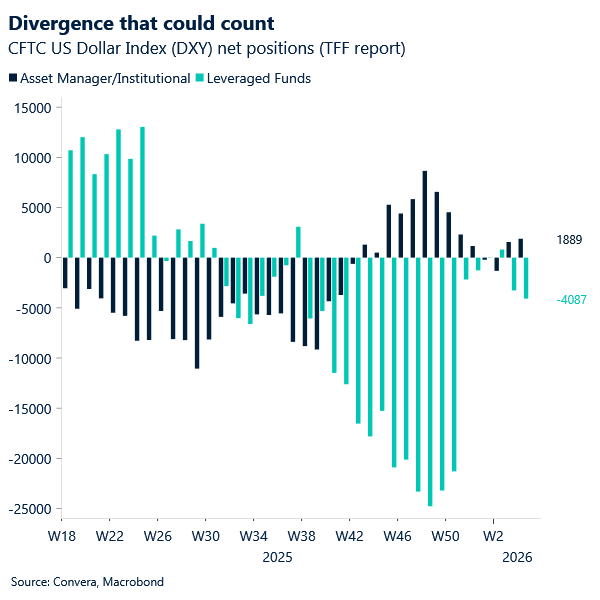
The FOMC’s 28 January meeting in fact sits at the centre of this week’s price action and also serves as a diagnostic tool for last week’s drivers. The meeting may help reveal whether the recent selling was driven by fear or by tactical long‑term buyers acting opportunistically. Should the dollar firm this week, it would suggest that the earlier weakness had a strong tactical character.
Beyond rates, earnings from the Magnificent 7 this week are highly anticipated as a gauge of AI‑profitability momentum. We will also note the final release of nonfarm productivity and unit labour costs this week (Thursday). Doves have leaned on these prints as evidence of AI‑fuelled productivity gains and lower unit labour costs, both of which may help cap inflation pressures.
GBP: Sterling finds lift only on big (positive) surprises
Sterling began last week on a softer note as the UK became a key target of Trump’s tariff threats. GBP/EUR was the clearest channel through which to observe sterling’s vulnerability during the geopolitical flareup. As expected, domestic data had limited impact. With the committee still split and well‑telegraphed trends such as labour‑market softness and sticky inflation once again validated in last week’s data, markets remain in a similar state of paralysis.
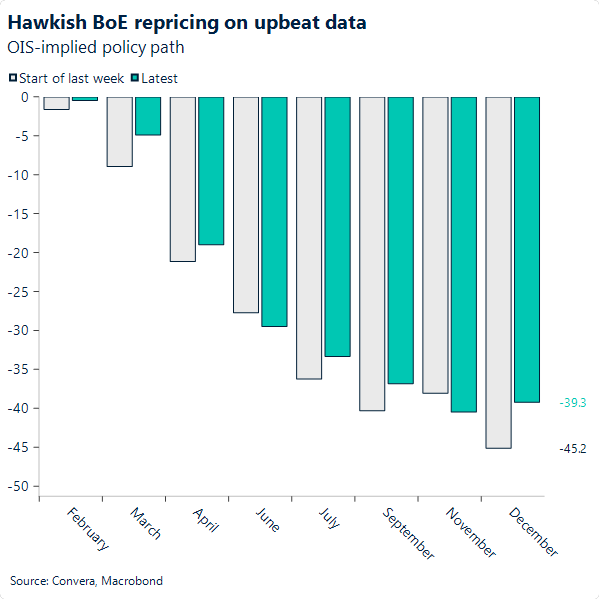
When consensus is anchored in one‑sided softness, however positive surprises carry greater weight. Friday’s stronger retail sales and firmer PMIs generated more meaningful upside. GBP/USD pushed into the 1.35 zone and GBP/EUR consolidated around 1.15. In GBP/EUR, the move higher also reflected the unwinding of the geopolitical risk premium as de‑escalation came through quickly.
In the coming days, we see GBP/EUR as less exposed to lingering geopolitical risk than GBP/USD. A break above January’s 1.1550 resistance looks unlikely on the back of two strong data prints alone, but support along the 100‑day moving average at 1.1455 should hold firmly. A confident test of that resistance becomes our base case if well known cut supporters on the committee begin to adopt more hawkish messaging.
This week is quiet on the data front and BoE speakers are sparse, leaving little scheduled impetus for sterling. That points to fairly orderly price action, with some downside risk if investors dial back Friday’s hawkish repricing, which looked overdone given that the two positive data surprises remain a drop in the ocean against a softer broader backdrop.
EUR: Fresh 4-year highs in sight
EUR/USD charged almost 2% higher last week — its biggest weekly gain since early April — as broad‑based dollar weakness propelled the pair toward $1.19. If negative USD momentum continues to build, the path toward a new 4‑year high may arrive sooner than we expected.
Adding to the euro’s bounce is the prospect of short covering in CFTC positioning, which hit a two‑month extreme in the latest data. That means positioning itself becomes a tailwind: as bearish bets are unwound, forced buying can amplify upside moves, giving EUR/USD an additional mechanical boost on top of the fundamental dollar weakness.

The fundamental backdrop for the euro remains mixed, but last Friday’s flash PMI data offered enough strength to keep the rally alive. The composite output index held at 51.5, signalling that eurozone private‑sector activity is still expanding — modestly, but now for 13 consecutive months. Manufacturing output has returned to growth, and business confidence has climbed to a 20‑month high, adding a layer of resilience to an otherwise uneven macro picture.

With early signs pointing to a brighter eurozone outlook in 2026, this week’s preliminary Q4 GDP prints for France, Germany and the wider bloc will be crucial in showing how the region closed out 2025 and entered the new year. At the same time, a fresh round of sentiment data — including Germany’s IFO Business Climate and the European Commission’s consumer and business surveys — will help reveal how confidence is evolving across households and firms. Together, these releases will offer the first meaningful read on whether optimism about a eurozone upturn is grounded in reality or still running ahead of the data.
And if USD/JPY continues to slide, the spillover will be felt across the majors. A weaker dollar against the yen often bleeds into broader USD softness, reinforcing moves in pairs like EUR/USD and GBP/USD as positioning adjusts and cross‑market correlations kick in.
Market snapshot
Table: Currency trends, trading ranges & technical indicators

Key global risk events
Calendar: January 26-30
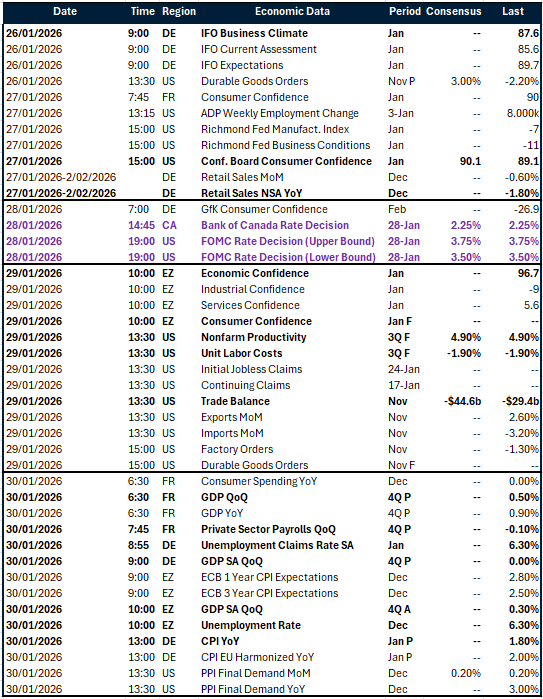
All times are in GMT
Have a question? [email protected]
*The FX rates published are provided by Convera’s Market Insights team for research purposes only. The rates have a unique source and may not align to any live exchange rates quoted on other sites. They are not an indication of actual buy/sell rates, or a financial offer.