

Key Takeaways
- The US dollar recovered slightly after being affected by last week’s intervention, with USD/JPY possibly facing further upside unless policy shifts occur.
- Stronger US manufacturing data bolstered the dollar, while inflation pressures remain a concern for the Fed in light of energy price volatility.
- The Canadian dollar lagged behind peers post-Fed meeting, constrained by lower oil prices and limited supportive local data.
- The Mexican peso strengthened against the dollar, supported by positive domestic GDP growth and a widening trade surplus, even as Banxico is expected to hold rates steady.
USD: Dollar holds as data offset Yen shock
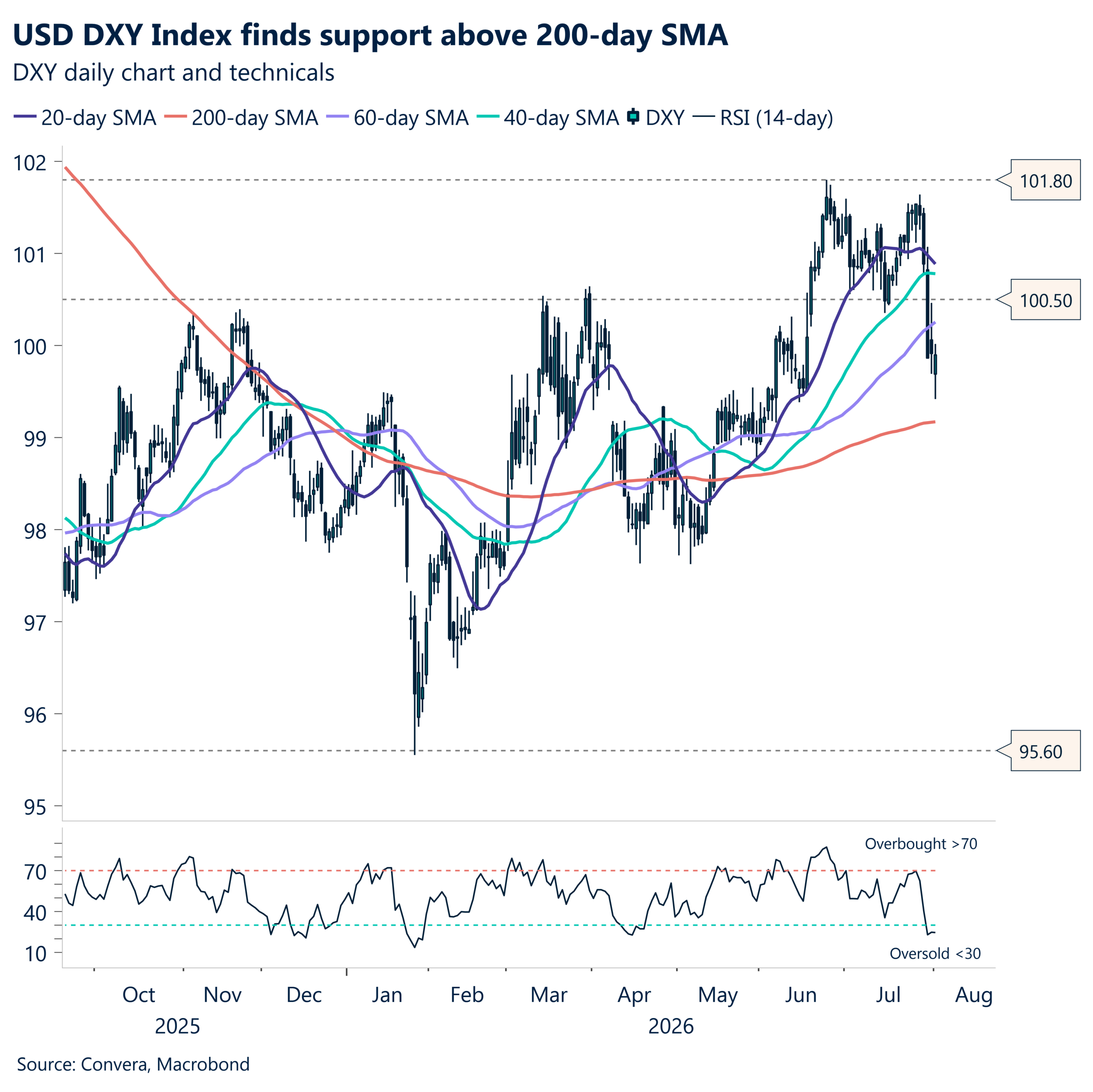
The US dollar regained some ground on Monday after last week’s intervention-led selloff. USD/JPY recovered from its post-intervention lows, even as traders remained alert for further official action. Japanese authorities, with US support, have made clear they are no longer comfortable with disorderly yen weakness. Still, intervention can slow USD/JPY’s rise more easily than reverse it while rate differentials remain wide.
Officials may lean harder against a fast rebound, especially near the 200-day moving average around 158 and with yen-funded carry trades still crowded. But the bigger drivers have not gone away: US-Japan yield gaps, strong AI-led equity momentum and lingering domestic policy risks in Japan. Unless Fed pricing turns softer or the BoJ backs the yen with a clearer policy shift, the path of least resistance for USD/JPY should remain higher.
Back in North America, stronger US manufacturing data gave the dollar another source of support. The ISM manufacturing index rose to 55.6 in July, its strongest reading since May 2022, with production and new orders both improving. The employment index also returned to expansion for the first time in 33 months, pointing to firmer factory momentum. AI-linked investment, defense spending and stronger capital expenditure continue to support the manufacturing channel.
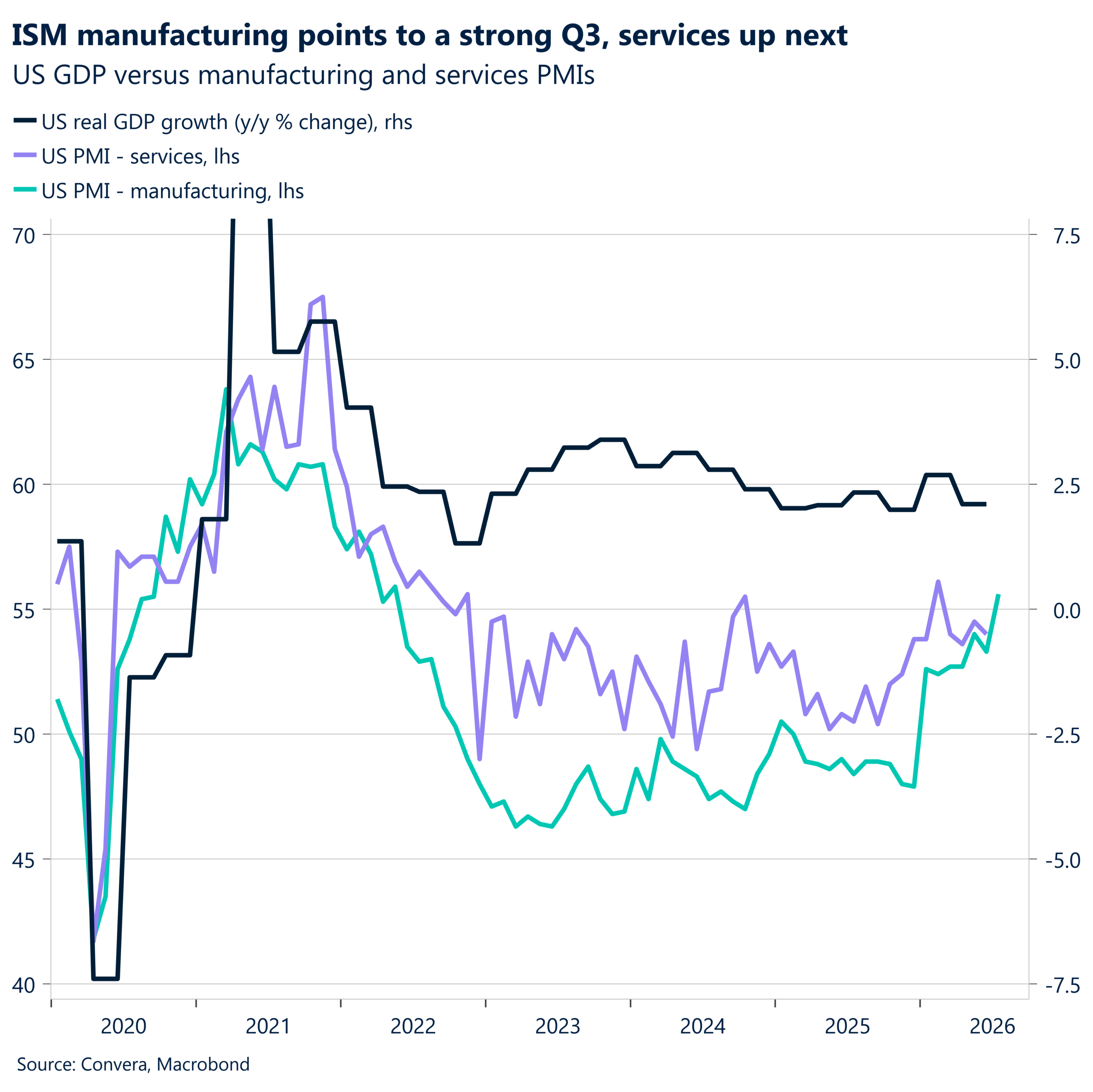
The report was not cleanly disinflationary. ISM’s prices index eased from June but remained elevated, showing that input-cost pressure has not gone away. That matters for rates, especially with energy prices still sensitive to Middle East headlines. For the Fed, the data point to an economy that is holding up, even if softer inflation gives policymakers room to wait.
Last week’s Fed meeting left the curve steeper, as long-end breakevens rose more than real yields. That suggests markets are not only pricing fewer near-term hikes but also questioning how firmly the Fed will defend the inflation target under Chair Warsh. Oil volatility and heavy AI-related bond issuance may have added noise, but the reaction still points to a higher dollar uncertainty premium than before the meeting.
Last week’s decline was amplified by stretched positioning and the yen rally, but stronger US data have helped limit the downside. This week’s JOLTS, ISM services and payrolls reports will now carry more weight. If labor demand stays firm, September could become the test of whether Warsh’s hawkish tone turns into action, allowing the dollar to rebuild some policy support.
CAD: Loonie trails the G10 post-Fed meeting
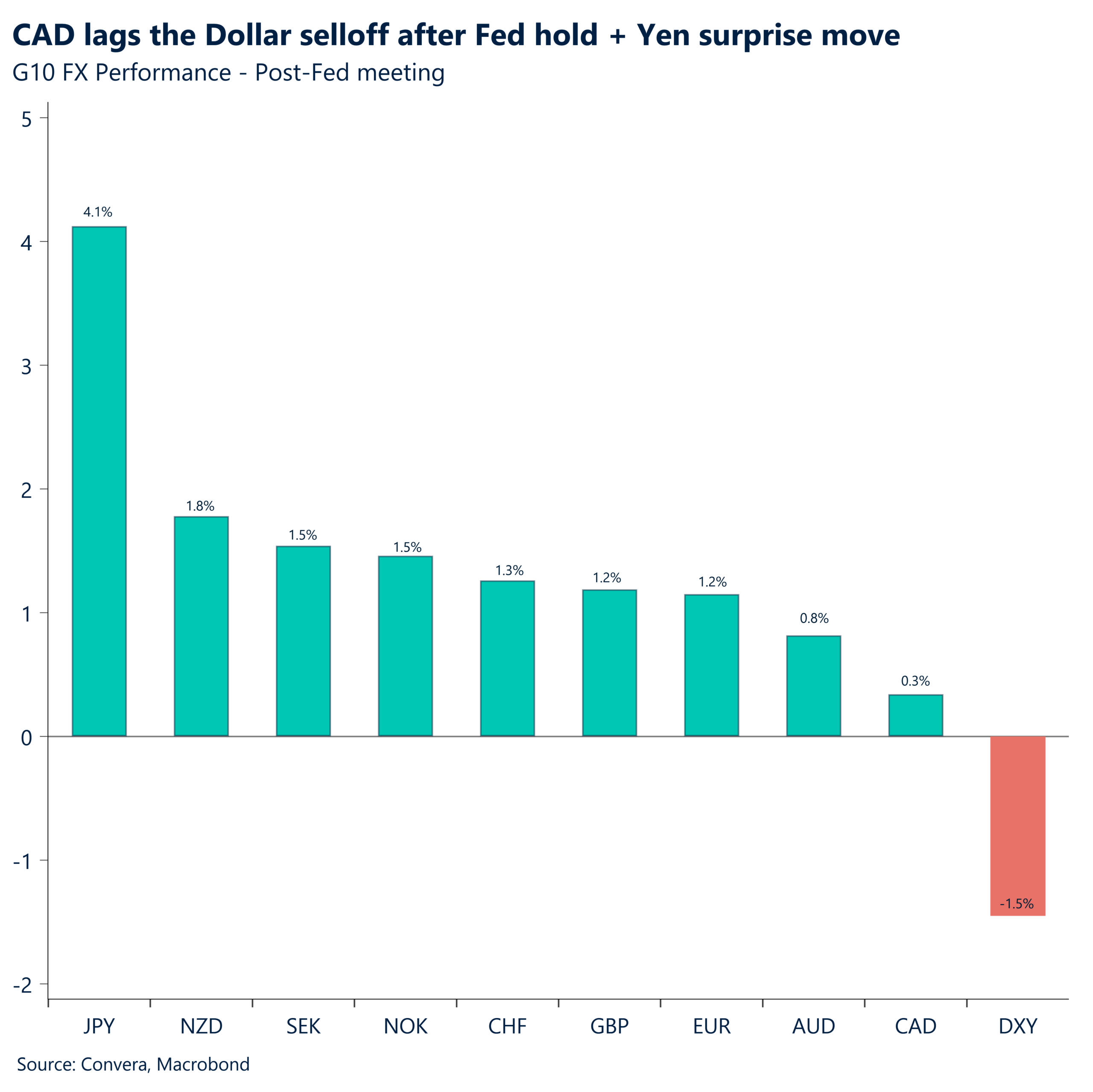
USD/CAD did not fully join the broader G10 rally after the Fed. The US dollar fell after the no-hike, no-guidance message, but CAD’s gain was more restrained than most peers. USD/CAD briefly touched 1.399, its lowest level in more than a month, before moving back toward 1.404. That price action shows the pair is not trading only on the broad dollar move.
The local backdrop explains part of the hesitation. Lower oil prices have removed a clear source of CAD support, while US-Canada rate spreads continue to limit downside in USD/CAD. The Fed may have taken immediate hike risk out of the dollar, but markets still see another move as possible by the fall. That keeps short-end rate support alive and makes a deeper USD/CAD pullback harder to sustain.
Canadian data have improved, but not enough to shift the pair on their own. May payrolls rose 26k and June GDP increased 0.2% m/m, adding to evidence that the economy is recovering despite a difficult external backdrop. Even so, the upbeat GDP print has done little for CAD so far. USD/CAD remains more tied to US dollar price discovery and relative yield performance.
That said, markets may not be fully pricing the firmer Canadian growth backdrop. Heavy short CAD positioning creates room for a sharper loonie rebound if domestic momentum continues and Fed pricing turns more dovish. For USD/CAD to break lower with conviction, Treasuries likely need to rally further, oil needs to stabilize, or Canadian data need to force more aggressive short covering. For now, CAD is only cautiously participating in the post-Fed dollar fade.
MXN: Peso holds firm ahead of Banxico meeting
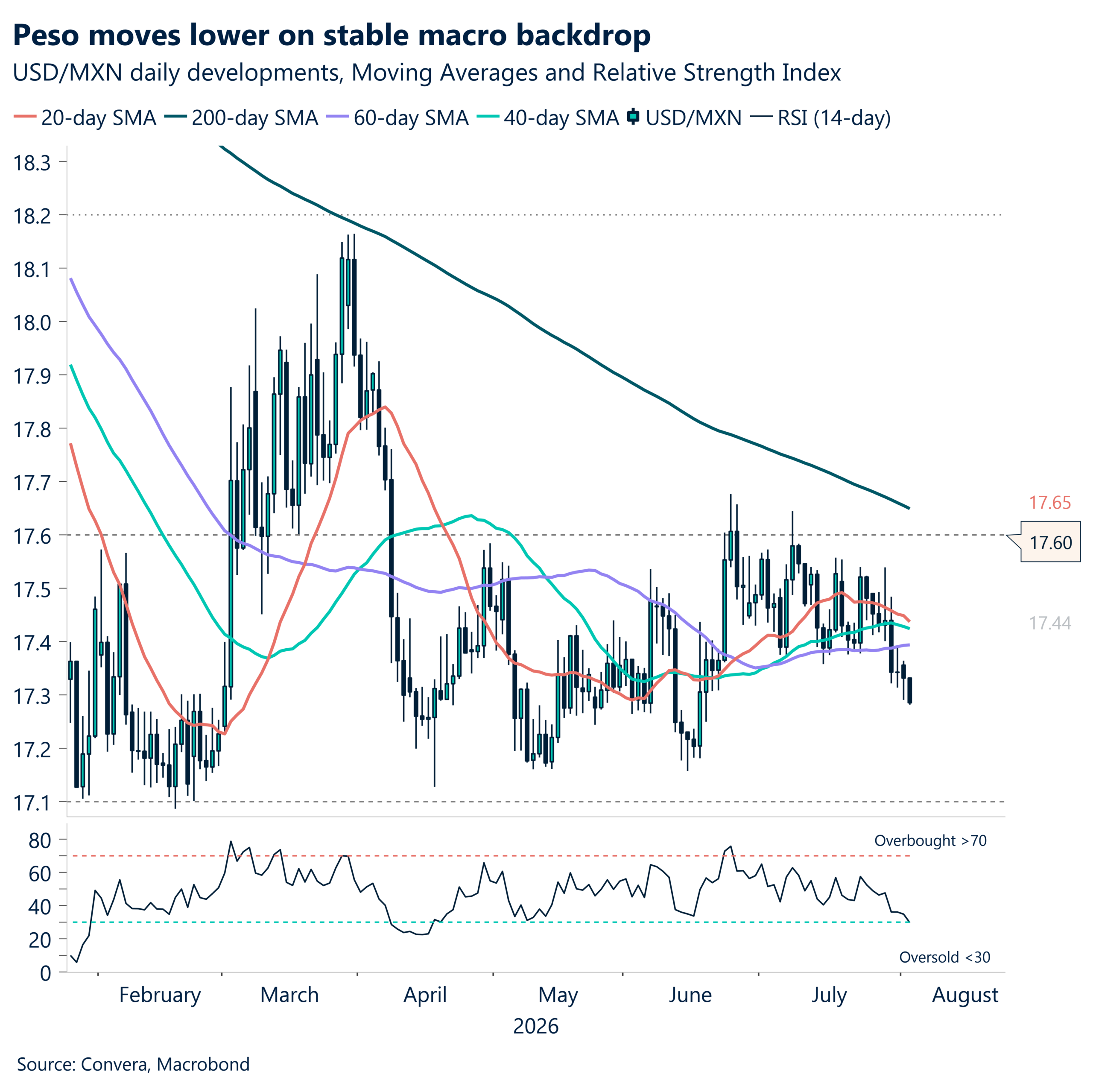
USD/MXN has fallen toward 17.28, with the peso at its strongest level in more than a month after the Fed held rates and yen intervention knocked the dollar lower. Domestic data added support, as Mexico’s Q2 GDP beat expectations with growth of 1.5% q/q and 2.2% y/y. That marked the fastest quarterly expansion since late 2020. All three major sectors contributed, giving the peso a stronger local backdrop than most peers.
The export story is also helping. Mexico’s June trade surplus widened to about $4.1bn, while exports rose 34.4% y/y to roughly $72.5bn. Strong exports have cushioned the economy against weak fixed investment and ongoing uncertainty around US trade policy. World Cup-related activity likely lifted commerce, tourism and transport in Q2, though that boost may fade later in the year.
For Banxico, stronger growth is unlikely to change this week’s decision. The central bank is still expected to keep rates unchanged and signal that the current policy stance remains appropriate. Inflation is close to target and with a Fed showing little urgency to tighten again, that leaves a stable macro backdrop for the Peso.
The technical setup remains tilted lower for USD/MXN. The pair is trading below the 20-day, 50-day and 100-day moving averages, while the 200-day near 17.66 now looks distant unless the dollar regains momentum. Near-term support sits around 17.25. With Mexico’s external accounts improving and the dollar premium back in focus, MXN should remain supported for now.
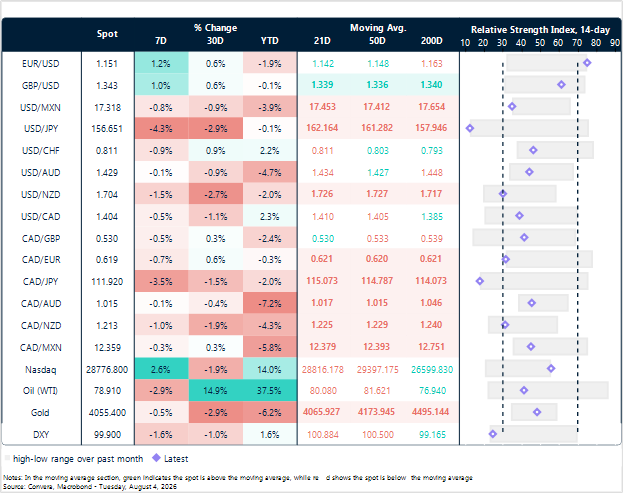
Market snapshot
Table: Currency trends, trading ranges & technical indicators
Key global risk events
Calendar: August 03 – 07
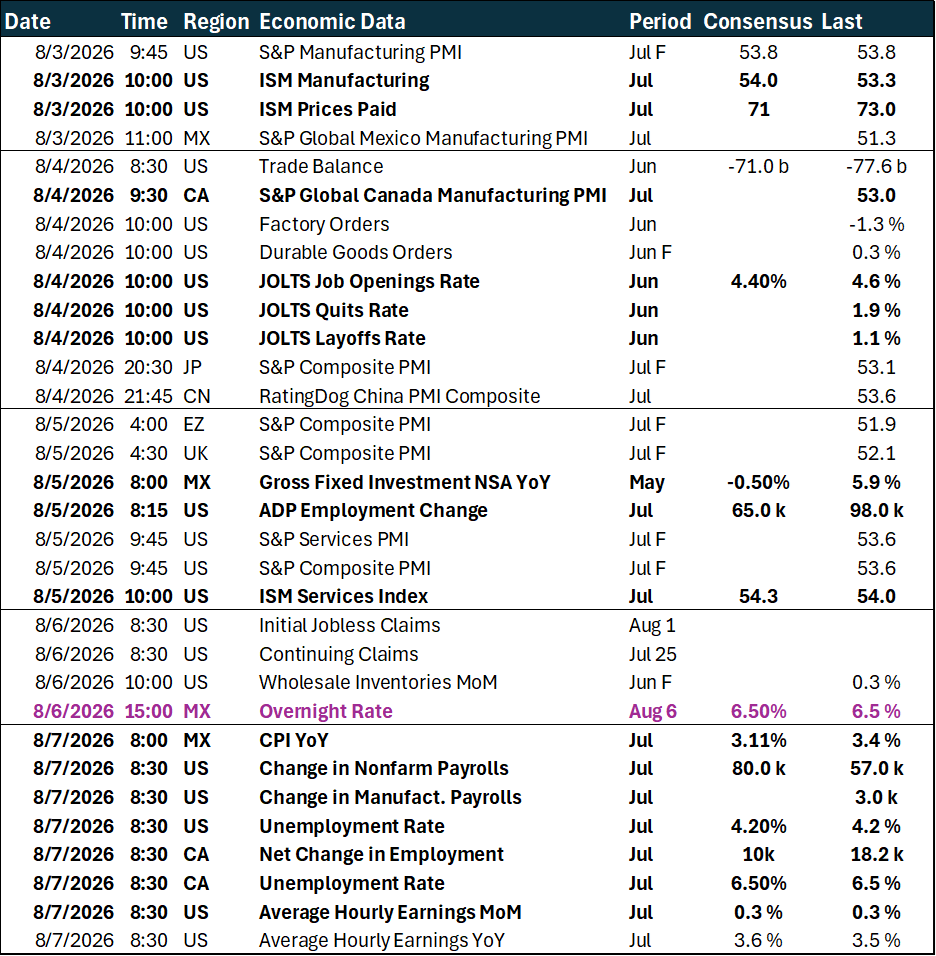
All times are in EST
Have a question? [email protected]
*The FX rates published are provided by Convera’s Market Insights team for research purposes only. The rates have a unique source and may not align to any live exchange rates quoted on other sites. They are not an indication of actual buy/sell rates, or a financial offer.