


Key Takeaways
- The US dollar index rose 1% last week due to a re-awakened hawkish Fed narrative, with markets pricing a December rate hike after inflation data.
- The euro has broken below key support levels, indicating persistent downside pressure amid hawkish Fed expectations and ongoing European political risks.
- Sterling stays supported, but a push through 1.20 looks like a difficult test for GBP/EUR.
USD: Hawkish Fed underpins dollar’s strength
The US dollar index rose just over 1% last week, reaching its highest level since April 2025 at 103.486 and closing out its best week in over a month.

A revitalized hawkish Fed narrative remains the main force behind the move. Markets are now fully pricing a 25bp December hike after October’s CPI overshot expectations. Friday’s PPI print was slightly more benign, with headline inflation at 6.5% y/y vs 6.6% expected and 0.3% m/m vs 0.4% expected.
Still, one print doesn’t make a trend. PPI inflation remains around 2022 highs as the Middle East energy shock continues to feed through the value chain.
Two-year Treasury yields climbed roughly 30bp over the week to trade near 4.85% as hawkish Fed bets strengthened.
The question now is how much further yields can rise, particularly beyond 5%, with markets already pricing nearly three hikes by April 2027. That makes the case for another leg higher in the dollar less straightforward.
Quite a lot of Fedspeak this week, with Warsh, Williams, Waller and Jefferson among the scheduled speakers.
Watch for any softening in tone following the recent decline in oil prices. The Fed will also have a pre-release copy of the November inflation report ahead of its December decision. Given the sharp drop in energy prices so far this month, the report could prove relatively underwhelming (we don’t get to see it until after the Fed’s December policy decision).
Outside of the Fed, watch for Nvidia’s earnings this week. They are particularly significant given the ousting of Jensen Huang as CEO and the toll this has taken on broader AI sentiment. Will an already high bar to impress investors be even higher now that the company’s future is less clear? That’s likely to be the case. There is a clear risk that selling pressure in stocks builds again in the aftermath.
Overall, we suspect the dollar doesn’t have much room to rise over the coming days. While retaining a constructive bias, we favour consolidation over another burst of bullish momentum for now. Any downside should remain contained around 103, followed by 102.50.
EUR: Key support gives way
The euro’s week has shifted decisively from attempted recovery to renewed downside pressure. EUR/USD initially benefited from improving risk sentiment and lower oil prices, but Tuesday’s hotter US CPI print, following an already strong payrolls report, reinforced Fed hiking expectations and put US yields and the dollar firmly back in control.
The result is technically significant. EUR/USD has broken below 1.11 to its weakest level since May 2025, extending a run that has seen the pair fall in nine of the past ten weeks. The decline has been persistent rather than disorderly. Individual weekly losses have generally been modest, but their consistency has created one of the sharpest 10-week declines of the past few years (see chart).
Crucially, the break takes spot below the 1.1110–1.1115 support zone, where the 50% retracement of the March 2025–January 2026 rally converges with the 200-week moving average. With that floor breached, attention shifts to the psychological 1.10 handle, followed by the next major retracement around 1.0880.
On the fundamental side, US data remain resilient and Fed expectations lean more hawkish by the week, while the euro continues to carry a sizeable domestic risk premium. French fiscal and political uncertainty remains unresolved, broader European political concerns linger, and Russia’s recent rejection of a Ukraine land swap has dampened hopes of near-term geopolitical progress.
The one potential brake on further declines is positioning. Euro shorts are already heavily stretched, increasing the risk of sharp short-covering rallies.
Still, the broader message is increasingly difficult to ignore: EUR/USD has lost an important technical floor just as relative rates and political risk are moving against it. Near-term rallies may therefore remain corrective rather than signal a durable change in trend.

GBP: Bulls meet the 1.20 ceiling
The pound faces a busy week ahead, with the jobs report (17 Nov) and October inflation (18 Nov) due.
Markets currently price a 75% chance that the BoE will hike rates again in December, having taken the Bank Rate to 4% on 4 Nov following a 25bp hike. This week’s data could very well be the catalyst for that pricing to deepen.
No surprise if October’s inflation snapshot comes in hot. But that may already be old news to Andrew Bailey, who seemed quite eager to acknowledge that the recent drop in oil prices, if sustained, could reduce the need for another hike.
Look for a repeat of that message this week, with the Governor scheduled to speak. That should leave markets in wait-and-see mode on the Bank’s next steps, barring, of course, a significant rebound in energy prices.
Our outlook for sterling remains constructive, but understandably more pragmatic now that consensus is building around a bullish pound profile.
GBP/EUR has somewhat exhausted its bullish fuel, unable to breach 1.20. Understandably so, given the significance of the level. The pair continues to be rejected at 1.20 but finds support around the 21-day moving average, suggesting buyers are still willing to defend this short-term anchor.
The case for more range-bound trading in the coming weeks, with 1.20 as a firm ceiling, looks to be the base case, although we do not exclude a breakout should the narrative around a 25bp hike in December strengthen.

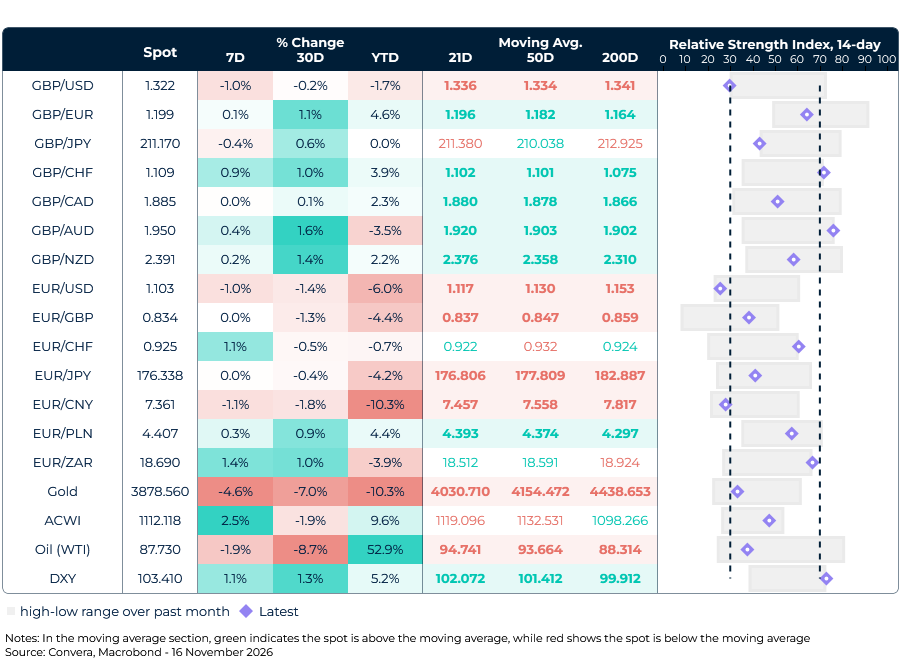
Market snapshot
Table: Currency trends, trading ranges & technical indicators
Key global risk events
Calendar: November 16-20

All times are in GMT
Have a question? [email protected]
*The FX rates published are provided by Convera’s Market Insights team for research purposes only. The rates have a unique source and may not align to any live exchange rates quoted on other sites. They are not an indication of actual buy/sell rates, or a financial offer.