
Written by Steven Dooley and Shier Lee Lim
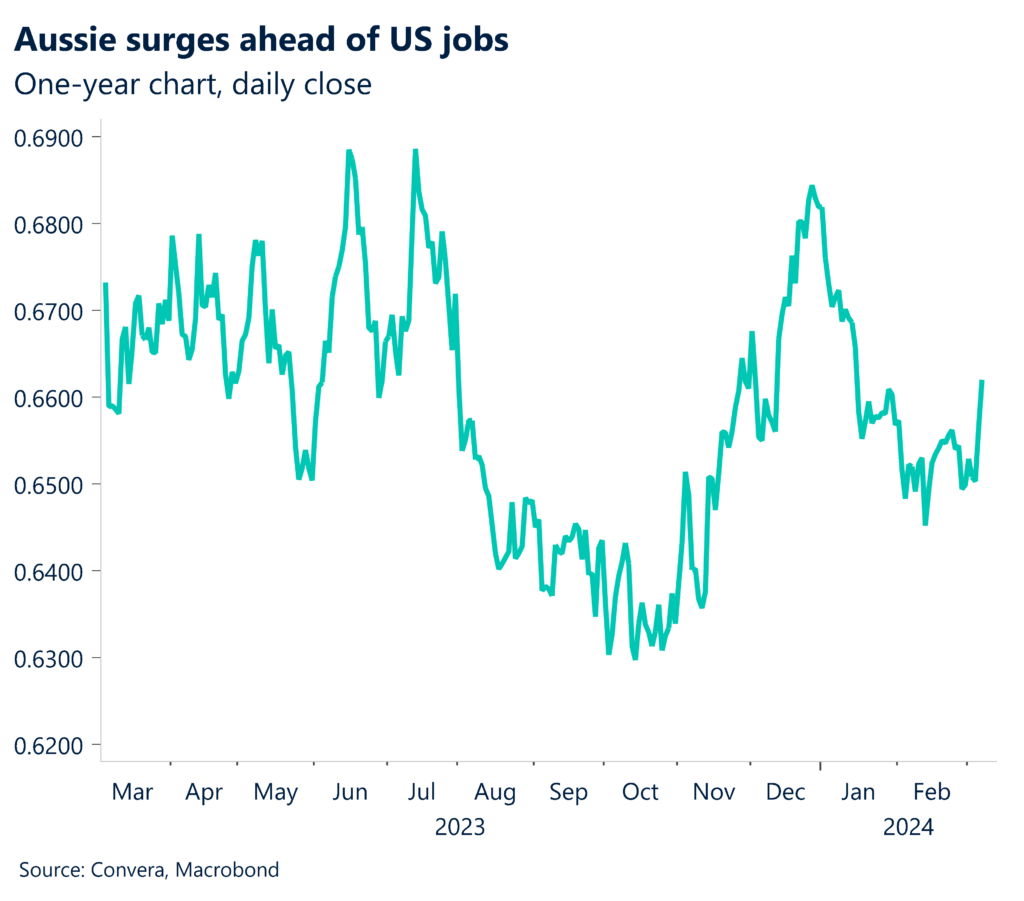
Aussie outperforms ahead of US jobs
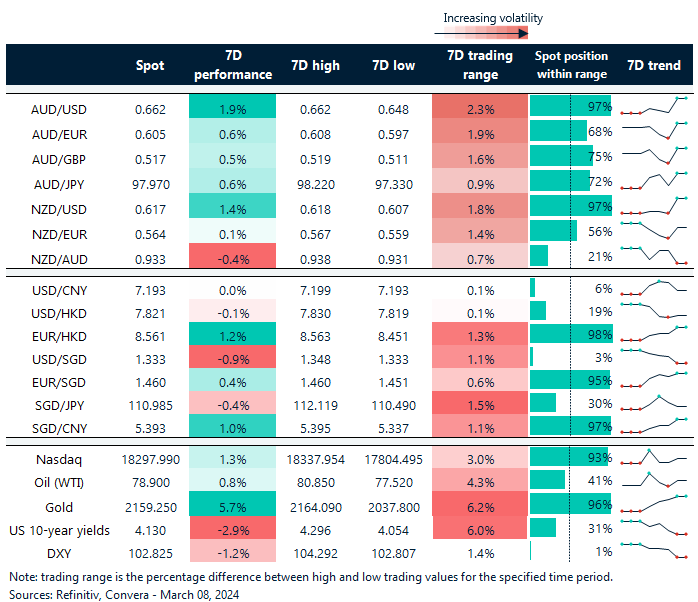
The greenback fell further on Thursday after this week’s testimony from US Federal Reserve chair Jerome Powell indicated the US central bank was likely to cut rates towards this middle of this year.
The USD index fell 0.5% as it dropped to the lowest level since 17 January.
The AUD/USD led gains for a second day up 0.8% to the highest level in two months.
The NZD/USD gained 0.7%. The euro and British pound saw smaller gains.
In Asia, the USD/JPY fell 0.8%, USD/SGD lost 0.4% while USD/CNH lost 0.1%.
Tonight, US non-farm employment report is due, with markets looking for around very strong 200k new jobs after last month’s massive 353k result.
German production likely to slow further
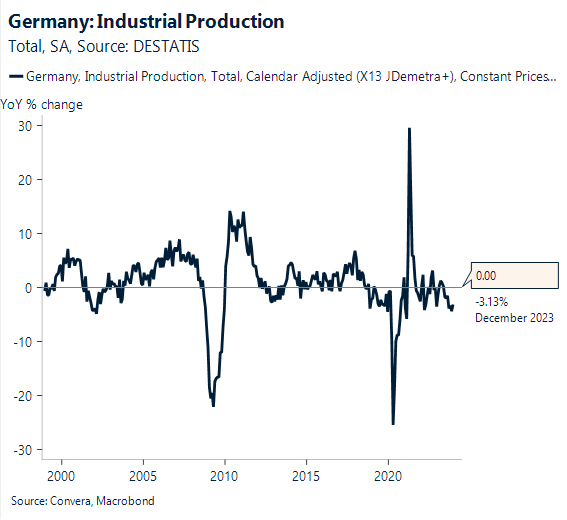
We project a 0.1% month-over-month fall in German industrial production, marking the fifth consecutive month of contraction.
Surveys are still far within contraction area, despite improvements throughout the month. We do, however, appreciate the upside risks associated with the 6% month-over-month rise in automobile manufacturing.
We maintain our pessimistic view on the euro, believing that it should eventually weaken vs USD given it is used as a funder.
UK jobs also due
The UK jobs news for January was typically worse. The permanent salary index dropped to 55.8, which is now below its long-run pre-pandemic average of 56.7, while the permanent placements index dropped down to 43.4, suggesting declining employment.
Nonetheless, there were indications that the supply and demand ratio was beginning to improve, as the need for staff index stabilized and staff availability somewhat eased. These numbers will be of great interest to many given the intense attention on the tight labor market, especially with regard to wages, employment, and supply vs demand.
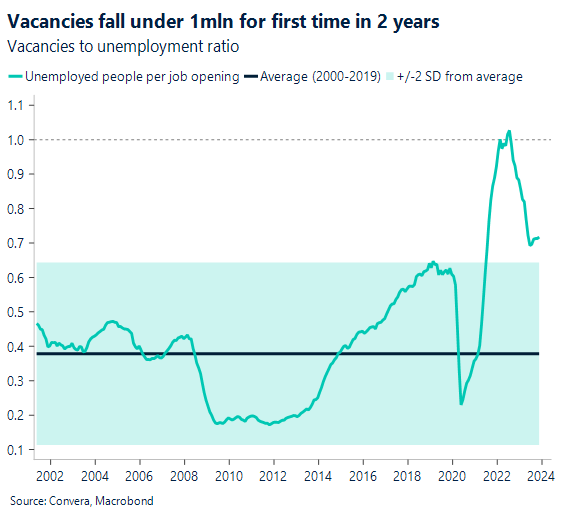
The above chart shows the unemployed people per job openings ratio, which is a valuable measure that can be used to identify tightness or slack in the economy. When ratios equal 1.0, there is approximately 1 unemployed person per job opening. When ratios equal more than 1.0, the labor market is tight, as job openings outnumber the unemployed. When less than 1.0, there is slack in the market because there are more unemployed people than available jobs.
Overall, we continue to believe that there is a route for wage growth and inflation in the UK to normalize, which will enable the market to price in more rate cuts in 2025 and weaken the yield support the GBP has received. We continue to have a pessimistic outlook for GBP.
USD lower ahead of jobs
Table: seven-day rolling currency trends and trading ranges
Key global risk events
Calendar: 4 – 9 March
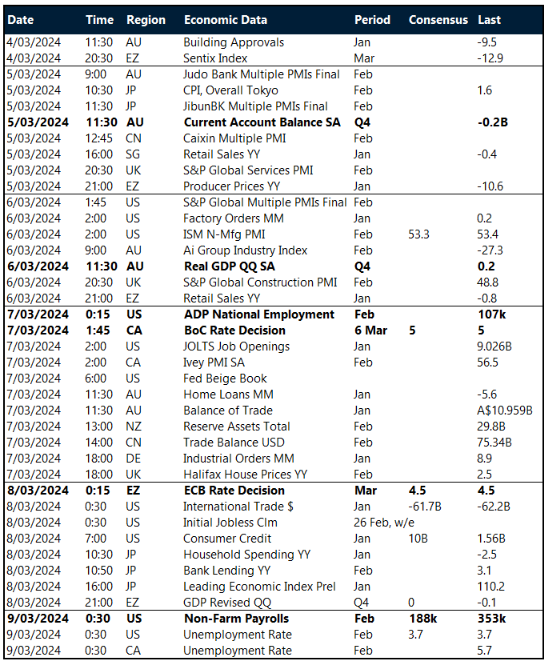
All times AEDT
*The FX rates published are provided by Convera’s Market Insights team for research purposes only. The rates have a unique source and may not align to any live exchange rates quoted on other sites. They are not an indication of actual buy/sell rates, or a financial offer.
Have a question? [email protected]
Check out this week’s Converge podcast with financial markets driven by key themes: falling inflation, reduced expectations for interest rate cuts and low volatility.