
Greenback gains as global shares fall
The US dollar was stronger overnight as global sharemarkets took another step lower reversing some of the strong gains seen over the month.
The US’s benchmark S&P 500 gained 8.4% since late May while the tech-focused Nasdaq was up 13.0% over the same time.
However, this enthusiasm has eased this week, with global equity markets lower, and the USD higher.
The US dollar gained across Asia with the USD/SGD and USD/CNH up 0.2%, while the NZD/USD fell further, down 0.5%.
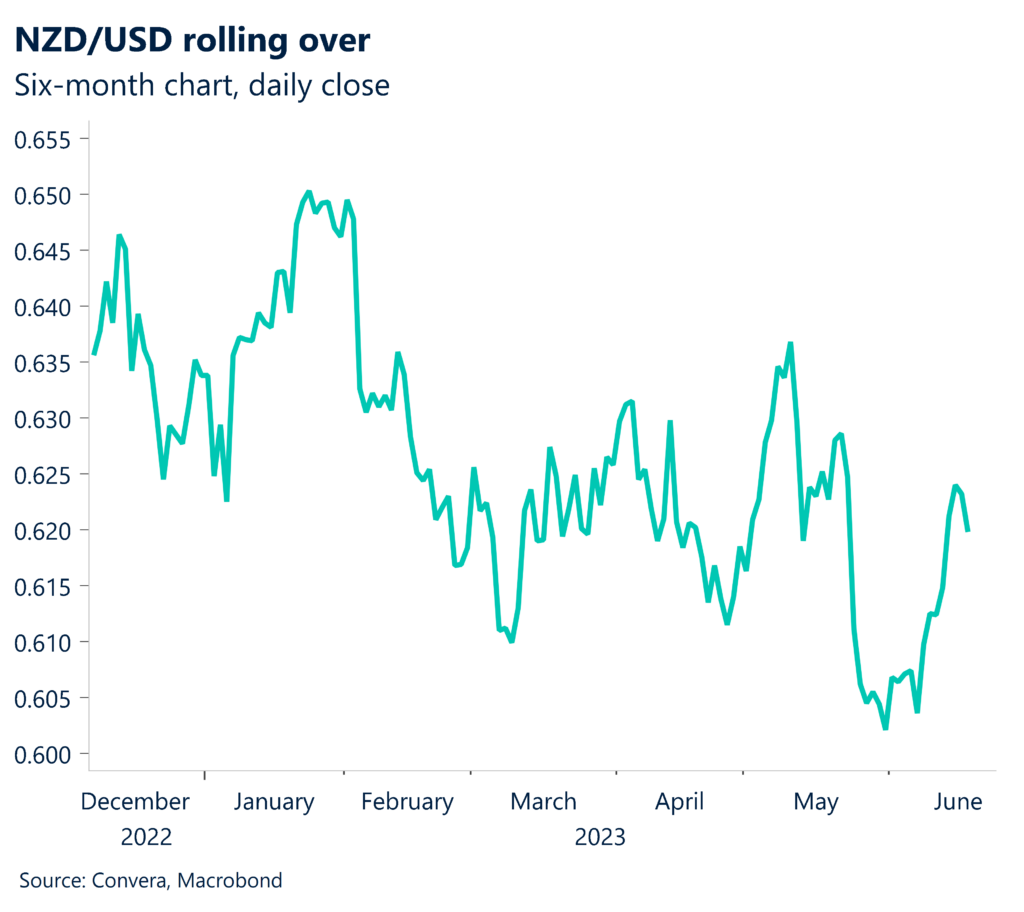
Aussie hit by RBA minutes
The Australian dollar was the hardest hit after yesterday’s Reserve Bank of Australia minutes saw this month’s decision to hike rates as “finely balanced”.
The description caused markets to wind back expectations for further rate hikes with an increase at next month’s decision seen as a 40% chance (source Refintiv).
The AUD/USD tumbled, down 1.0%, as it extended losses from four-month highs.
The key question is whether Australian inflation will follow US inflation lower. US inflation looks to have been leading Australian inflation through most of this cycle – a similar move lower in Australia will take the heat off the RBA.

PBOC cut seen as “too little, too late”
Global markets were also pressured with investors disappointed by yesterday’s rate cut from the People’s Bank of China.
The PBOC cut the one-year loan prime rate from 3.65% to 3.55% and the five-year rate from 4.30% to 4.20% — with both reductions smaller than some had hoped.
The Shanghai Composite fell 0.5% yesterday.
Central banks are likely to continue to drive sentiment with Federal Reserve chair Jerome Powell speaking to the US Congress tonight.
Aussie hit by RBA minutes
Table: seven-day rolling currency trends and trading ranges

Key global risk events
Calendar: 19 – 23 June
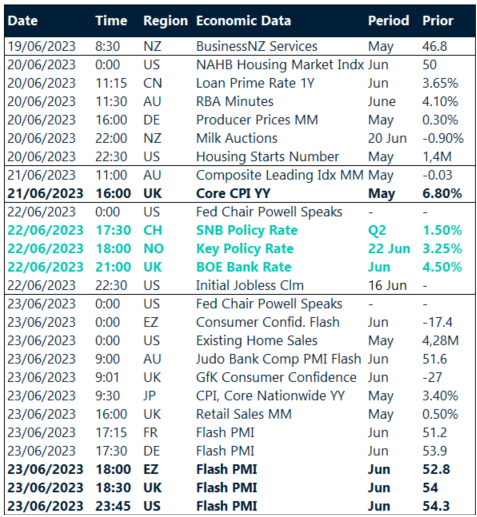
All times AEST
Have a question?[email protected]
*The FX rates published are provided by Convera’s Market Insights team for research purposes only. The rates have a unique source and may not align to any live exchange rates quoted on other sites. They are not an indication of actual buy/sell rates, or a financial offer.