


USD: Conflict escalates, FX hesitates
The US dollar heads into today’s Federal Reserve (Fed) meeting on the backfoot as its reaction function is becoming increasingly nuanced. Hopes of a gradual de-escalation in the Middle East have faded once again after a fresh round of military activity across the region. Iran reportedly targeted commercial tankers and a US air base overnight, while US and Saudi forces stepped up operations against Iran-backed militant groups. This has pushed oil prices more than 4% higher this morning, reigniting concerns around energy supply disruptions and inflation.
Under normal circumstances, a combination of rising oil prices, weaker equities and escalating geopolitical tensions would be expected to generate a stronger safe-haven bid for the dollar. Yet the greenback has struggled to build on recent gains. That likely reflects the extent to which investors have become conditioned to recurring cycles of escalation and de-escalation.
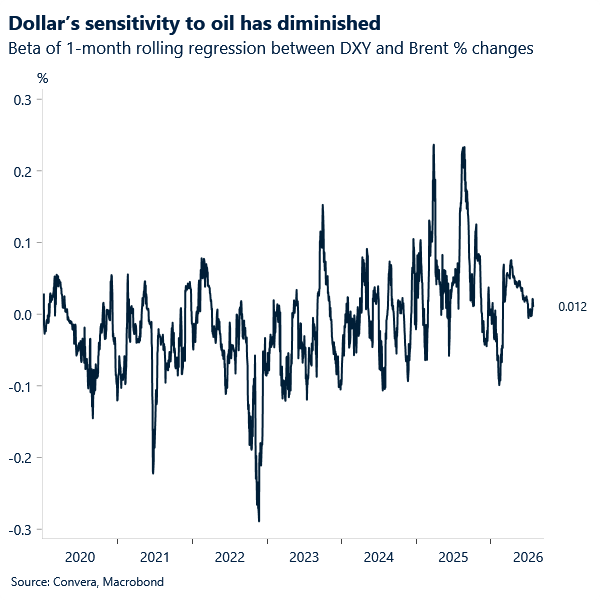
The key question is why the USD is not stronger. One explanation is that markets continue to favour carry strategies amid unusually low FX volatility, limiting demand for defensive dollar exposure. Another is that investors increasingly view geopolitical developments through the lens of inflation and central bank policy rather than as a direct trigger for a flight to safety.
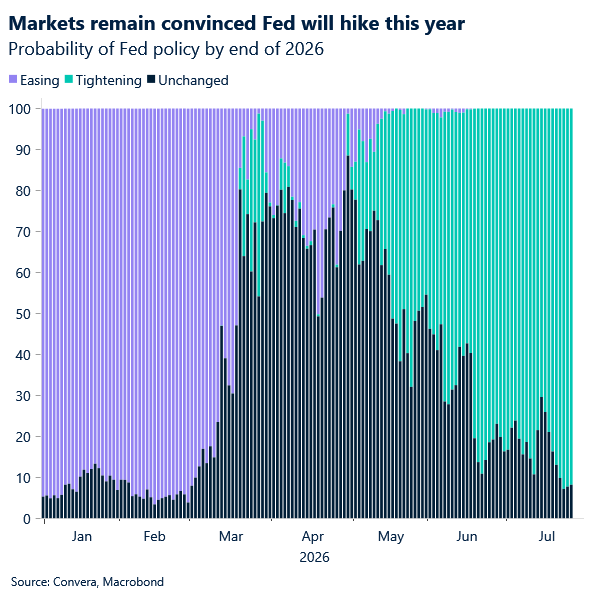
Thus, attention now turns to the Fed decision, the week’s key catalyst. We expect rates to remain unchanged, with Chair Warsh likely to reiterate the Fed’s commitment to returning inflation to target and maintain a broadly hawkish tone. While the Iran conflict has increased upside inflation risks, recent data argue for patience rather than immediate action. Payroll growth has slowed, underlying inflation pressures eased in June, and some of the AI- and tariff-related price pressures have moderated at the margin.
The June meeting revealed a committee still divided on the need for further tightening, and the latest data provide additional cover for those favouring an extended pause. The focus therefore shifts less to the rate decision itself and more to the Fed’s communication. Markets will be looking for clues on how Warsh intends to shape policy guidance going forward, particularly given his preference for a less prescriptive and more data-dependent approach. A hold is broadly priced; any indication that the bar for further tightening remains lower than investors currently assume would be supportive for the dollar.
EUR: Fed decision to test fragile stabilisation
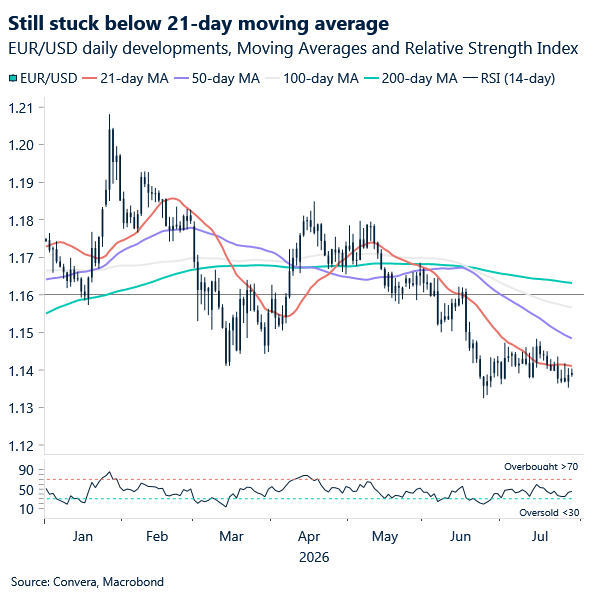
The euro is up a modest 0.25% on the week but continues to trade below its key daily moving averages. That said, the 21-day moving average is beginning to flatten after trending lower since early May, suggesting downside momentum may be fading. While this is not yet evidence of a sustained recovery, it does indicate that EUR/USD may be entering a period of consolidation following its sharp decline from April’s highs.
The decisive catalyst may come later today from the Federal Reserve. A dovish outcome that reinforces expectations for lower US rates could allow EUR/USD to reclaim the 1.1450–1.15 area and validate the recent stabilisation. Conversely, a hawkish message that keeps US real yields elevated would likely reinforce the dollar’s advantage and risk sending the pair back toward the recent lows near 1.13.
GBP: Sterling gives back ground
Sterling continues to give back some of its June and July gains against G10 peers. It’s hard to pinpoint a single catalyst. Sentiment is playing a role, although the risk-off mood tied to AI concerns has been partly offset by improving US-Iran peace prospects. We suspect the steady unwinding of BoE hawkish bets since last Thursday, helped by easing oil prices, has also weighed on the currency. Markets now assign roughly a 50% chance of a September hike, down from 70% last week.
The bar for a hawkish surprise at this week’s BoE meeting looks high, as we highlighted in Monday’s note. As such, we struggle to see the event providing much support for sterling.
On the political front, there has been little in the way of major news since Burnham took office and appointed the cabinet. Markets have largely moved from pricing out the worst-case scenario to settling into the new status quo, inevitably taking a closer look at the government’s early moves. As a result, investors have fewer reasons to further unwind bearish positions, which had been a key driver of sterling’s gains ahead of Burnham taking office.
We see scope for further downside in GBP/EUR this week, with 1.16 as key support. For GBP/USD, it may come down to which central bank sounds more hawkish a their respective policy meetings: the Fed or the BoE. Our suspicion is that neither will try particularly hard.
Market snapshot
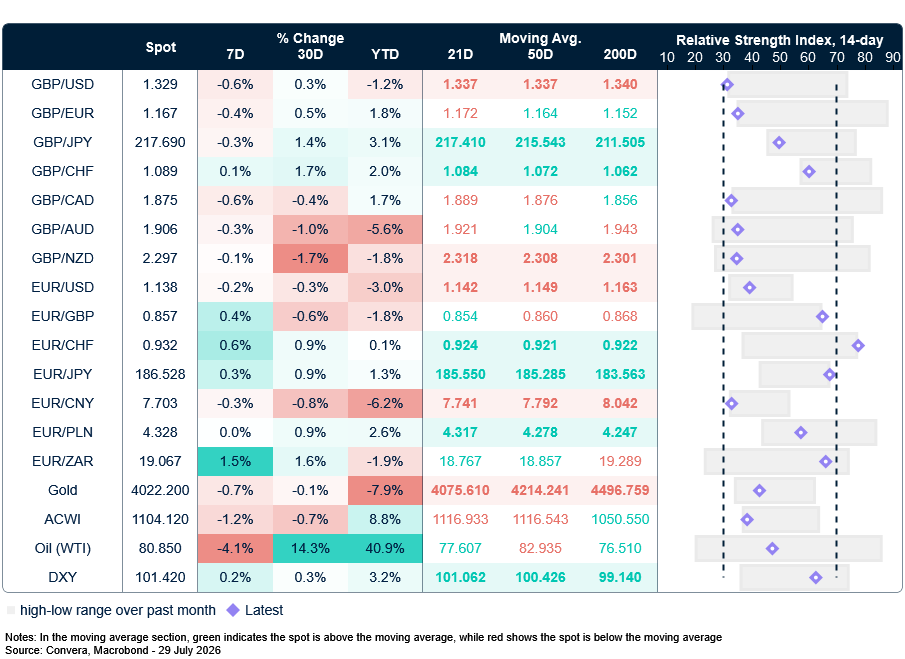
Table: Currency trends, trading ranges & technical indicators
Key global risk events
Calendar: July 27-31
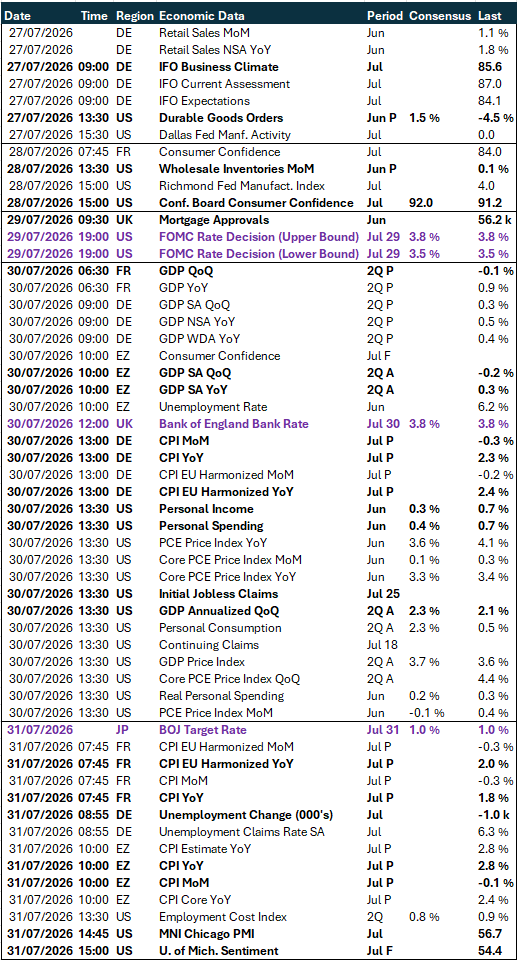
All times are in BST
Have a question? [email protected]
*The FX rates published are provided by Convera’s Market Insights team for research purposes only. The rates have a unique source and may not align to any live exchange rates quoted on other sites. They are not an indication of actual buy/sell rates, or a financial offer.