
Key Takeaways
- Currency forward contracts help businesses lock in exchange rates for future transactions, managing FX risk effectively.
- They help provide viability into into budgeting and cash flow by reducing currency exposure .
- Forwards work best for known payments in foreign currencies, especially where adverse rate movements could impact finances.
- The costs of hedging with forwards are embedded in the forward rate, without explicit upfront premiums like with FX options.
- Convera offers tailored forward contract solutions for businesses to align with their payment needs and exposures.
Every business that pays or gets paid in a foreign currency is exposed to exchange rate movements, whether they’re managing that exposure or not. Those movements have a direct cost, from budgets that no longer reflect reality to forecasts built on exchange rates that have already shifted. A currency forward contract is how you can stop absorbing that cost and start controlling it.
Currency forward contracts allow you to lock in an exchange rate today for a transaction that will happen at a defined future date — helping to protect your growth prospects, your budgets, and your ability to plan with confidence.
This guide explains how forwards work, when they make sense, what they cost, and how they compare with other foreign exchange (FX) risk management solutions.*
In this guide:
- What is a currency forward contract?
- How forwards reduce business risk
- When a forward contract makes sense for your business
- The real cost of hedging currency
- Forward contracts vs. other FX risk management solutions
- How Convera helps businesses lock in rates
What is a currency forward contract?
A currency forward contract — also called an FX forward or foreign exchange forward contract — is an agreement to exchange a specified amount of one currency for another at a pre-agreed rate, on a specified future date. Unlike a spot exchange, which settles immediately at today’s market rate, a forward contract separates the rate agreement from the actual payment.
The forward rate comes from today’s spot rate plus the interest rate differential between the two currencies. This figure is called the forward points.
Most corporate forwards settle on a fixed date (known as closed forwards). However, window forwards allow settlement within a date range, which is ideal for businesses with less predictable payment timing.
It’s important to note that a forward is an obligation, not an option. When a forward is executed, both parties are committed to the agreed terms regardless of where the market moves.
How forwards help reduce business risk
Reducing currency exposure and reducing business risk are two very different things. Exposure management limits the size of your foreign currency position. Business risk management, meanwhile, helps protect the commercial outcomes that depend on it, including everything from budget accuracy and forecasting to cash flow predictability.
A currency forward contract does both, and, even more importantly, it creates a level of certainty at the planning level. Many businesses ignore FX risk management, believing it to be too complicated or costly. However, there’s a clear benefit, as this company discovered while expanding overseas.
If your cost structure, for example, includes inputs priced in a foreign currency, a strengthening of that currency can disrupt your cash flow (even if nothing else changes). A forward locks in the exchange rate for those payments, providing clearer visibility into your cash flow for the duration of the hedge.
Similarly, businesses that price long-term contracts in their home currency while incurring costs in a foreign currency can use forwards to see their exact FX cost at the time of signing. That means no currency buffer is needed, and there is less risk if rates move before the contract closes.
For finance teams working to a budget rate, forwards are equally useful. Rather than assuming a rate and hoping the market cooperates, you can lock in at or near your budget rate, removing FX as a primary planning variable altogether.
it’a important to note, Convera’s hedging products are derivative financial instruments which may expose you to risk should the underlying exposure you are hedging cease to exist. They may be suitable if you have a high level of understanding and accept the risks associated with derivative financial instruments that involve foreign exchange and related markets. If you are not confident about your understanding of derivative financial instruments, or foreign exchange and related markets, we strongly suggest you seek independent advice before making the decision to use these instruments.
When a forward contract makes sense for your business
Forwards tend to work best when you have a known payment in a foreign currency at a reasonably predictable future date, and when an adverse rate movement could materially affect budget planning or forecasting. The clearer you are on the amount and the timing, the more precisely a forward can be sized to match the exposure.
Forwards are also particularly valuable for businesses that price contracts or proposals in their domestic currency while incurring costs in a foreign one, because the gap between when you quote and when you pay is exactly where currency risk can occur.
Forwards are less useful when the payment amount is highly uncertain — such as when hedging the wrong amount creates a different kind of risk — or when you want to retain upside if rates move in your favor. In those cases, an FX option may be a better fit.
Finally, for payments due within a few days, a spot exchange is usually more practical than a forward contract.
The real cost of hedging currency and what you get for it
Unlike FX options, forward contracts don’t carry an explicit upfront premium. The cost is embedded in the forward rate itself, reflecting:
- The spot rate
- The interest rate differential between the two currencies (the forward points)
- Your provider’s bid/ask spread
In some cases, especially for longer-dated forwards or in volatile conditions, you may be asked to post a margin deposit as a performance guarantee. This deposit isn’t a fee; it’s returned at settlement.
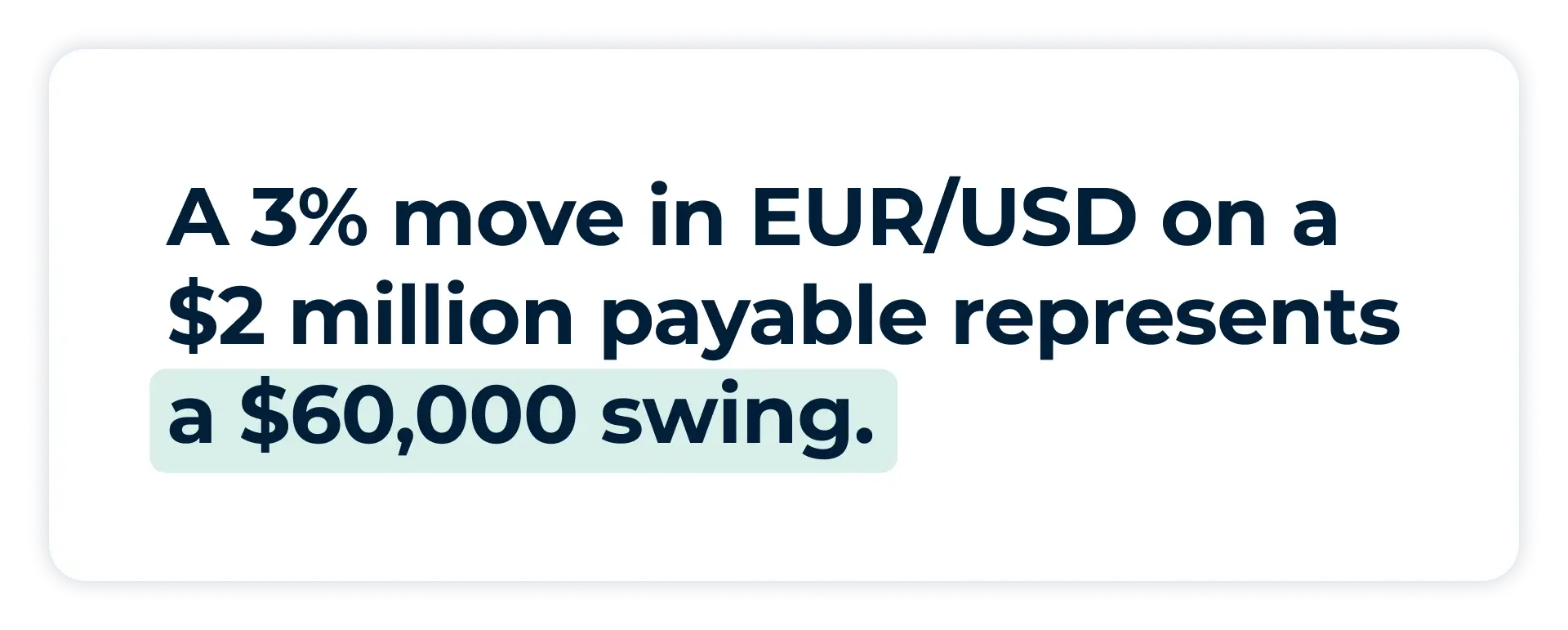
A helpful way to think about forward contracts is to compare their cost with the cost of remaining exposed to currency movements. For instance, a 3% move in EUR/USD on a $2 million payable represents a $60,000 swing. On a $10 million supplier contract, a 5% currency move can materially impact cash flow.
Forward contracts come with trade-offs, including the possibility of missing out if rates later move in your favor. But for many businesses, the value lies in replacing uncertainty with greater cost visibility, budgeting confidence, and protection against adverse market moves.
Forward contracts vs. other FX risk management solutions
Forward contracts are one of several tools available for FX risk management. Here’s a breakdown of how the key ones compare:
| Currency forward contracts | FX options | FX swaps | Global currency accounts | Market orders | |
| Rate certainty | High: Rate locked in advance for a set date | Partial: Floor rate guaranteed; upside open | High: Both legs are fixed at the outset | Low: Conversion happens at the prevailing spot rate when funds move | Low: Executed at live market rate |
| Upfront cost | No premium; a margin or deposit may be required | Option premium required | No premium | Usually, a low or no setup fee | No premium |
| Flexibility | Limited: Obligation to transact on the agreed date and amount | High: No obligation to exercise; can let it lapse | Moderate: Structured around two fixed legs | High: Convert any amount at any time | High: Transact on demand |
| Downside protection | Full | Full | Full | None | None |
| Upside participation | None | Full | None | Full | Full |
| Best for | Businesses with predictable, fixed FX obligations wanting additional certainty | Businesses with uncertain exposure, willing to pay a premium to keep upside open | Businesses managing timing differences between currency inflows and outflows | Businesses with ongoing, variable cross-border payments needing operational simplicity | Businesses making one-off conversions and comfortable with live market rates |
A few points to highlight:
- FX options give you the right — but not the obligation — to exchange at a set rate, preserving upside if the market moves in your favor. However, that flexibility comes at a cost. Option premiums can be significant, especially for longer durations. Forwards, on the other hand, are generally more cost-effective when your exposure is well-defined and you’re not looking to participate in the upside of market movements.
- Forward contracts and FX swaps** both offer the highest rate of certainty but eliminate any benefit if rates move in your favor.
- You can typically book forwards and swaps months or years ahead, while market orders and global currency accounts are purely short-term/spot.
- Global currency accounts and market orders are the most operationally flexible. However, because they’re spot-rate instruments, they’re best suited to businesses seeking a simpler way to manage FX exposure and bring predictability to international operations.
How Convera helps businesses lock in rates
Convera offers currency forward contracts to businesses of all sizes, from growing small businesses to large multinationals, providing access to corporate FX hedging tools that were once reserved for major financial institutions.
Working with Convera’s FX specialists, businesses can structure forwards that align with their payment schedules and budget rates, layer strategies across multiple currency pairs and time horizons, and combine forwards with FX options (and other FX risk management solutions) when additional flexibility is needed.
Convera helps finance teams build a hedging program that reflects their specific exposure profile and operational reality. That means understanding which exposures pose a real threat, which payment timelines are predictable enough to hedge, and which tools are the right fit for each situation.
Whether you’re early on in making international payments or tasked with managing a complex multi-currency balance sheet, Convera enables you to utilize the right tool. Talk to a Convera FX specialist about building a forward contract strategy for your business today.
**The availability of FX swaps varies by jurisdiction and is currently offered in Australia, the EU (excluding Malta), Switzerland, the UK, and the US.