
The FX Outlook for May 2026 carries a steadier tone, supported by resilient economic data, strong earnings, and clearer central bank signaling. However, elevated energy prices and lingering geopolitical uncertainty continue to shape currency movements.
Markets may no longer be pricing in crisis, but nor are they pricing resolution. Is your business prepared for the full range of scenarios, risks, and opportunities in the month ahead?
Download the Global FX Outlook for May 2026 now.
FX trends at a glance
- FX volatility eased as markets priced out extreme geopolitical risks.
- Energy prices remain elevated, reinforcing inflation concerns and supporting the US dollar.
- Central banks are holding a cautious, data-dependent stance.
- The US dollar remains range-bound, reacting to oil prices and geopolitical headlines.
- Commodity-linked currencies, particularly the Australian dollar, are showing strong momentum.
What is driving FX markets in May 2026?
Fragile calm, rising risks
FX markets are being driven by a shift from crisis pricing to a more stable, but uncertain, environment. While an April ceasefire between the US and Iran reduced immediate tail risks, ongoing blockades in the Strait of Hormuz continue to disrupt energy flows and sustain elevated oil prices.
Markets are no longer reacting sharply to incremental developments, but they are also not pricing a full resolution. This has created a backdrop of “fragile stability,” where currencies are increasingly influenced by how long risks persist, rather than sudden shocks.
Are central banks changing their policy stance?
Central banks are currently in a holding pattern, balancing growth uncertainty against inflation risks.
Recent policy meetings have emphasized flexibility rather than decisive action, as policymakers await clearer economic signals. The hawkish repricing seen earlier this year has begun to moderate, resulting in more neutral FX market positioning.
Until clearer divergence emerges between major economies, interest rate differentials are likely to exert less directional influence on currency markets.
How the Federal Reserve leadership transition could impact FX
The expected appointment of Kevin Warsh as Federal Reserve chair introduces policy uncertainty into the market. Concerns about the potential erosion of central bank independence, and a possible bias toward lower rates, have added a modest risk premium.
Over time, this could weigh on the US dollar if market confidence in policy credibility weakens. In the near term, however, markets will be focused on how effectively the new leadership reassures investors.
Oil prices central to FX outcomes
Oil prices are a critical driver of FX markets in May 2026 because they directly influence inflation, growth expectations, and central bank policy. Elevated energy costs are constraining policymakers’ ability to ease, while reinforcing yield differentials that continue to shape currency movements.
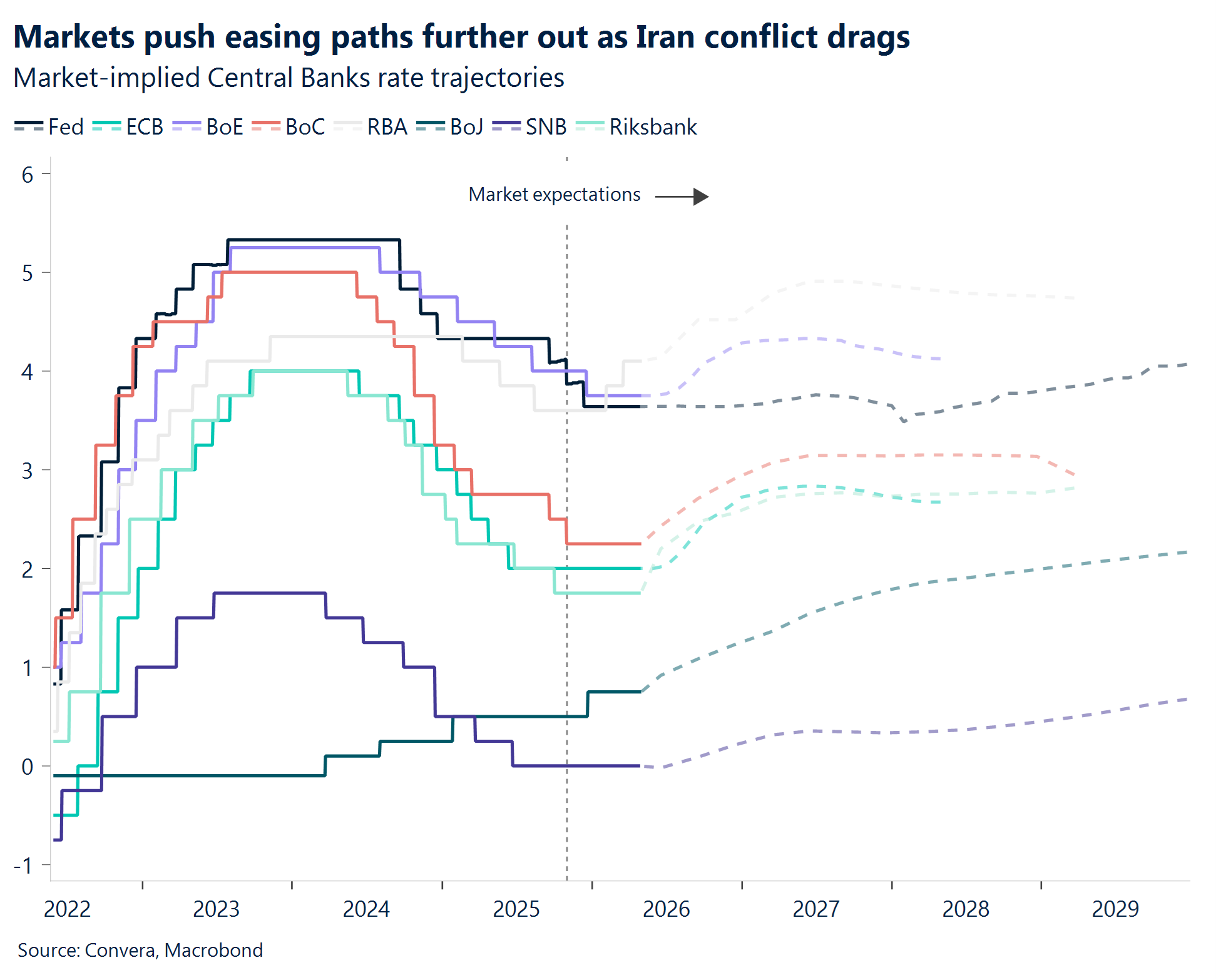
With geopolitical tensions keeping oil prices high, markets are pushing expectations for rate cuts further into the future. This has kept interest rate differentials in focus, making oil a key transmission channel into FX volatility.
How are major currencies performing?
- US dollar (USD): Trading is increasingly driven by geopolitical headlines. The dollar weakens when de-escalation appears credible, but strengthens as energy risks and uncertainty re-emerge.
- Euro (EUR): Upside remains limited, with expectations for range-bound trading as policy divergence remains muted.
- British pound (GBP): Sterling has gained momentum, breaking key technical levels and recovering on improved sentiment.
- Australian dollar (AUD): The strongest performer among major currencies in April, supported by commodity strength and positive risk sentiment.
What to watch next in FX markets
- The trajectory of oil prices, and whether elevated levels persist.
- Developments in the Middle East, particularly around shipping flows.
- Market reaction to the Fed leadership transition.
- Signals from central banks as new economic data emerges.
What does the FX Outlook for May 2026 mean for businesses?
For businesses operating across borders, the FX outlook for May 2026 points to a more stable, yet still uncertain, trading environment. While extreme volatility has eased, currency markets remain sensitive to energy prices, geopolitical developments, and shifting policy expectations, meaning predictability is still limited.
Range-bound currency movements may offer short-term planning visibility, but the underlying fragility of the macro backdrop suggests that conditions can shift quickly, particularly if energy prices remain elevated or geopolitical tensions re-escalate. For corporates, this reinforces the importance of maintaining flexibility in pricing, procurement, and treasury strategies.
Download the full Global FX Outlook to explore detailed scenarios, risks, and opportunities for navigating cross-border markets.