


The ADP data for November revealed a surprisingly steep decline in US private-sector employment, which fell by 32,000, significantly missing the estimated gain of 10,000 and marking the largest drop since early 2023. This weak report, coming just before the Federal Reserve’s final policy meeting, intensifies concerns about a more rapid deterioration in the labor market, sending the US Dollar lower against all G10 currencies and causing the odds of a rate cut next week to climb to 93%. This market conviction reflects the pressure on policymakers to ease monetary policy, given that the recent job losses, led by small businesses and concentrated in professional/business services, information, and manufacturing, necessitate balancing a slowing job market with persistent inflation.
USD: Fed liquidity trumps macro gloom
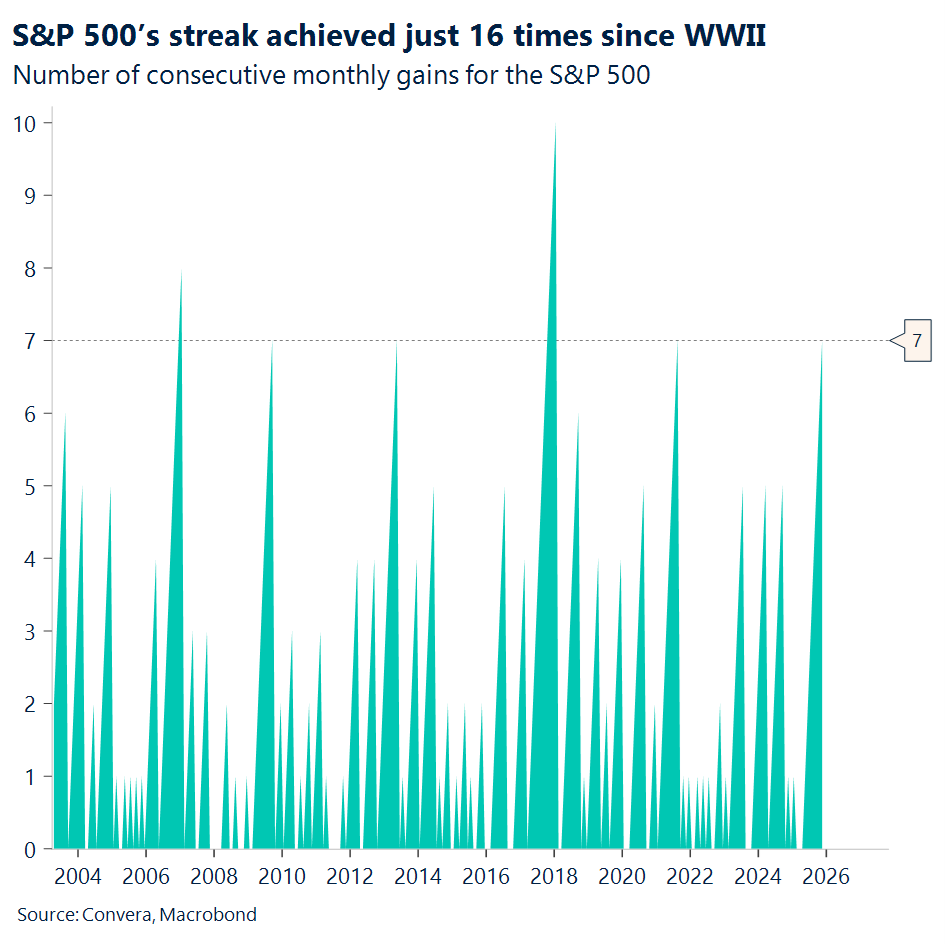
The resilience of risk assets is becoming impossible to ignore, most notably underscored by the S&P 500’s seven-month winning streak, a milestone achieved only sixteen times since World War II. Fueling this momentum is a distinct shift in liquidity dynamics, with the Federal Reserve officially concluding Quantitative Tightening on December 1 and simultaneously injecting $13.5 billion into the banking system via overnight repurchase agreements. This operation, the second largest since the pandemic and surpassing peaks seen during the Dot-Com bubble, suggests that the financial “plumbing” is now primed to support further risk-taking. However, this asset buoyancy sharply contrasts with a softening macro backdrop, where investors are increasingly pricing in a December rate cut, a conviction deepened by weak ISM data and the Beige Book’s reports of uneven economic activity and a cooling labor market.
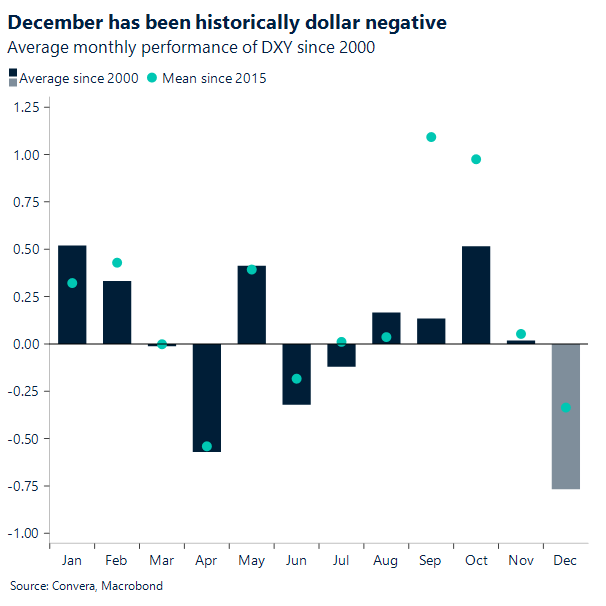
This expectation of monetary easing converges with a powerful seasonal headwind for the US currency. December has notoriously been the Dollar’s cruelest month, with the broad index suffering declines in eight of the past ten years. The current setup seems destined to rhyme with history, as easing geopolitical anxiety and firm risk appetite drag capital away from the greenback’s safe-haven appeal. The market’s gaze is now fixed squarely on Federal Reserve Chair Jerome Powell, specifically looking for any signaling regarding a sub-3% terminal rate. If the Fed acknowledges the cooling data with a dovish tilt, it would reinforce the seasonal pressure on the Dollar, leaving it vulnerable to a continued slide as we close out the year.
Beyond immediate monetary policy, the medium-term outlook is clouded by the complex legal and political maneuvering surrounding trade policy. The narrative regarding tariffs appears binary on the surface, yet a closer inspection reveals that both potential outcomes from the Supreme Court lean bearish for the long end of the bond market. If the President retains authority under the International Economic Emergency Powers Act (IEEPA), inflation is likely to remain sticky due to inventory depletion and cost passthrough, a reality seemingly confirmed by the Walmart CFO’s expectation of peak tariff impacts hitting in early 2026. Conversely, if the high court strips this authority, the administration would likely pivot to Section 301 investigations or flat reciprocal duties to achieve similar ends, meaning the protectionist agenda survives regardless of the legal vehicle used.
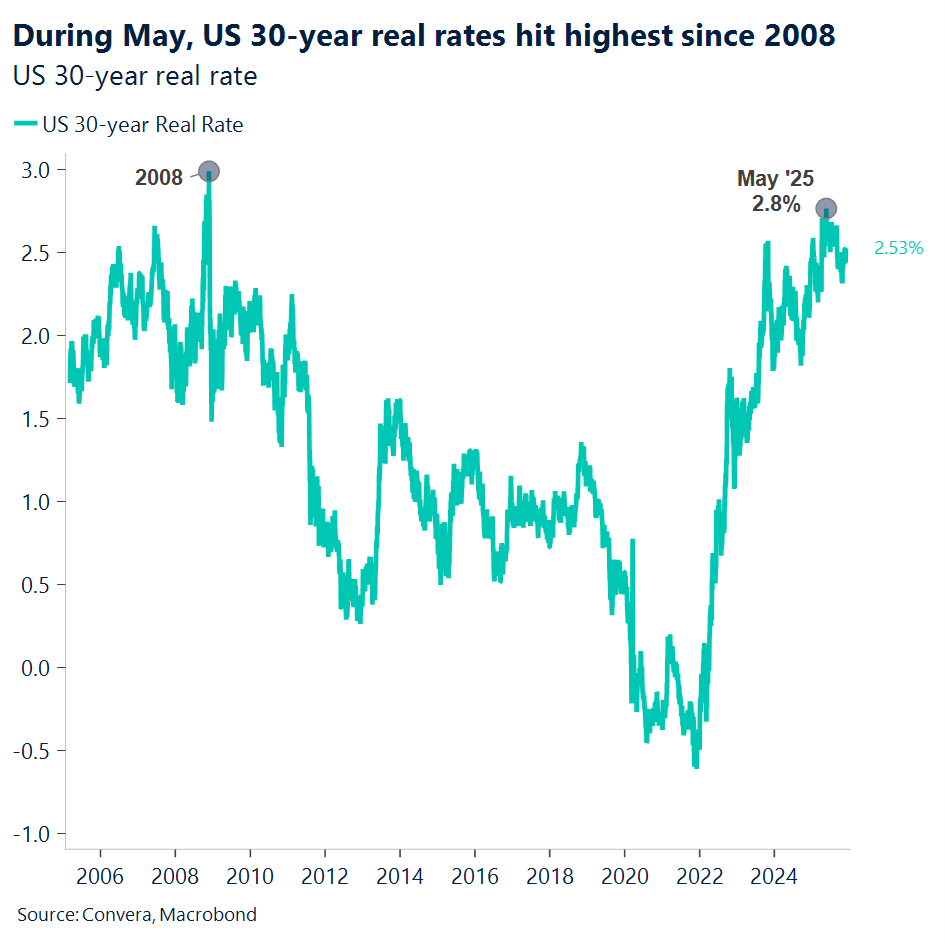
These trade dynamics are creating a dissonance within the Treasury market, where the yield curve is currently stuck in a range that struggles to price the developing reality. There is a palpable collision between the market’s hope for a dovish Fed in 2026 and the fiscal reality of a deficit overhang combined with sticky inflation. If the Supreme Court limits executive tariff power, Washington faces a larger fiscal hole, incentivizing greater debt issuance that further pressures the long end of the curve. Consequently, the Treasury market is left navigating a disconnect where yields may need to rise to attract buyers, irrespective of the central bank’s rate-cutting ambitions.
Ultimately, this confluence of factors creates a complicated environment for the US Dollar. A steeper yield curve, exacerbated by the threat of unanchored inflation and renewed worries about political interference at the central bank, serves as a clear negative for the currency. The Dollar has yet to fully recover from the initial shock of tariff headlines, and it now faces the compounding weight of pending Supreme Court rulings, including the decision in the Lisa Cook case. With the “tariff story” likely to result in either higher inflation or higher deficits, the path of least resistance for the Dollar appears lower, trapped between seasonal weakness and structural fiscal headwinds.
EUR: Eying up a crucial closing price
Witkoff arrived in Moscow yesterday to discuss a revised Ukraine peace plan, with Zelenskyy calling the proposal “better now” and Putin showing openness last week. Markets remain hopeful, watching for concrete steps, with high‑beta European currencies and the euro set to benefit via the lower oil price channel on more substantial progress.
That said, Putin has offered no sign of easing Russian demand, while claiming advances in Donetsk yesterday, which Ukraine disputes. Any battlefield gains underscore his insistence that Kyiv surrender the region, raising doubts about the immediacy of a deal.
On the macro front, eurozone headline CPI y/y came in above expectations at 2.2% versus 2.1%, while core y/y was steady at 2.4%. The higher inflation rate was mainly driven by a smaller negative contribution from energy prices. While downside risks to inflation remain intact in the months ahead, yesterday’s print clearly does not create any urgency for further easing at this stage. As anticipated, the FX response was muted.
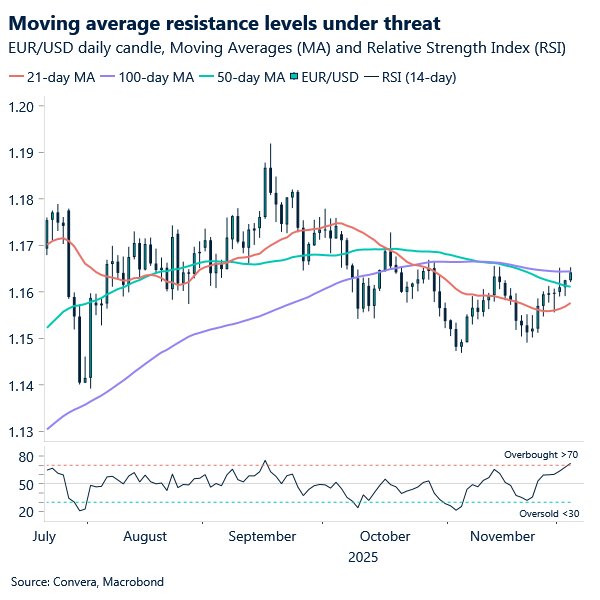
The euro was broadly flat versus the dollar on Tuesday, but has since pushed above the 1.1630 resistance due to broad-based dollar weakness. A sustained close above the 50- and 100‑day moving averages at 1.1611 and 1.1644 respectively would mark a short‑term bullish signal, challenging the pair’s bearish technical downtrend in place since mid September. Keep an eye on US industrial production and ADP labour market data today, which could push the pair to challenge that resistance if they deliver a meaningful miss.
CAD: Rental relief and steel strain
Statistics Canada’s latest rent survey (Q2–Q3 2025) signals a cooling trend in Canada’s rental market, particularly across the country’s most expensive cities. Average asking rents for two-bedroom apartments declined year-over-year in 24 of 40 metropolitan areas. The sharpest corrections were recorded in Vancouver (-5.9% to $3,190) and Toronto (-3.9% to $2,720), while Montréal posted a modest dip (-1.0% to $1,930). The slowdown reflects weaker population growth—the softest pace since 2020—combined with a surge in housing completions, with more than 148,000 units delivered in the first three quarters alone.
Relief, however, was uneven. Rental costs continued to climb across the Prairies, led by Saskatoon (+6.0%), Winnipeg (+4.5%), and Regina (+2.1%). Smaller markets saw even sharper increases, including Drummondville (+11.5%) and Greater Sudbury (+7.1%). Room rentals mirrored this divergence: falling across much of British Columbia but rising in Sherbrooke (+8.0%). Analysts note that weaker resale activity in Toronto and Vancouver prompted more homeowners to rent rather than sell, expanding supply and exerting downward pressure on asking rents.
Meanwhile, on the industrial front, Algoma Steel in Sault Ste. Marie, Ontario has announced 1,000 layoffs effective March 2026 as part of its accelerated shift from traditional blast furnace operations to Electric Arc Furnace (EAF) technology. The transition, brought forward by a full year, underscores the “fundamentally altered” competitive environment created by U.S. tariffs. With duties on Canadian steel doubled from 25% to 50% in 2025, Algoma’s legacy integrated steelmaking model became financially untenable, forcing the company to restructure and close a chapter on its long history as an integrated producer earlier than planned.
In foreign exchange markets, after the weaker than expected US ADP report, the Canadian dollar has firmed to 1.395, supported by a weaker U.S. dollar and a stronger-than-expected Q3 GDP print. Attention now turns to Friday’s November employment report, the key domestic data release of the week.
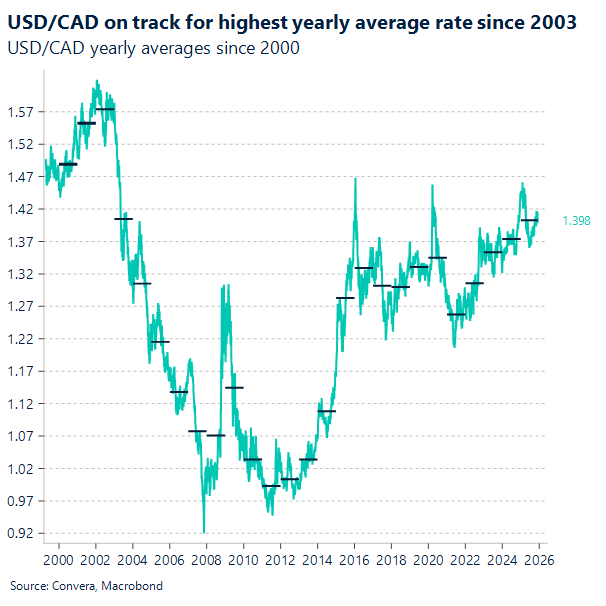
US Dollar stays fragile to start the month
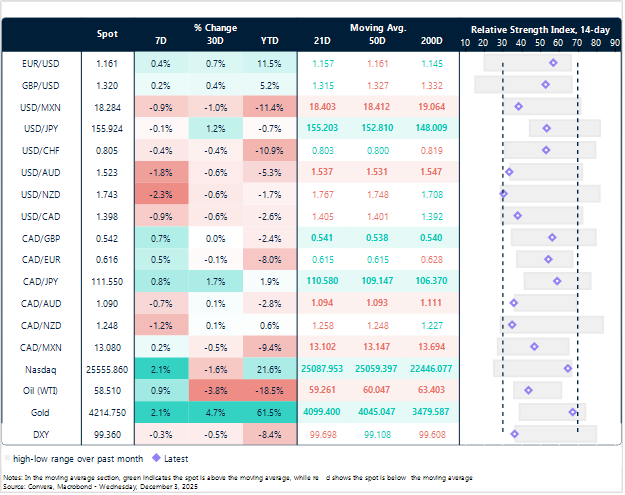
Table: Currency trends, trading ranges and technical indicators
Key global risk events
Calendar: December 01 – 05
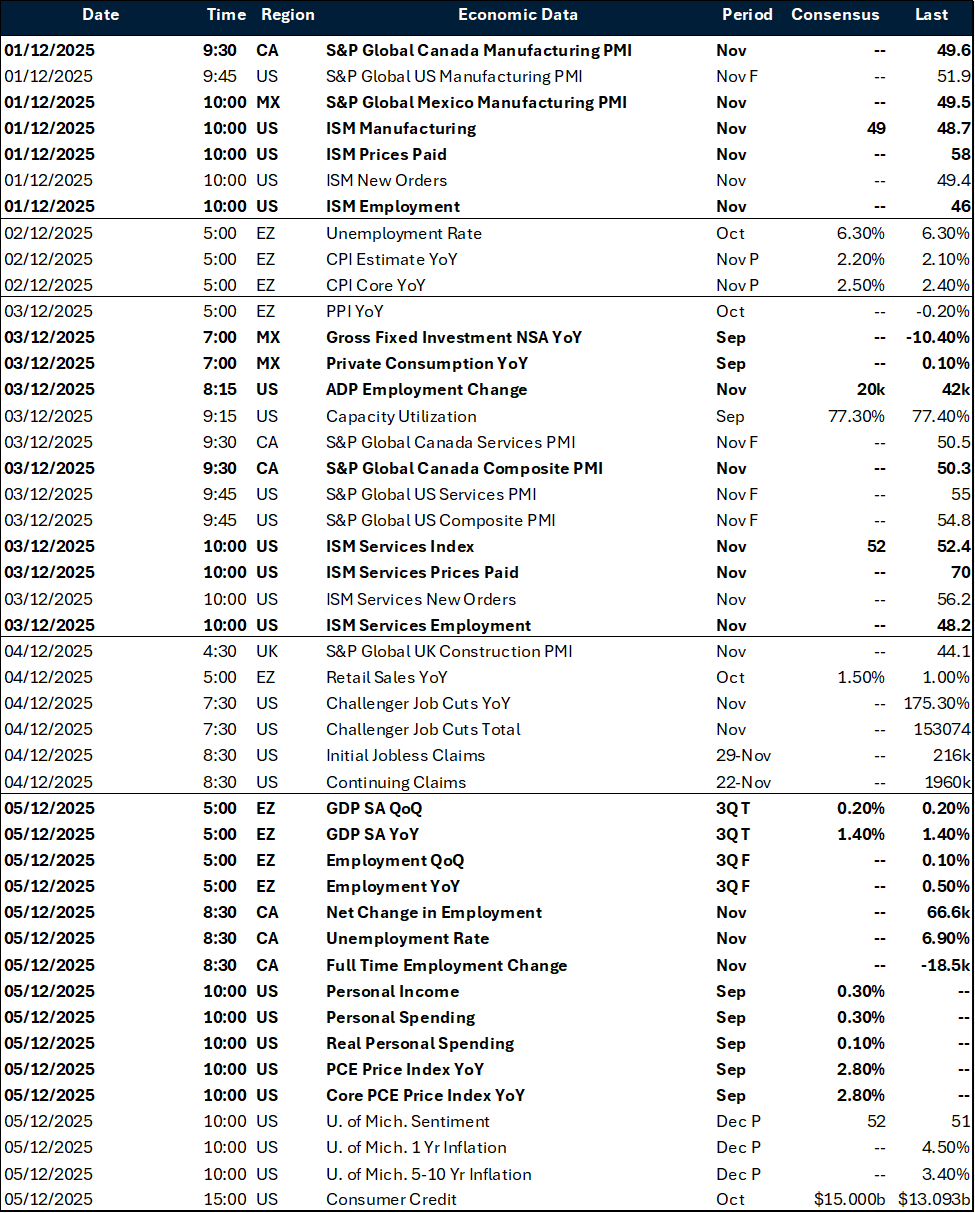
All times are in EST
Have a question? [email protected]
*The FX rates published are provided by Convera’s Market Insights team for research purposes only. The rates have a unique source and may not align to any live exchange rates quoted on other sites. They are not an indication of actual buy/sell rates, or a financial offer.