
For investment funds, foreign exchange (FX) risk is ultimately unavoidable, especially in emerging markets, where local currency exposure can introduce volatility that is unrelated to the asset’s underlying performance.
Non-deliverable forwards (NDFs) have become one of the most effective tools for managing this risk. When used correctly, they allow funds to hedge currency exposure with precision, flexibility, and discipline — without the operational complexity of settling in restricted or illiquid currencies.
As emerging markets continue to offer opportunities alongside risk, NDFs allow funds to participate confidently, while protecting returns, supporting investor confidence, and bringing structure to FX management.
What is a non-deliverable forward?
A non-deliverable forward (NDF) is a forward contract in which two parties agree on an exchange rate for a future date, but rather than exchanging the underlying currencies, the contract is settled in cash – typically in a major currency such as USD.
At maturity, the agreed-upon forward rate is compared to a reference spot rate. The difference between the two is settled in cash, meaning:
- No local currency needs to change hands
- No onshore bank accounts are required
- Capital controls and settlement restrictions are avoided
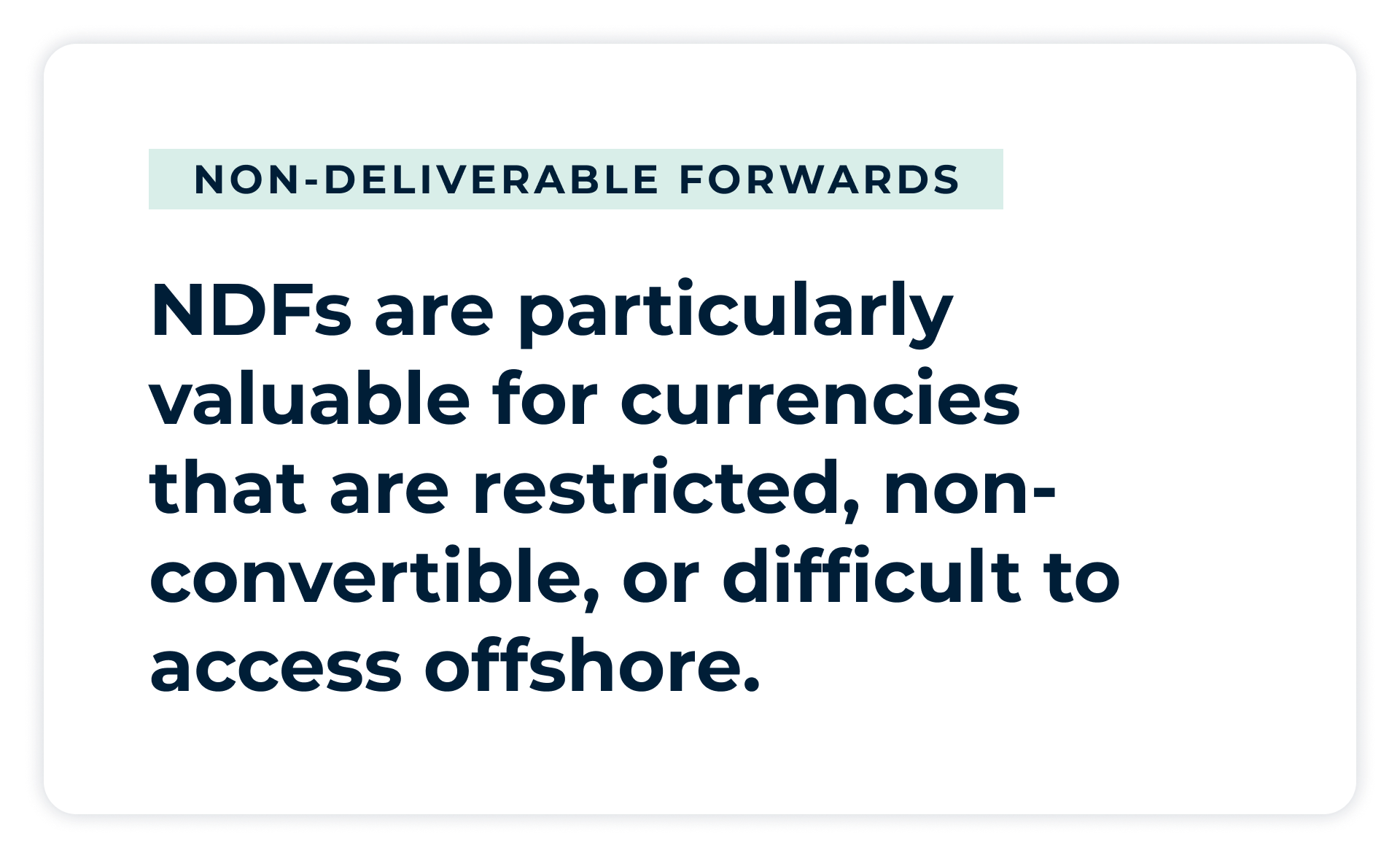
This structure makes NDFs particularly valuable for currencies that are restricted, non-convertible, or difficult to access offshore. Common NDF currencies include those in parts of Latin America, Asia, Eastern Europe, Africa, and other regions that are increasingly central to global investment strategies.
Investing in emerging markets
Emerging markets offer growth opportunities that are difficult to replicate elsewhere. However, the currency risk associated with these investments can easily overwhelm underlying asset performance if left unmanaged.
Local currency depreciation, political risk, inflation shocks, and capital controls can all drive FX volatility independent of fundamentals. For global investment funds, this creates a fundamental challenge: How to maintain exposure to growth while insulating returns from currency swings?
In many emerging markets, traditional deliverable FX instruments are simply not viable. Regulatory barriers, liquidity constraints, and operational complexity can limit access or increase friction.
NDFs emerged precisely to solve this problem, allowing offshore investors to hedge currency exposure efficiently while maintaining their investment mandates.
How NDFs help investment funds hedge FX risk
NDFs allow funds to separate asset performance from currency risk.
By fixing an exchange rate for a future date, investment managers can:
- Stabilize projected returns
- Reduce FX-driven volatility
- Improve the reliability of NAV calculations
- Provide clearer expectations to investors
Importantly, NDFs are often used as part of a systematic FX strategy rather than a one-off trade. Funds may roll NDFs regularly, align hedges with expected cash flows, or hedge a defined percentage of exposure based on risk tolerance.
Because NDFs settle in cash, they also simplify operations. Funds avoid the complexities of local settlement infrastructure, custody arrangements, and regulatory approvals, reducing both cost and execution risk.
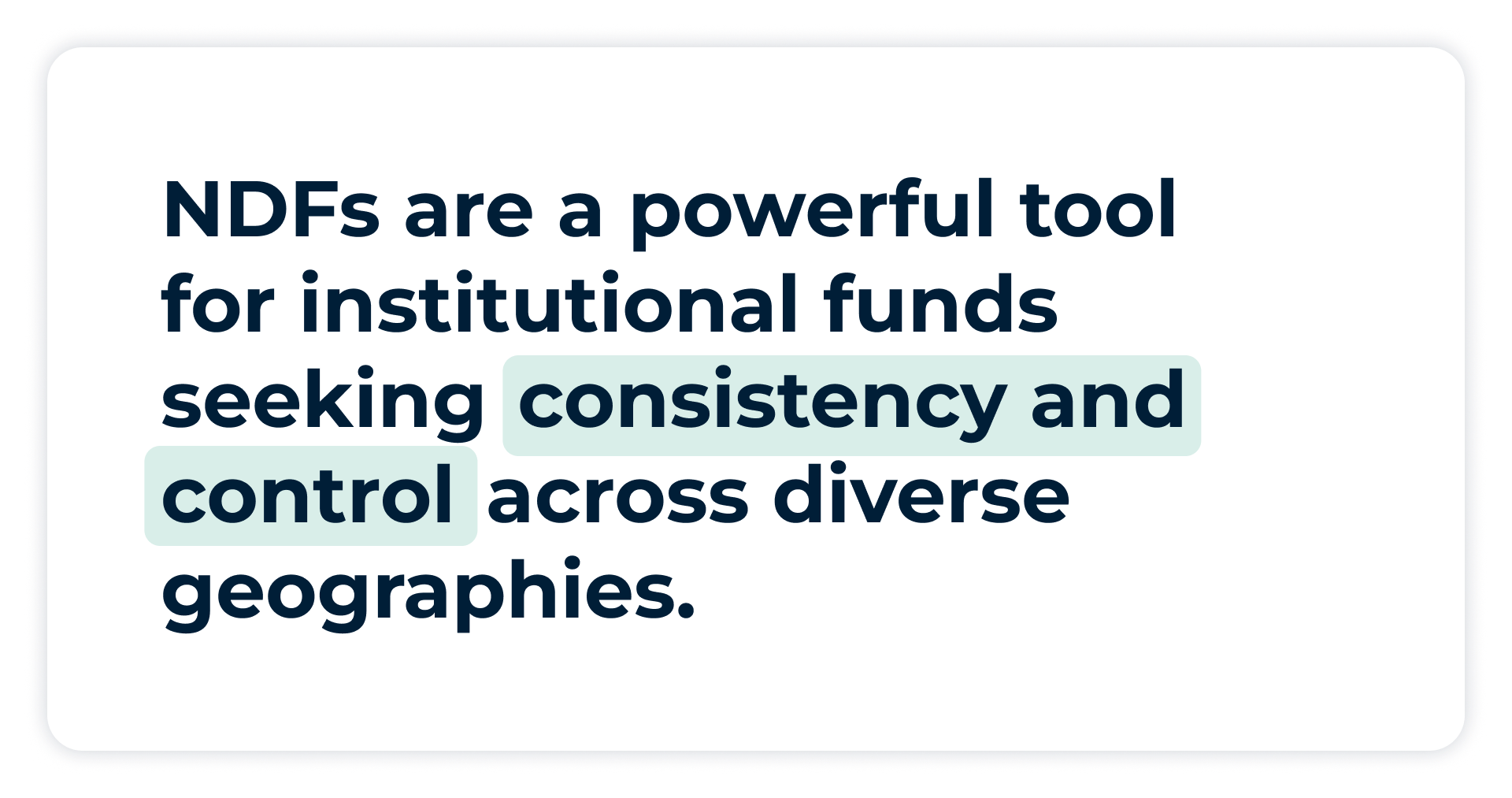
In practice, this makes NDFs are a powerful tool for institutional funds seeking consistency and control across diverse geographies.
Funds use case: Programmatic hedging with NDFs
A compelling example of NDFs in action comes from investment funds using programmatic hedging to support long-term strategies rather than reacting to market noise.
Investment firms such as Prisma Capital, which operates across multiple emerging markets, face ongoing FX exposure that evolves as portfolios grow and capital is deployed. Rather than timing the market, Prisma implemented a structured hedging program using NDFs for their fund in Brazil, to reduce uncertainty and deliver more predictable outcomes.
By working with Convera, Prisma was able to:
- Establish consistent hedging rules aligned with investment horizons
- Execute NDFs efficiently across relevant currencies
- Reduce FX volatility at the portfolio level
- Increase confidence among investors by demonstrating disciplined risk management
The result was not only smoother performance but also improved transparency. FX risk became a managed component of Prisma Capital’s broader strategy with repeatable frameworks that scale with the business.
Getting started with NDFs at your fund with Convera
Using NDFs effectively requires insight, execution capability, and an understanding of how FX fits into a fund’s risk profile. For funds operating globally, the objective is to manage FX exposure deliberately, so currency movements do not undermine otherwise sound investment decisions.
Convera works with institutional funds to design NDF strategies that align with investment timelines, liquidity needs, risk appetite, and investor reporting requirements.
Get in touch with Convera experts today to learn more about NDFs and other products for institutional funds.
*Convera’s hedging products are derivative financial instruments which may expose you to risk should the underlying exposure you are hedging cease to exist. They may be suitable if you have a high level of understanding and accept the risks associated with derivative financial instruments that involve foreign exchange and related markets. If you are not confident about your understanding of derivative financial instruments, or foreign exchange and related markets, we strongly suggest you seek independent advice before deciding to use these instruments.