
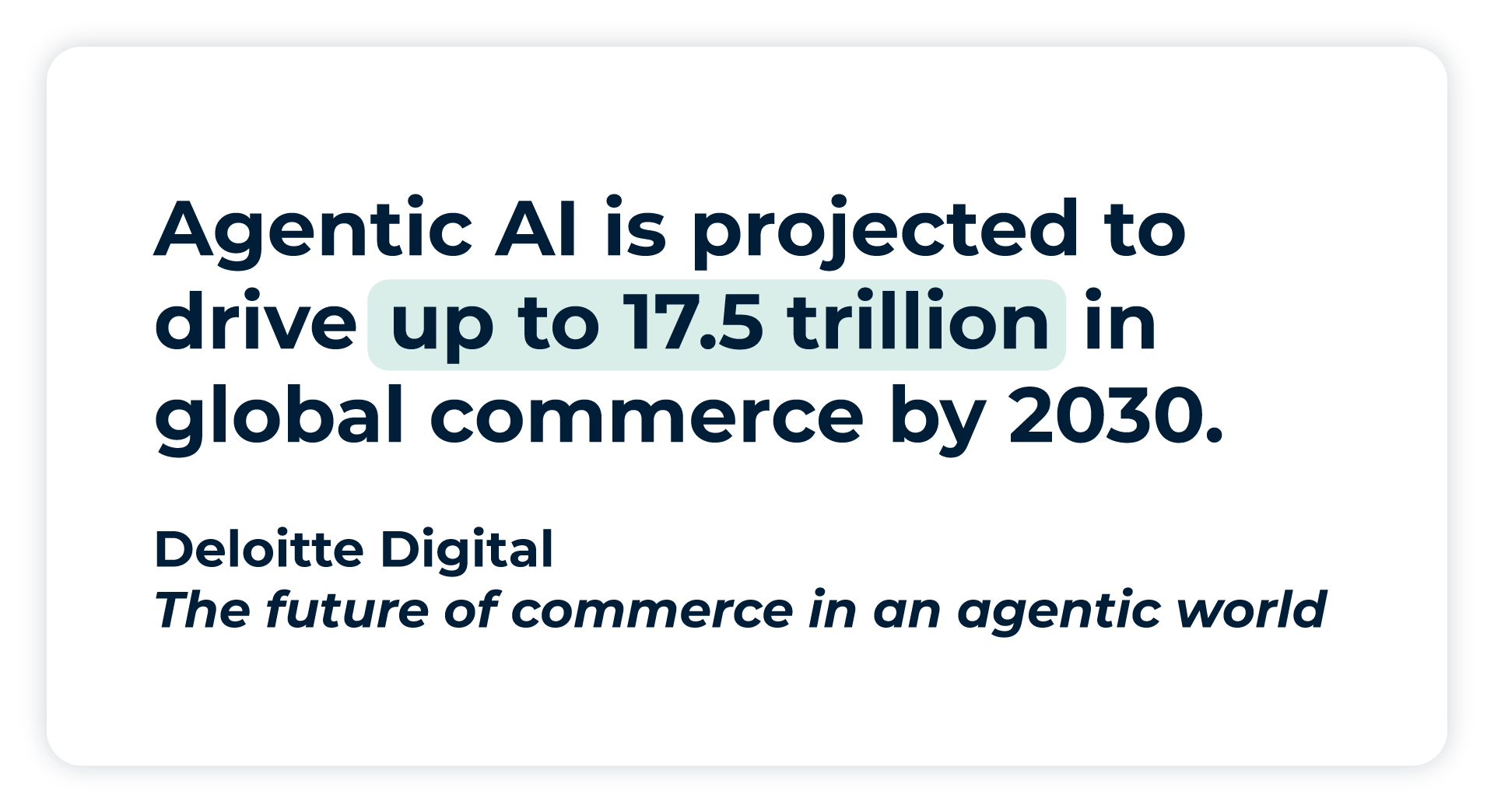
Imagine a future in which a company’s artificial intelligence (AI) agents autonomously initiate, route, monitor, and settle global payments. That’s the promise of agentic AI, which goes beyond simple automation or generative tasks to act on behalf of users, and is projected to drive up to $17.5 trillion in global commerce by 2030.
Financial institutions, such as Mastercard, are exploring agentic systems to enhance their payment systems, while Convera has partnered with Amazon Web Services to automate customer service requests with greater speed and accuracy.
What is agentic AI, and how can it be used for global payments?
Agentic AI is an autonomous AI system capable of independent action to achieve specific goals. AI agents can interpret instructions, plan out, and complete tasks using various tools. They also adapt to new information in real time, without instructions or oversight from humans.
AI agents are poised to disrupt today’s cross-border payments ecosystem, an often slow process that can expose international businesses to fraud, high costs, and regulatory friction. Agentic AI can address these pain points with new automated workflows, from initiation to settlement, while embedding compliance and fraud protection at every stage.
From faster FX conversions and optimized payment execution to enhanced risk management and simplified auditability, enterprises that can offer frictionless, near-instant cross-border payments with built-in compliance will ultimately build trust in the global marketplace — making them more attractive to global customers and partners.
How agentic AI transforms cross-border payments
There are numerous benefits to using agentic AI for cross-border payments. According to McKinsey, agentic AI can coordinate know-your-customer (KYC) checks across jurisdictions, transaction monitoring, suspicious-activity handling, and escalation, with minimal human intervention.
Specifically, agentic AI can offer accounts payable and receivable teams the following improvements:
1. End-to-end orchestration
Traditional systems often automate some parts of the cross-border payment process, such as currency conversion, messaging, or screenings, but they still require human handoffs.
Agentic AI can orchestrate the complete chain: accept a payment mandate, choose routing (via correspondent banks, local partners, or tokenized rails), trigger compliance checks, monitor settlement, and respond to exceptions. McKinsey experts describe these as “digital factories” of AI agents that handle entire tasks, with humans only needed for exceptions and oversight.
2. Dynamic routing and FX optimization
Because agentic AI can continuously monitor exchange rates, liquidity, and network conditions, it can dynamically route payments to minimize cost, reduce latency, and avoid poor foreign exchange (FX) spreads by strategically timing transactions, splitting payments, or choosing rails to take advantage of temporary arbitrage or liquidity windows.
3. Real-time compliance and regulatory adaptation
One of the most powerful benefits of AI agents is embedding compliance into the global payments process. Agentic AI can help international companies avoid trouble with sanctions, fraud, or regulatory scrutiny in multiple jurisdictions. Additionally, agentic AI systems can maintain full audit trails of agent decisions, disclosing which data was used, which rules were triggered, and which paths were chosen as a result.
4. Fraud protection and pattern recognition
Agentic AI can build behavioral profiles for counterparties and cross-border corridors, then use those profiles to detect deviations, such as a recipient suddenly receiving funds in an unusual currency or routing through a high-risk jurisdiction. AI agents can analyze fraud pattern changes, flag suspicious flows, and autonomously escalate or block transactions when thresholds are exceeded.
Learn more about AI’s role in fraud detection from Convera’s The Payments Pulse report
5. Scalability and reduction in errors
With agentic systems, businesses can scale compliance and payment operations without adding resources, allowing productivity to soar and supporting expansion into new overseas markets. Plus, human manual errors are minimized.
6. Smart contracts and tokenization support
As tokenized rails, stablecoins, or central bank digital currencies (CBDCs) gain traction in today’s cross-border payment landscape, agentic AI can integrate these into international transactions and autonomously determine whether funds should go through token rails to optimize cost or speed. Cryptographic signatures, wallet identities, and smart contract triggers are other features of tokenization that agentic AI can help international businesses manage.
What’s next for agentic AI in payments?
In the next few years, as more businesses adopt this technology, AI agents are likely to roll out as hybrid models, where AI handles the majority of requests but humans supervise and intervene in complex cases. Over time, as trust, maturity, and regulatory clarity increase, fully autonomous cross-border payment agents will be more common.
Companies that start investing in agentic AI and partnerships with expert payments providers now will be better positioned to lead in this new era of AI-powered global finance.