


Key Takeaways
- The dollar hit a five-week low as Democrats gained control of Congress, shifting market dynamics.
- A Democratic-led Congress may lead to increased legislative constraints, impacting fiscal policy and the AI investment outlook.
- The euro gains strength as the dollar weakens, supported by ECB expectations of rate hikes amid inflation risks.
- Sterling remains resilient with a hawkish BoE, but faces near-term challenges in sustaining gains against the dollar.
- Overall dollar weakness influences currency markets, but the future of the dollar depends on economic data and fiscal policies.
USD: A Blue Wave meets US exceptionalism
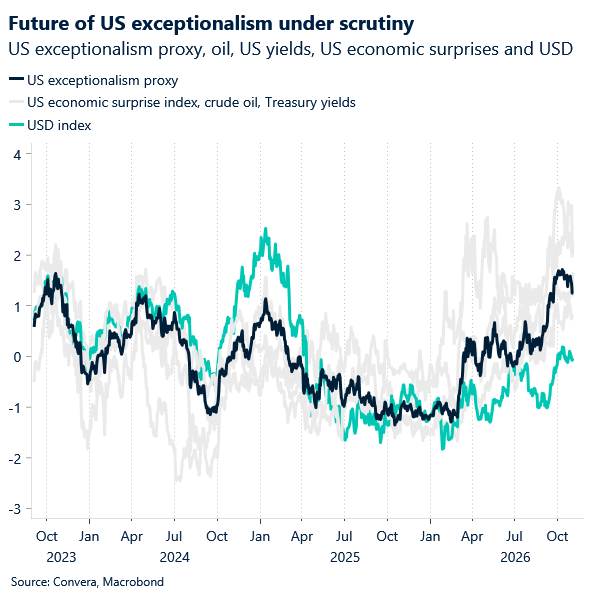
The US dollar touched a fresh five-week low overnight as the Democrats secured control of both the House and Senate, taking command of Congress for the remainder of President Trump’s term. Markets initially reacted decisively, with Treasury yields falling, Nasdaq futures dropping more than 2%, and the US dollar coming under broad pressure as investors reassessed the outlook for fiscal policy, growth and the future of the US exceptionalism trade.
Democrats flipped several traditionally Republican states, including Texas, Ohio, South Carolina and North Carolina, while veteran Republican senator Susan Collins lost her Maine seat after nearly three decades in office. In Texas, James Talarico becomes the state’s first Democratic senator since 1988. While the drivers of the result are multifaceted, the Democratic gains coincide with a period of rising gasoline prices and mounting household cost pressures, highlighting the continued political sensitivity of inflation and the Iran war.
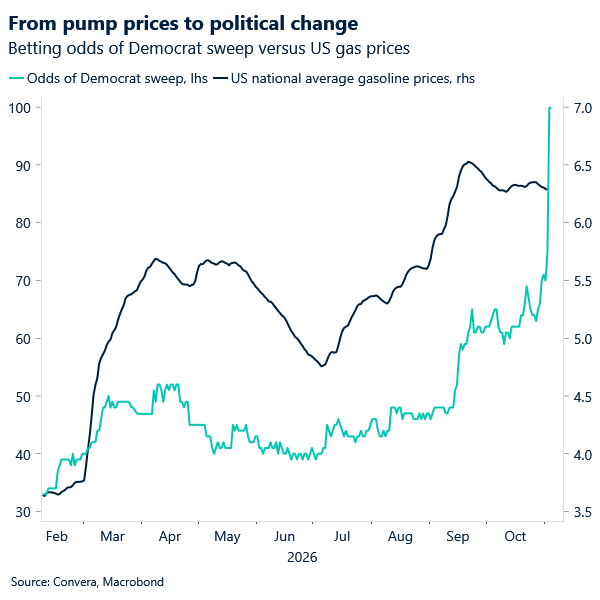
From politics to policy
A Democratic-controlled Congress will place significant constraints on Trump’s domestic agenda over the final two years of his presidency, increasing the likelihood of legislative gridlock, tougher budget negotiations and limits on further fiscal expansion. That helped pull long-end Treasury yields lower and weighed on the dollar, particularly against pro-cyclical and higher-beta currencies.
Beyond the fiscal implications, investors are also reassessing the outlook for the AI investment boom that has underpinned the US exceptionalism narrative. Democratic control of Congress raises the prospect of greater scrutiny over data-centre expansion, power infrastructure and the broader AI ecosystem, helping drive weakness in technology shares overnight. While many approvals remain at the state and local level, any perceived slowdown in AI-related capital expenditure matters for markets. The AI boom has been a key pillar of US growth optimism, supporting equity valuations, capital inflows and the dollar. A moderation in that investment cycle could therefore reinforce the recent decline in Treasury yields and leave the USD more exposed.
That said, some of the initial market reaction has already begun to fade. The dollar remains softer but has recovered from its overnight lows alongside a rebound in Treasury yields, while Trump has signalled a willingness to work with Democratic lawmakers. Investors increasingly appear to be viewing the election outcome as a constraint on future policy rather than a fundamental challenge to the broader US growth story.
For now, the so-called “Blue Wave” has checked the dollar’s advance. Whether the move develops into a more sustained period of dollar weakness will likely depend less on politics and more on whether softer yields, a cooling AI trade and incoming economic data begin to challenge the narrative of continued US exceptionalism.
EUR: Dollar weakness finally gives the euro a lift
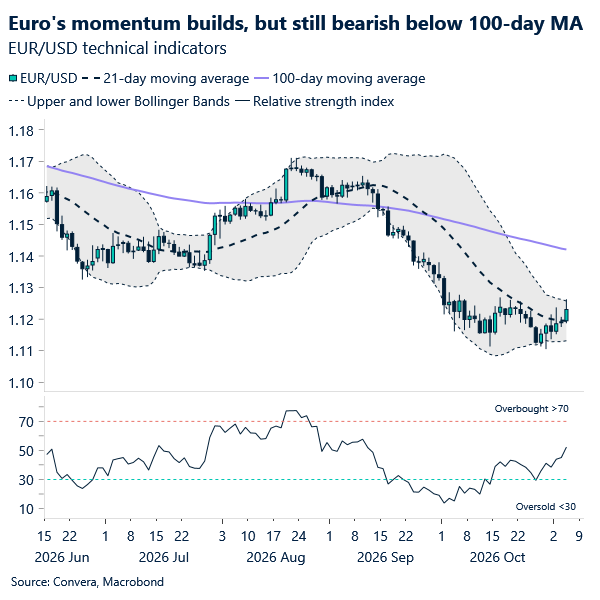
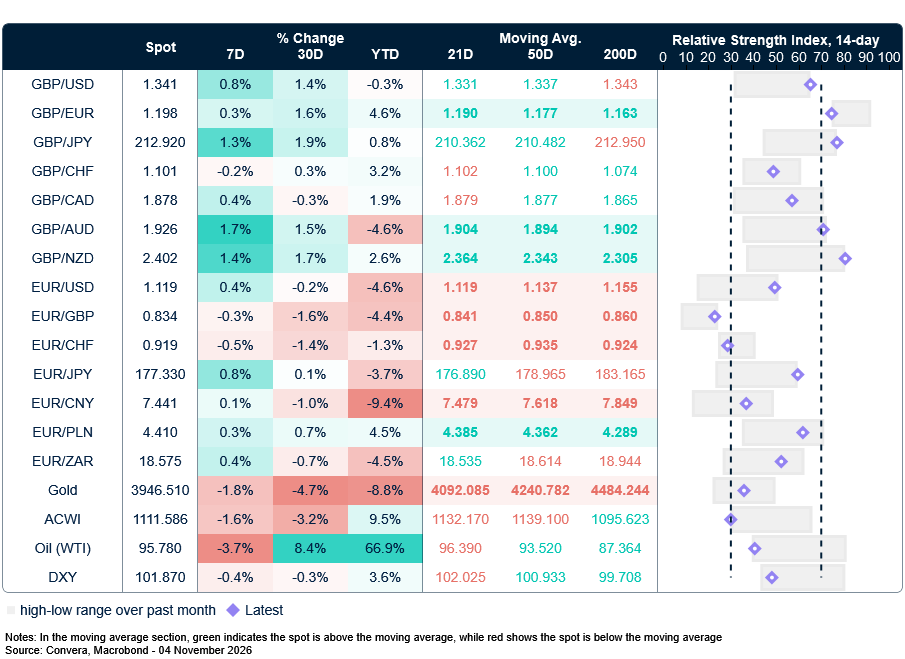
The euro is building some momentum, with EUR/USD pushing towards 1.1250 and trading above its 21-day moving average for the first time since mid-September. The move reflects a softer dollar following the US midterm elections rather than a wholesale reassessment of the euro’s fundamentals, but it is nonetheless an encouraging technical development after weeks of persistent selling pressure.
Under the surface, the picture remains mixed. The pair is still trading below its 100-day moving average, suggesting the broader downtrend has yet to be fully reversed. However, momentum indicators are stabilising, and the recent break above short-term resistance points to growing confidence that a medium-term floor may be forming.
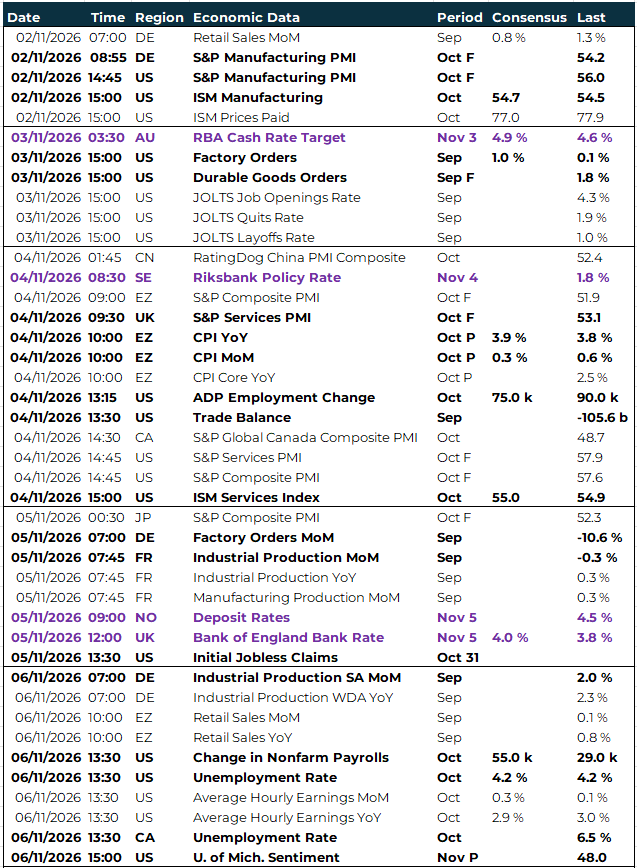
On the domestic side, ECB expectations remain supportive. Comments from Bundesbank President Nagel that a December rate hike is “very likely” reinforced the view that policymakers remain concerned about inflation risks despite slowing growth and ongoing fiscal concerns in France. Today’s flash eurozone inflation data therefore takes on added significance. It is forecast to show consumer prices rose at a 4% clip for the first time in three years. This will boost market conviction the ECB will have to raise interest rates further and could provide the euro with the catalyst needed to challenge the next resistance zone above 1.1250.
That said, the broader narrative remains familiar. While the euro is benefiting from a softer dollar and still-hawkish ECB expectations, concerns around French fiscal stability and the longer-term growth outlook have not disappeared.
For now, the technical picture is improving, but whether EUR/USD can build on the breakout will depend on whether the euro can finally generate its own positive catalyst rather than relying on periods of dollar weakness.
GBP: Sterling buoyant, but upside may be limited
The pound has a few things going in its favour: resilient economic momentum, a relatively stable fiscal backdrop, and a hawkish BoE. With Bank Rate likely to reach 4% on Thursday following another hike, sterling remains one of the more attractive currencies in the G10 space.
GBP/EUR continues to trade near 17-month highs, although it has so far struggled to break decisively above the psychologically important 1.20 level.
Despite the broadly constructive GBP outlook, near-term catalysts appear somewhat lacking. The BoE delivers its rate decision on Thursday, but as argued previously, with four further hikes priced in by July 2027 and an MPC unlikely to provide much forward guidance, we do not see this as a particularly bullish event for sterling. As such, GBP/EUR may struggle to sustain a move above 1.20.
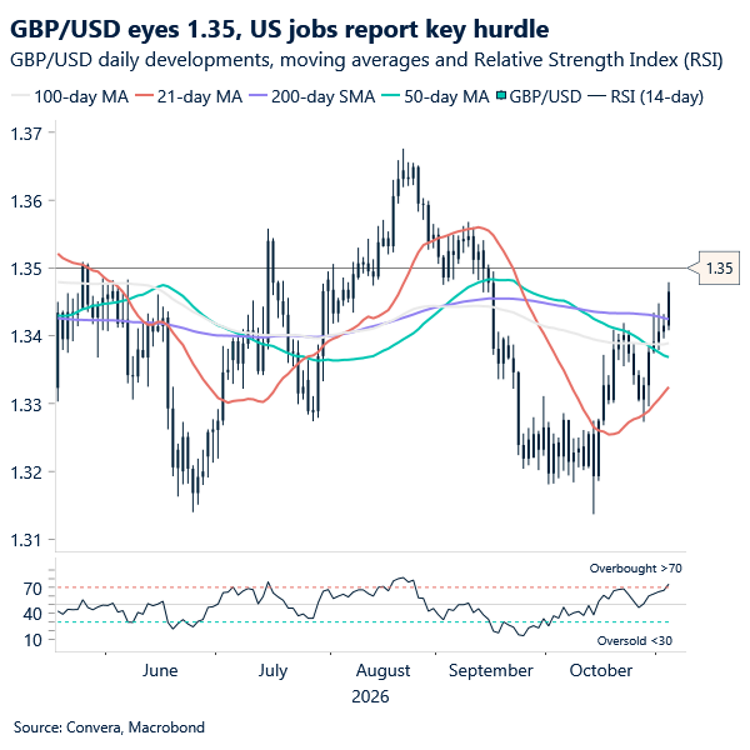
As for GBP/USD, the pair found fresh bullish momentum overnight as the US midterm election results point to a Blue Wave sweeping across the US. GBP/USD has broken above the 200-day moving average near 1.3420, reaching a one-month high.
That said, we would be cautious about calling for more sustained upside from here. Investors are likely to set election event risk aside and shift their attention back to the US macro backdrop and the Fed outlook.
Friday’s jobs report looks set to be the next key catalyst. An upside surprise would likely strengthen expectations for a Fed hike in December, offering fresh support to the US dollar. That could make the 1.35 area a tough hurdle for GBP/USD to clear around Friday’s release.
Market snapshot
Table: Currency trends, trading ranges & technical indicators
Key global risk events
Calendar: November 02-06
All times are in GMT
Have a question? [email protected]
*The FX rates published are provided by Convera’s Market Insights team for research purposes only. The rates have a unique source and may not align to any live exchange rates quoted on other sites. They are not an indication of actual buy/sell rates, or a financial offer.